Answer:
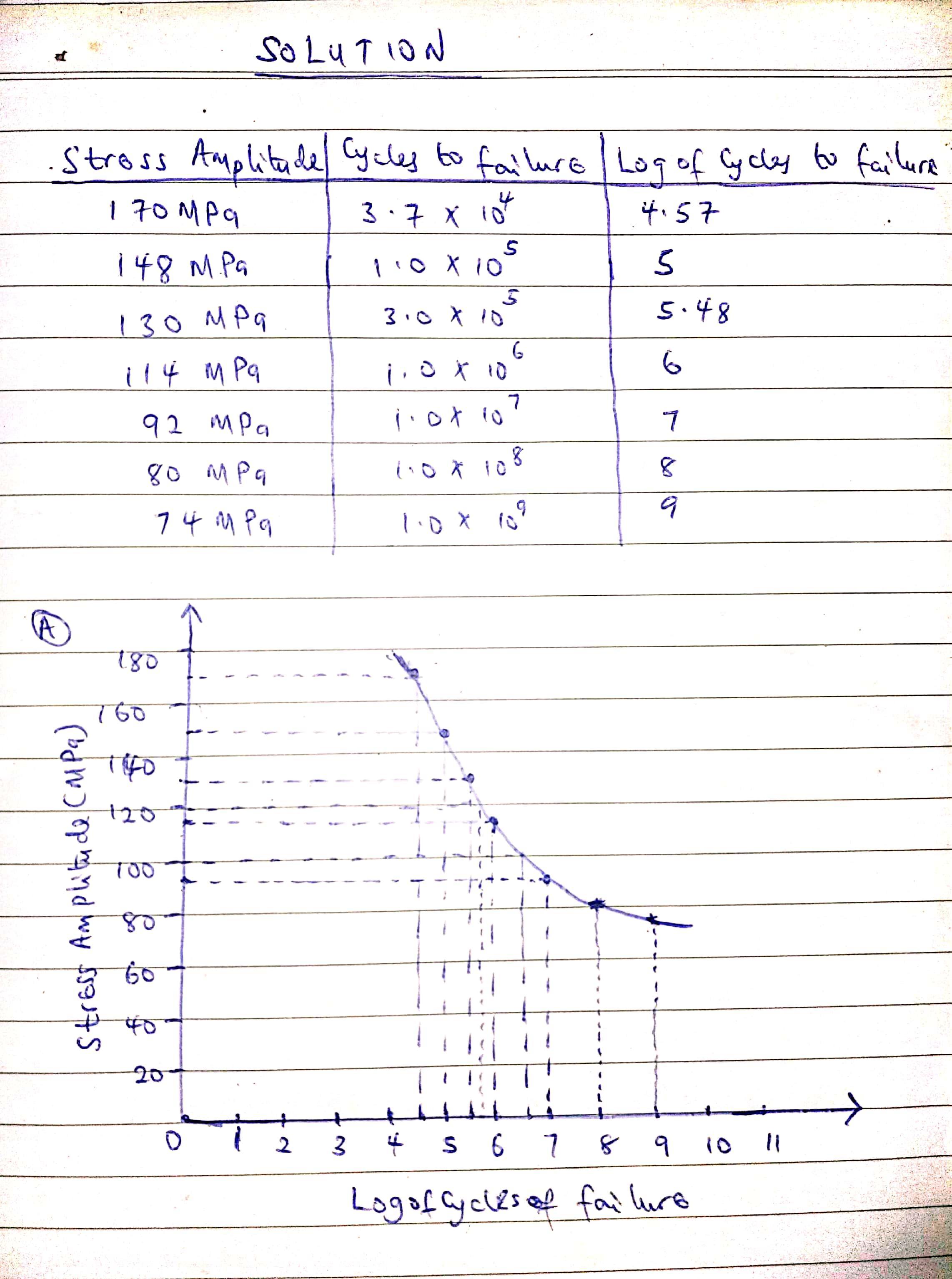
i) S–N plot is attached
ii) fatigue strength = 100 MPa
iii) fatigue life = 5.62 x 10^(5) cycles
Explanation:
i) I have attached the S–N plot (stress amplitude versus logarithm of cycles to failure)
ii) The question says we should find the fatigue strength at 4 × 10^(6) cycles.
So let's find the log of this and trace it on the graph attached.
Log(4 × 10^(6)) = 6.6
From the graph attached, at log of cycle value of 6.6, the fatigue strength is approximately 100 MPa
iii) The question says we should find the fatigue life for 120 MPa.
Thus, from the graph, at stress amplitude of 120 MPa, the log of cycles is approximately 5.75.
Thus,the fatigue life will be the inverse log of 5.75.
Thus, fatigue life = 10^(5.75)
Fatigue life = 5.62 x 10^(5)
Answer:
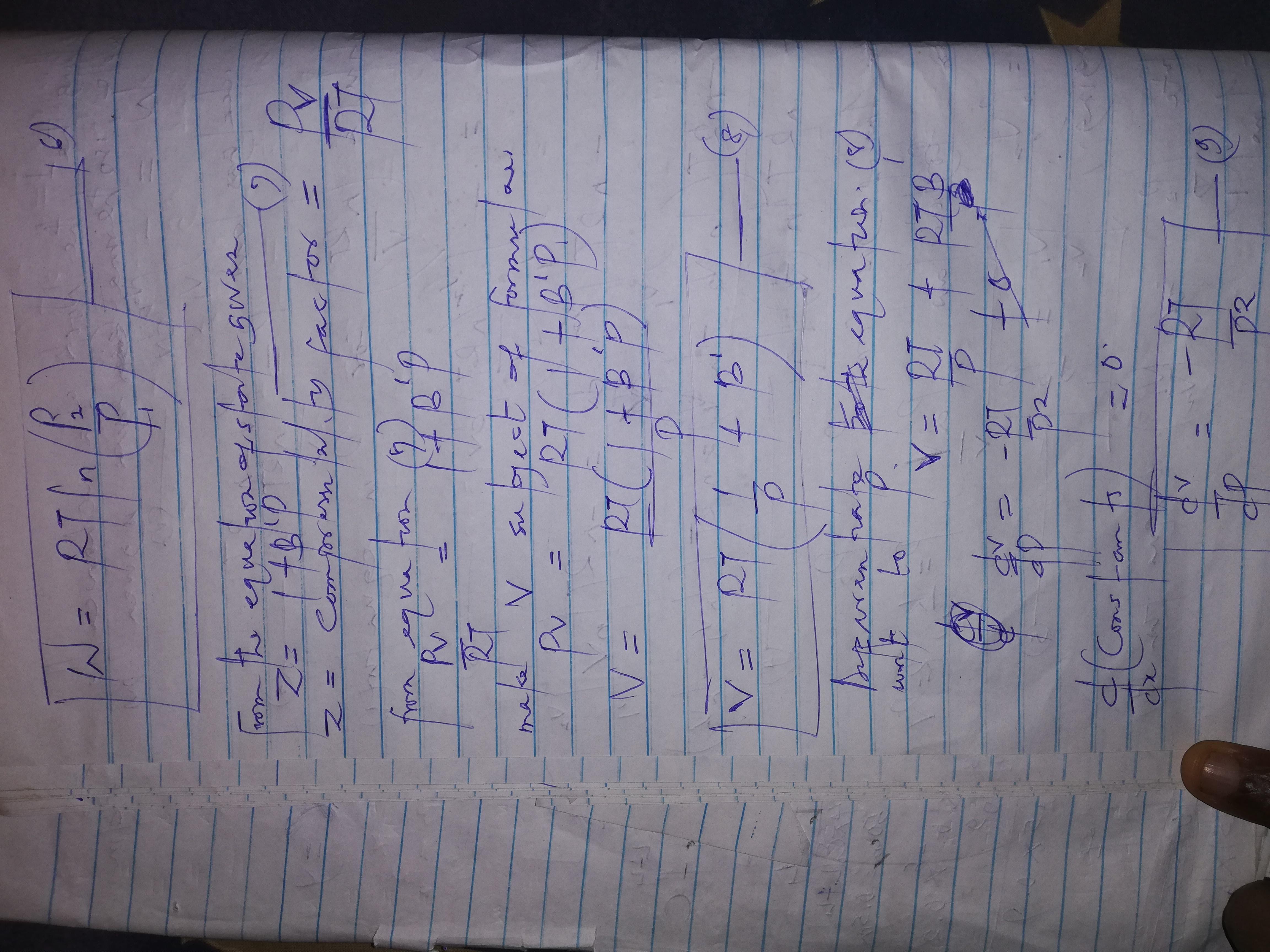
The long derivation for work of a mechanically reversible, isothermal compression was done with detailed steps as shown in the attachment.
Explanation:
what is applied here is a long derivation from Work done in an isobaric process, the expression for the compressibility factor (Z) and the equation of state that was given. The requisite knowledge of Differentiation and Integration was used.
The detailed derivation from firs principle is as shown in the attachment.
Answer:
ALL CAREFULLY ANSWERED CORRECTLY
Explanation:
1) A loaf of Bread PHYSICAL SYSTEM
✓ How can the environment affect the edibility of the bread
✓ What are the constituents that makes up the bread
✓ What process is involved in these constituents mixing to form the loaf.
2) The law of thermodynamics makes us to understand that when heat/energy passes through a system, the systems internal energy changes with respect to the conservation of energy law. That is energy lost = energy gained. Typically, ice would melt in a cup of hot tea because of the thermal energy in the molecules of the hot tea. When you heat a material, you are adding thermal kinetic energy to its molecules and usually raising its temperature. The temperature of the ice raises due to the kinetic energy added to it and it melts to water.
3) The theory of systems view the world as a complex system of interconnected parts. If we consider the society; (financial systems, political systems, etc) we will agree that they individually have their own components and it's the summation of this components that makes the system, this implies that system thinking could be applicable in this kinda of systems as long as they are made up of components.
4) Technology has boosted every sector of our lives and it has the capacity to do more. Restricting it's importance to entertainment alone would be an underusing of its potentials. Engineering students infact should not need any drive to be encouraged about maximizing all it can do in shaping our world.
5) ~ Nature shows its splendid soul
~Never ceases to leave us in amazement
~And we are in love
Answer:
For aluminum 110.53 C
For copper 110.32 C
Explanation:
Heat transmission through a plate (considering it as an infinite plate, as in omitting the effects at the borders) follows this equation:

Where
q: heat transferred
k: conduction coeficient
A: surface area
th: hot temperature
tc: cold temperature
d: thickness of the plate
Rearranging the terms:
d * q = k * A * (th - tc)


The surface area is:


If the pan is aluminum:

If the pan is copper: