answer.
Ask question
Login Signup
Ask question
All categories
  • English
  • Mathematics
  • Social Studies
  • Business
  • History
  • Health
  • Geography
  • Biology
  • Physics
  • Chemistry
  • Computers and Technology
  • Arts
  • World Languages
  • Spanish
  • French
  • German
  • Advanced Placement (AP)
  • SAT
  • Medicine
  • Law
  • Engineering
dexar [7]
2 years ago
13

t-Butyl alcohol (TBA) is an important octane enhancer that is used to replace lead additives in gasoline [Ind. Eng. Chem. Res.,

27, 2224 (1988)]. TBA was produced by the liquid-phase hydration (W) of isobutene (I) over an Amberlyst-15 catalyst. The system is normally a multiphase mixture of hydrocarbon, water, and solid catalysts. However, the use of cosolvents or excess TBA can achieve reasonable miscibility. The reaction mechanism is believed to be

Chemistry
1 answer:
Andrew [12]2 years ago
5 0

Complete Question:

t-Butyl alcohol (TBA) is an important octane enhancer that is used to replace lead additives in gasoline [Ind. Eng. Chem. Res., 27, 2224 (1988)]. TBA was produced by the liquid-phase hydration (W) of isobutene (I) over an Amberlyst-15 catalyst. The system is normally a multiphase mixture of hydrocarbon, water, and solid catalysts. However, the use of cosolvents or excess TBA can achieve reasonable miscibility. The reaction mechanism is believed to be

I + S ⇄ I*S

W + S ⇄ W*S

W*S + I*S ⇄ TBA * S * S

TBA * S ⇄ TBA + S

Derive a rate law assuming:

(a) The surface reaction is rate limiting

(b) The adsorption of isobutene is limiting

(c) The reaction follows Eley-rideal Kinetics

I*S+W ⇄ TBA * S

and surface reaction is limiting

(d) Isobutene (I) and water (W) are adsorbed on different sites

I + S₁ ⇄ I*S₁

W + S₂ ⇄ W*S₂

TBA is not on the surface, and the surface reaction is rate-limiting

[Ans: r'_{TBA}=-r'_1=\frac{k[C_1C_w-C_{TBA/K_C}]}{(1+K_WC_W)(1+K_1C_1)} ]

(e) What generalizations can you make by comparing rate laws derived from part (a) through (d)?

Answer and explanation:

The mechanism for the production of t-butyl alcohol is as follows:

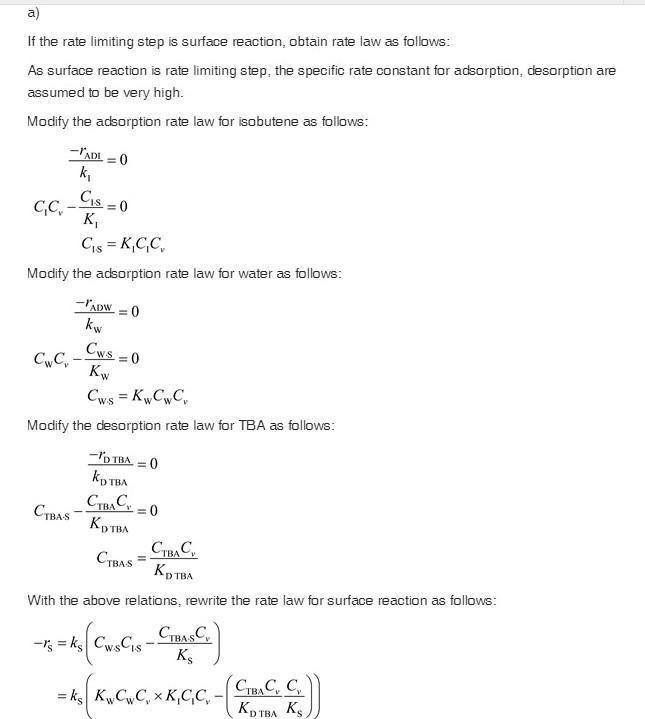
the reaction and rate law for the adsorption of isobutene over the amberlyst-15 is as follows:

I + S ⇄ I * S                                        -r_{ADI} = k_I(C_1C_v-\frac{C_{I.S}}{K_I} )

where C_V is the concentration of vacant site

K_I is the equilibrium constant of the adsorption

k_I is the rate constant for forward

C_I,C_{I.S} are concentration of isobutene and site filled with isobutene

The reaction and rate law for the adsorption of water (W) over the amberlyst-15 catalyst catalyst is as follows

W + S ⇄ W.S                                      -r_{ADW} = k_W(C_WC_V-\frac{C_{W.S}}{K_W} )

The reaction and rate law for the surface reaction on the catalyst is as follows

W.S + I.S ⇄ TBA . S + Sn                         -r_s = k_s(C_{W.S}C_{I.S}-\frac{C_{TBA.S}C_V}{K_s} )

The reaction and rate law for the desorption of TBA from catalyst is as follows

TBA . S ⇄ TBA + S                             -r_{D TBA} = k_{DTBA}(C_{TBA.S}-\frac{C_{TBA}C_V}{K_{DTBA}} )

the attached image below gives the remaining steps    
You might be interested in
Imagine that a new polyatomic anion called "platoate" is invented. What would an acid of "platoate" be named?
o-na [289]
<h3>Answer:</h3>

                   Platoic Acid

<h3>Explanation:</h3>

                        While naming Carboxylic Acids we know that when the Carboxylic Acid looses proton it is converted into corresponding conjugate base called as Carboxylate.

Examples:

                        HCOOH           →           HCOO⁻  +  H⁺

                     Formic acid                     Formate Ion

                    H₃CCOOH           →           H₃CCOO⁻  +  H⁺

                     Acetic acid                       Acetate Ion

                    H₅C₂COOH           →           H₅C₂COO⁻  +  H⁺

                 Propanoic acid                       Propanoate Ion

Therefore, if the conjugate base is Platoate then the corresponding acid will be Platoic Acid means we will replace the -ate by -ic acid <em>i.e.</em>

                   RCOO⁻  +  H⁺        →            RCOOH

                   Platoate Ion                         Platoic Acid

8 0
2 years ago
Read 2 more answers
Quiz 1: Asian Music
marishachu [46]
Question 1 the answer is sheng
Question 2 is Zheng
Question 3 is B
8 0
2 years ago
When a pH probe is inserted into a solution containing the chloride ion it is neutral. What is the pH of a solution containing t
vivado [14]

Answer:

a. the solution will be weakly basic.

b. Greater than 7 because CN⁻ is a stronger base than NH₄⁺ is an acid.

Explanation:

a. The fluoride ion (F⁻) reacts with water thus:

F⁻ + H₂O → HF + OH⁻

That means that fluoride ions produce OH⁻ ions in solution doing <em>the solution will be weakly basic.</em>

b. The acidic equilibrium of NH₄⁺ is:

NH₄⁺ ⇄ NH₃ + H⁺ with a ka of 5,6x10⁻¹⁰.

The basic equilibrium of CN⁻ is:

CN⁻ + H₂O → HCN + OH⁻ with a kb of 2x10⁻⁵

That means that the production of OH⁻ from CN⁻ is higher than production of H⁺ from NH₄⁺. The CN⁻ is a stronger base than NH₄⁺ is an acid.

Thus, the pH of a salt solution of NH₄CN would be <em>Greater than 7 because CN⁻ is a stronger base than NH₄⁺ is an acid.</em>

<em></em>

I hope ot helps!

3 0
2 years ago
Water flowing at the rate of 13.85 kg/s is to be heated from 54.5 to 87.8°C in a heat exchanger by 54 to 430 kg/h of hot gas flo
weeeeeb [17]

Answer:

=> 572.83 K (299.83°C).

=> 95.86 m^2.

Explanation:

Parameters given are; Water flowing= 13.85 kg/s, temperature of water entering = 54.5°C and the temperature of water going out = 87.8°C, gas flow rate 54,430 kg/h(15.11 kg/s). Temperature of gas coming in = 427°C = 700K, specific heat capacity of hot gas and water = 1.005 kJ/ kg.K and 4.187 KJ/kg. K, overall heat transfer coefficient = Uo = 69.1 W/m^2.K.

Hence;

Mass of hot gas × specific heat capacity of hot gas × change in temperature = mass of water × specific heat capacity of water × change in temperature.

15.11 × 1.005(700K - x ) = 13.85 × 4.187(33.3).

If we solve for x, we will get the value of x to be;

x = 572.83 K (2.99.83°C).

x is the temperature of the exit gas that is 572.83 K(299.83°C).

(b). ∆T = 339.2 - 245.33/ln (339.2/245.33).

∆T = 93.87/ln 1.38.

∆T = 291.521K.

Heat transfer rate= 15.11 × 1.005 × 10^3 (700 - 572.83) = 1931146.394.

heat-transfer area = 1931146.394/69.1 × 291.521.

heat-transfer area= 95.86 m^2.

7 0
2 years ago
Which of the following statements concerning hydrocarbons is/are correct?
Alona [7]

Answer:

1.  Saturated hydrocarbons may be cyclic or acyclic molecules.

2.  An unsaturated hydrocarbon molecule contains at least one double bond.

Explanation:

Hello,

In this case, hydrocarbons are defined as the simplest organic compounds containing both carbon and hydrogen only, for that reason we can immediately discard the third statement as ethylenediamine is classified as an amine (organic chain containing NH groups).

Next, as saturated hydrocarbons only show single carbon-to-carbon bonds and carbon-to-hydrogen bonds, they may be cyclic (ring-like-shaped) or acyclic (not forming rings), so first statement is true

Finally, since we can find saturated hydrocarbons which have single carbon-to-carbon and carbon-to-hydrogen bonds only and unsaturated hydrocarbons which could have double or triple bonds between carbons and carbon-to-hydrogen bonds, the presence of at least one double bond makes the hydrocarbon unsaturated.

Therefore, first and second statements are correct.

Best regards.

6 0
2 years ago
Other questions:
  • In the chemical reaction NaHCO3 + CH3COOH → CH3COONa + H2O +CO2, 83 g of sodium bicarbonate reacts with 70 g of acetic acid. Whi
    5·1 answer
  • Problem page a virus has a mass of ×9.010−12mg and an oil tanker has a mass of ×3.0107kg . use this information to answer the qu
    5·2 answers
  • A 75.00 g sample of a substance is analyzed and found to consist of 32.73 g phosphorus and 42.27 g oxygen. calculate the percent
    5·1 answer
  • Identify the type of solid from the description. Select from the following choices: metallic solid, network solid, molecular sol
    5·1 answer
  • What is the pH of a solution prepared by mixing 50.00 mL of 0.10 M methylamine, CH3NH2, with 20.00 mL of 0.10 M methylammonium c
    6·1 answer
  • Suppose that 0.323 g of an unknown sulfate salt is dissolved in 50 mL of water. The solution is acidified with 6M HCl, heated, a
    6·1 answer
  • An object accelerates 3.0 m/s2 when a force of 6.0 Newton’s is applied to it. What is the mass of the object?
    13·1 answer
  • Lastly, Snape thinks we should try one more calculation. What is the retention factor if the distance traveled by the solvent fr
    8·1 answer
  • How many grams of lithium nitrate, LiNO3 (68.9 g/mol), are required to prepare 342.6 mL of a 0.783 M LiNO3 solution ? A) 0.00389
    11·1 answer
  • 2. If 2.50g of sodium hydroxide is being reacted with 4.30g of magnesium chloride, how many grams of magnesium hydroxide would b
    6·1 answer
Add answer
Login
Not registered? Fast signup
Signup
Login Signup
Ask question!