answer.
Ask question
Login Signup
Ask question
All categories
  • English
  • Mathematics
  • Social Studies
  • Business
  • History
  • Health
  • Geography
  • Biology
  • Physics
  • Chemistry
  • Computers and Technology
  • Arts
  • World Languages
  • Spanish
  • French
  • German
  • Advanced Placement (AP)
  • SAT
  • Medicine
  • Law
  • Engineering
Xelga [282]
2 years ago
11

A relatively nonvolatile hydrocarbon oil contains 4.0 mol % propane and is being stripped by direct superheated steam in a strip

ping tray tower to reduce the propane content to 0.2%. The temperature is held constant at 422 K by internal heating in the tower at 2.026 × 10⁵ Pa pressure. A total of 11.42 kg mol of direct steam is used for 300 kg mol of total entering liquid. The vapor–liquid equilibria can be represented by y = 25x, where y is mole fraction propane in the steam and x is mole fraction propane in the oil. Steam can be considered as an inert gas and will not condense. Plot the operating and equilibrium lines and determine the number of theoretical trays needed.

Engineering
1 answer:
hram777 [196]2 years ago
5 0

Answer:

Number of Trays = Six (6)

Explanation:

Given that: y' = 25x' , in terms of molecular ratio, we can write it as

\frac{Y'}{1 + Y'} =25 \frac{X'}{1 + X'}  ......... 1

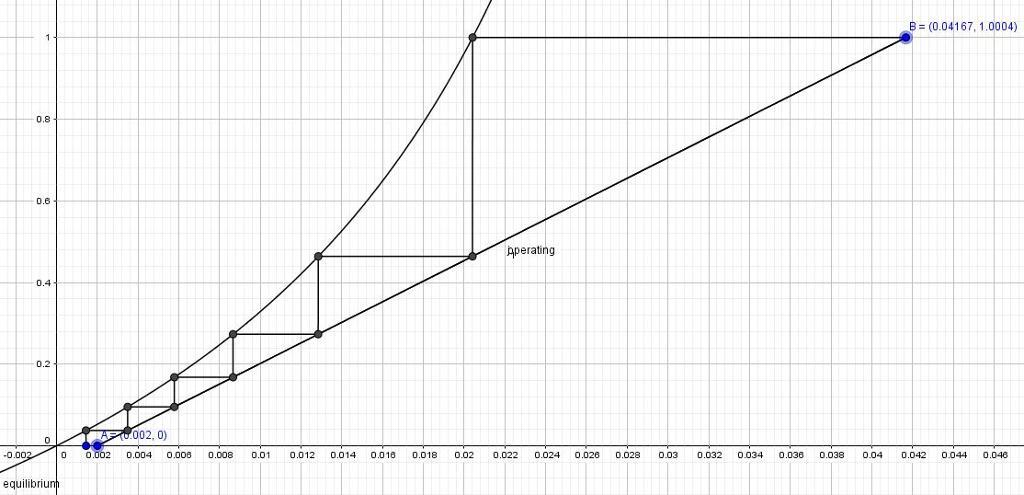
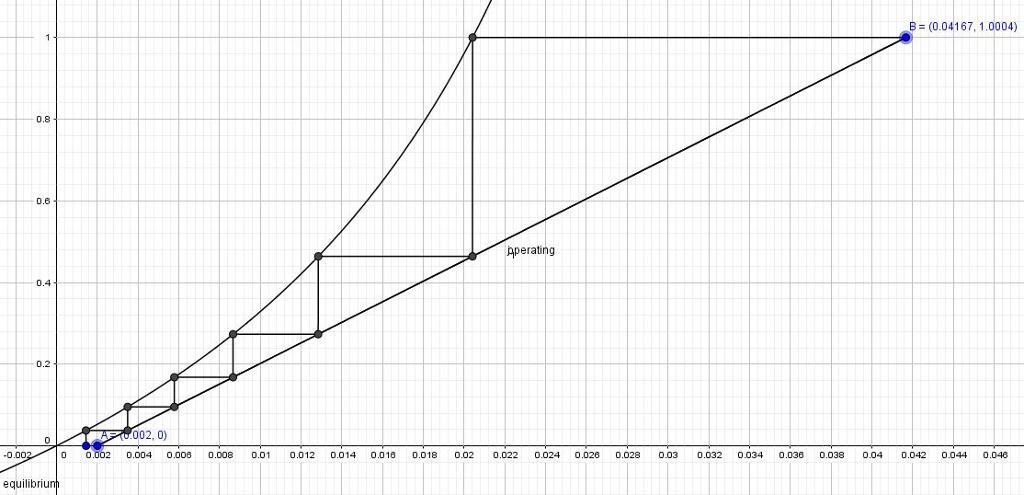
after plotting this we get equilibrium curve as shown in the attached picture.

inlet concentration and outlet concentration of liquid phase is

x₂ = 4% = 0.04 (inlet)

so that can be converted into molar

X_2 = \frac{x_2}{1-x_2} = \frac{0.04}{1-0.04} = 0.04167

and

x₁ = 0.2% = 0.002

X_1 = \frac{x_1}{1-x_1} = \frac{0.002}{1-0.002} = 2.004*10^{-3}

Now we have to use the balance equation a

\frac{G_s}{L_s} = \frac{X_2-X_1}{Y_2-Y_1} .............. a

here amount of solute is comparably lower than

Here we have

L = 300 kmol (total)

L_s = 300(1 - 0.04) = 288 kmol pure oil

G = G_s = 11.42 kmol

Y_1 = 0 , solvent free steam

substitute into the equation a

\frac{11.42}{288} = \frac{0.04167 - 2*10^{-3}}{Y_2 - 0}

Y₂ = 1.0003

Now plot the point A(X₁ , Y₁) and B(X₂ , Y₂) and join them to construct operating line AB.

Starting from point B, stretch horizontal line up to equilibrium curve and from there again go down to operating line as shown in the picture attached. This procedure give one count of tray and continue the same procedure up to end of operating.

at last count, the number of stage, gives 6.

∴ <em>Number of trays = 6</em>

You might be interested in
We are undergoing a period of rapid technology change with cloud computing, artificial intelligence, robotics, mobile devices, w
Law Incorporation [45]
2 cause this shot gas
3 0
2 years ago
When leveraging Artificial Intelligence (AI) in today's business landscape, which statement represents the data leveraged for so
adoni [48]

Answer:

Some AI could end up taking the jobs of many humans.

Explanation:

Their intelligence exponentially grows and human intelligence grows gradually, causing more ideas and better work efficiency from AI.

8 0
2 years ago
The ingredient weights for making 1 yd (cyd) of concrete by assuming aggregates in SSD state are given below. The volume of air
Pachacha [2.7K]

Answer:

Explanation:

Ans) Given batch weight of each component :

Cement = 700 lb

Water = 315 lb

Coarse aggregate = 1575 lb

Fine aggregate = 1100 lb

Part 1) Amount of water = 328.5 lb

Amount of water is needed to be increased if the aggregates has absorption capacity, To maintain constant water cement ratio, the mixing water is increased because some of the water is absorbed by aggregates.

Amount of water absorbed = 328.5 lb - 315 lb = 13.5 lb

Total amount of aggregates = 1575 + 1100 = 2675 lb

=> % Absorption capacity = 13.5 x 100 / 2675 = 0.5 %

Hence, new amount of Coarse aggregate = (1 - 0.005) x 1575 lb = 1567.125 lb

New amount of fine aggregate = (1 - 0.005) x 1100 = 1094.5 lb

Since, water cement ratio is maintained constant , amount of cement remains unchanged

=> Volume of water = 328.5 / 62.4 = 5.26 ft3

=> Volume of cement = 700 / (3.15 x 62.4) = 3.56 ft3

=> Volume of coarse aggregate = 1567.125 / (2.4 x 62.4) = 10.46 ft3

=> Volume of fine aggregate = 1100 / (2.4 x 62.4) = 7.34 ft3

Volume of air = 2% = 0.02 x 27 = 0.54 ft3

Total concrete volume = 5.26 + 3.56 + 10.46 + 7.34 + 0.54 \approx 27 ft3 = 1 yd3

Hence, calculated amount of each component is correct

Part 2) We know, minus sign indicated that the aggregate will absorb some moisture from concrete, hence mixing water amount needed to be corrected .

=> Amount of water absorbed by coarse aggregate = 0.01 x 1567.125 lb = 15.67 lb

=> Amount of water absorbed by fine aggregate = 0.02 x 1094.50 lb = 21.89 lb

Total amount of water absorbed = 15.67 + 21.89 = 37.56 lb

To maintain same water cement ratio, amount of mixing water is needed to be increased

=> Corrected amount of mixing water = 328.5 lb + 37.56 lb = 366 lb

=> Corrected amount of coarse aggregate = (1 - 0.01) x 1567.125 = 1551.45 lb

=> Corrected amount of fine aggregate = (1 - 0.02) x 1094.5 = 1072.6 lb

Part 3) We know,

Unit weight = Sum of weight of each material / Total volume

=> Sum of weight = 366 + 700 + 1551.45 + 1072.6 = 3690.05 lb

Total volume = 1 yd3 or 27 ft3

=> Expected Unit Weight = 3690.05 lb / 27 ft3 = 136.67 lb/ft3

Also, Concrete Yield = Weight of all components / Unit weight of concrete

=> Yield = 3690.05 / 136.67 = 27 ft3 or 1 yd3
4 0
2 years ago
The closed tank of a fire engine is partly filled with water, the air space above being under pressure. A 6 cm bore connected to
skelet666 [1.2K]

Answer:

The air pressure in the tank is 53.9 kN/m^{2}

Solution:

As per the question:

Discharge rate, Q = 20 litres/ sec = 0.02\ m^{3}/s

(Since, 1 litre = 10^{-3} m^{3})

Diameter of the bore, d = 6 cm = 0.06 m

Head loss due to friction, H_{loss} = 45 cm = 0.45\ m

Height, h_{roof} = 2.5\ m

Now,

The velocity in the bore is given by:

v = \frac{Q}{\pi (\frac{d}{2})^{2}}

v = \frac{0.02}{\pi (\frac{0.06}{2})^{2}} = 7.07\ m/s

Now, using Bernoulli's eqn:

\frac{P}{\rho g} + \frac{v^{2}}{2g} + h = k                  (1)

The velocity head is given by:

\frac{v_{roof}^{2}}{2g} = \frac{7.07^{2}}{2\times 9.8} = 2.553

Now, by using energy conservation on the surface of water on the roof and that in the tank :

\frac{P_{tank}}{\rho g} + \frac{v_{tank}^{2}}{2g} + h_{tank} = \frac{P_{roof}}{\rho g} + \frac{v_{tank}^{2}}{2g} + h_{roof} + H_{loss}

\frac{P_{tank}}{\rho g} + 0 + 0 = \0 + 2.553 + 2.5 + 0.45

P_{tank} = 5.5\times \rho \times g

P_{tank} = 5.5\times 1\times 9.8 = 53.9\ kN/m^{2}

4 0
2 years ago
A thermal energy storage unit consists of a large rectangular channel, which is well insulated on its outer surface and encloses
yaroslaw [1]

Answer:

the temperature of the aluminum at this time is 456.25° C

Explanation:

Given that:

width w of the aluminium slab = 0.05 m

the initial temperature T_1 = 25° C

T{\infty} =600^0C

h = 100 W/m²

The properties of Aluminium at temperature of 600° C by considering the conditions for which the storage unit is charged; we have ;

density ρ = 2702 kg/m³

thermal conductivity k = 231 W/m.K

Specific heat c = 1033 J/Kg.K

Let's first find the Biot Number Bi which can be expressed by the equation:

Bi = \dfrac{hL_c}{k} \\ \\ Bi = \dfrac{h \dfrac{w}{2}}{k}

Bi = \dfrac{hL_c}{k} \\ \\ Bi = \dfrac{100 \times \dfrac{0.05}{2}}{231}

Bi = \dfrac{2.5}{231}

Bi = 0.0108

The time constant value \tau_t is :

\tau_t = \dfrac{pL_cc}{h} \\ \\ \tau_t = \dfrac{p \dfrac{w}{2}c}{h}

\tau_t = \dfrac{2702* \dfrac{0.05}{2}*1033}{100}

\tau_t = \dfrac{2702* 0.025*1033}{100}

\tau_t = 697.79

Considering Lumped capacitance analysis since value for Bi is less than 1

Then;

Q= (pVc)\theta_1 [1-e^{\dfrac {-t}{ \tau_1}}]

where;

Q = -\Delta E _{st} which correlates with the change in the internal energy of the solid.

So;

Q= (pVc)\theta_1 [1-e^{\dfrac {-t}{ \tau_1}}]= -\Delta E _{st}

The maximum value for the change in the internal energy of the solid  is :

(pVc)\theta_1 = -\Delta E _{st}max

By equating the two previous equation together ; we have:

\dfrac{-\Delta E _{st}}{\Delta E _{st}{max}}= \dfrac{  (pVc)\theta_1 [1-e^{\dfrac {-t}{ \tau_1}}]} { (pVc)\theta_1}

Similarly; we need to understand that the ratio of the energy storage to the maximum possible energy storage = 0.75

Thus;

0.75=  [1-e^{\dfrac {-t}{ \tau_1}}]}

So;

0.75=  [1-e^{\dfrac {-t}{ 697.79}}]}

1-0.75=  [e^{\dfrac {-t}{ 697.79}}]}

0.25 =  e^{\dfrac {-t}{ 697.79}}

In(0.25) =  {\dfrac {-t}{ 697.79}}

-1.386294361= \dfrac{-t}{697.79}

t = 1.386294361 × 697.79

t = 967.34 s

Finally; the temperature of Aluminium is determined as follows;

\dfrac{T - T _{\infty}}{T_1-T_{\infty}}= e ^ {\dfrac{-t}{\tau_t}}

\dfrac{T - 600}{25-600}= e ^ {\dfrac{-967.34}{697.79}

\dfrac{T - 600}{25-600}= 0.25

\dfrac{T - 600}{-575}= 0.25

T - 600 = -575 × 0.25

T - 600 = -143.75

T = -143.75 + 600

T = 456.25° C

Hence; the temperature of the aluminum at this time is 456.25° C

3 0
2 years ago
Other questions:
  • Water is the working fluid in an ideal Rankine cycle. The condenser pressure is 8 kPa, and saturated vapor enters the turbine at
    10·1 answer
  • A meter stick can be read to the nearest millimeter and a travelling microscope can be read to the nearest 0.1 mm. Suppose you w
    11·1 answer
  • Add a calculated field named AccountTime that calculates the number of days each client's accounts have been open. Assume today'
    6·1 answer
  • Why is it that dislocations play an important role in controlling the mechanical properties of metallic materials, however, they
    10·1 answer
  • The in situ moist unit weight of a soil is 17.3 kN/m3 and the moisture content is 16%. The specific gravity of soil solids is 2.
    12·1 answer
  • A thin-walled tube with a diameter of 12 mm and length of 25 m is used to carry exhaust gas from a smoke stack to the laboratory
    7·1 answer
  • 1. A spur gear made of bronze drives a mid steel pinion with angular velocity ratio of 13 /2 : 1. Thepressure angle is 14 1/2° .
    12·1 answer
  • An air standard cycle with constant specific heats is executed in a closed pistoncylinder system and is composed of the followin
    10·1 answer
  • What are some goals of NYFEA? Select three options.
    9·2 answers
  • Dalton needs to prepare a close-out report for his project. Which part of the close-out report would describe
    6·1 answer
Add answer
Login
Not registered? Fast signup
Signup
Login Signup
Ask question!