answer.
Ask question
Login Signup
Ask question
All categories
  • English
  • Mathematics
  • Social Studies
  • Business
  • History
  • Health
  • Geography
  • Biology
  • Physics
  • Chemistry
  • Computers and Technology
  • Arts
  • World Languages
  • Spanish
  • French
  • German
  • Advanced Placement (AP)
  • SAT
  • Medicine
  • Law
  • Engineering
vodomira [7]
2 years ago
4

A metal bromide, MBr_2, is converted to a molten form at high temperature. Electrolysis of this sample with a current of 6.13A f

or 73.1 seconds results in deposition of 0.148 g of metal M at the cathode. The other product is bromine gas, Br_2(g), which is released at the anode. Determine the identity of metal M. Enter symbol of the element into clicker.
Chemistry
1 answer:
iren2701 [21]2 years ago
8 0

Answer:

M is copper (Cu)

Explanation:

Step 1:

Data obtained from the question. This includes:

Compound => MBr2

Current (I) = 6.13A

Time (t) = 73.1 secs

Mass of M = 0.148 g

Identity of M =?

Step 2:

Determination of the quantity of electricity that deposit 0.148 g of the metal M. This is illustrated below:

Current (I) = 6.13A

Time (t) = 73.1 secs

Quantity of electricity (Q) =?

Q= it

Q = 6.13 x 73.1

Q = 448.103C

Step 3:

Determination of the number of faraday and the quantity of electricity required to deposit the metal M. This is illustrated below:

In solution, the compound MBr2 will dissociate as follows

MBr2 —> M^2+ + 2Br^-

The metal M, will be deposited in the cathode according to the equation:

M^2+ + 2e- —> M

From the above, we can see clearly that 2 faraday is needed to deposit the metal M. Converting the number of faraday to electricity, we have:

1 faraday = 96500C

Therefore, 2 faraday = 2 x 96500C = 193000C

From the calculations made above, 193000C of electricity is needed to deposit the metal M.

Step 4:

Determination of the identity of the metal M. This is illustrated below:

From the calculations made above,

448.103C deposit 0.148 g of the metal M.

Therefore 193000C will deposit = (193000x0.148)/448.103 = 63.74g of the metal M.

Comparing the molar mass of M with the molar masses in the periodic table, M is copper (Cu).

You might be interested in
3. The following data of decomposition reaction of thionyl chloride (SO2Cl2) were collected at a certain temperature and the con
KonstantinChe [14]

Answer:

a) First-order.

b) 0.013 min⁻¹

c) 53.3 min.

d) 0.0142M

Explanation:

Hello,

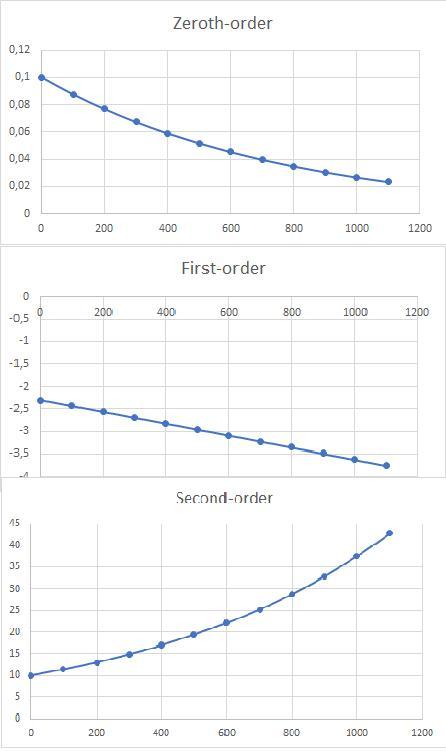
In this case, on the attached document, we can notice the corresponding plot for each possible order of reaction. Thus, we should remember that in zeroth-order we plot the concentration of the reactant (SO2Cl2 ) versus the time, in first-order the natural logarithm of the concentration of the reactant (SO2Cl2 ) versus the time and in second-order reactions the inverse of the concentration of the reactant (SO2Cl2 ) versus the time.

a) In such a way, we realize the best fit is exhibited by the first-order model which shows a straight line (R=1) which has a slope of -0.0013 and an intercept of -2.3025 (natural logarithm of 0.1 which corresponds to the initial concentration). Therefore, the reaction has a first-order kinetics.

b) Since the slope is -0.0013 (take two random values), the rate constant is 0.013 min⁻¹:

m=\frac{ln(0.0768)-ln(0.0876)}{200min-100min} =-0.0013min^{-1}

c) Half life for first-order kinetics is computed by:

t_{1/2}=\frac{ln(2)}{k}=\frac{ln(2)}{0.013min^{-1}}  =53.3min

d) Here, we compute the concentration via the integrated rate law once 1500 minutes have passed:

C=C_0exp(-kt)=0.1Mexp(-0.013min^{-1}*1500min)\\\\C=0.0142M

Best regards.

6 0
2 years ago
Compare and contrast the functions of each of the following types of flasks: filter, Erlenmeyer, volumetric.
harkovskaia [24]
The Erlenmeyer Flask was <span>introduced in 1861 by German chemist </span>Emil Erlenmeyer and is shaped like a cone. This has a triangular shape and mouth wide for it to be easier to pour and store liquids. The Volumetric flask<span> is used for preparing liquids with volumes of high precision. It has a </span>pear-shaped body and a long neck with a circumferential fill line. The Filter Flask is also known as the <span>A Büchner </span><span>flask. It is like the Erlenmeyer but this one is thick-walled and has a special arm in the side. It is used for filtering liquid. </span>
4 0
2 years ago
Suppose a species of snake is living in a certain area. Some of the snakes in the population are black and some are orange. Over
nikdorinn [45]

The theory of biological evolution known as Darwin's theory of evolution or Darwinism given by Charles Darwin an English naturalist. According to the theory, all the species of organisms develop and originate via the natural selection of minor, inherited changes, which enhances the tendency of an individual to survive, compete, and develop the tendency to give rise to new ones.  

Thus, according to Darwin's theory of evolution in the given case of black and orange snakes, the black snakes will survive and reproduce, therefore, passing their traits to their offspring, while few orange snakes will remain in the population.  

6 0
2 years ago
Read 2 more answers
SO3 has how many regions of high electron density and how many bonded electrons when the octet rule is strictly obeyed?1.5; 142.
motikmotik

Answer:

3 regions of high electronic density

2 simple links

1 double bond

Explanation:

Hello!

First we calculate the total valence electrons that make up the molecule (6 + 6 * 3 = 24)

We locate six electrons forming the bonds and complete the octecs with the remaining 18 electrons.

We move 2 electrons of an oxygen to complete the sulfur octet.

Successes with your homework!

3 0
2 years ago
Calculate how many grams of the product form when 16.7 g of liquid bromine reacts with solid potassium. Assume that there is mor
salantis [7]

Answer: 49.7 grams of the product will be formed.

Explanation:

According to avogadro's law, 1 mole of every substance occupies 22.4 Liters at STP and contains avogadro's number 6.023\times 10^{23} of particles.

To calculate the moles, we use the equation:

\text{Number of moles}=\frac{\text{Given mass}}{\text {Molar mass}}

{\text {Number of moles of bromine}}=\frac{16.7g}{80g/mol}=0.21moles  

Thus Br_2 acts as limiting reagent as it limits the formation of product as potassium is in excess.

2K(s)+Br_2(l)\rightarrrow 2KBr(s)

According to stoichiometry:

1 mole of Br_2 reacts to give 2 moles of KBr

Thus 0.21 moles of Br_2 will react to give=\frac{2}{1}\times 0.21=0.42 moles of KBr

Mass of KBr=moles\times {\text {Molar mass}}=0.42moles\times 119g/mol=49.7grams

49.7 grams of the product will be formed.

4 0
2 years ago
Other questions:
  • Which sample of ethanol has particles with the highest average kinetic energy?
    8·2 answers
  • An irregularly shaped solid which has a mass of 10.283g was placed in a graduated cylinder containing an inert liquid. The initi
    12·1 answer
  • The forces between water molecules are stronger than the forces between ethanol molecules. Which liquid would probably be most d
    12·2 answers
  • A certain electrochemical cell has for its cell reaction: zn + hgo → zno + hg which is the half-reaction occurring at the anode?
    5·1 answer
  • Why does silver iodide have a higher melting point than vanillin
    7·1 answer
  • You are asked to identify compound X (a white, crystalline solid), which was extracted from a plant seized by customs inspectors
    15·1 answer
  • Which of the following is correctly balanced redox half reaction? Group of answer choices A. 14H+ + 9e- + Cr2O72- ⟶ Cr3+ + 7H2O
    13·1 answer
  • Estimate the increase in the molar entropy of O2(g) when the temperature is increased at constant pressure from 298 K to 348 K,
    6·1 answer
  • 2. If 2.50g of sodium hydroxide is being reacted with 4.30g of magnesium chloride, how many grams of magnesium hydroxide would b
    6·1 answer
  • Describe how you would prepare exactly 100 mL of 0.109 M picolinate buffer, pH 5.61. Possible starting materials are pure picoli
    12·1 answer
Add answer
Login
Not registered? Fast signup
Signup
Login Signup
Ask question!