answer.
Ask question
Login Signup
Ask question
All categories
  • English
  • Mathematics
  • Social Studies
  • Business
  • History
  • Health
  • Geography
  • Biology
  • Physics
  • Chemistry
  • Computers and Technology
  • Arts
  • World Languages
  • Spanish
  • French
  • German
  • Advanced Placement (AP)
  • SAT
  • Medicine
  • Law
  • Engineering
Ymorist [56]
2 years ago
4

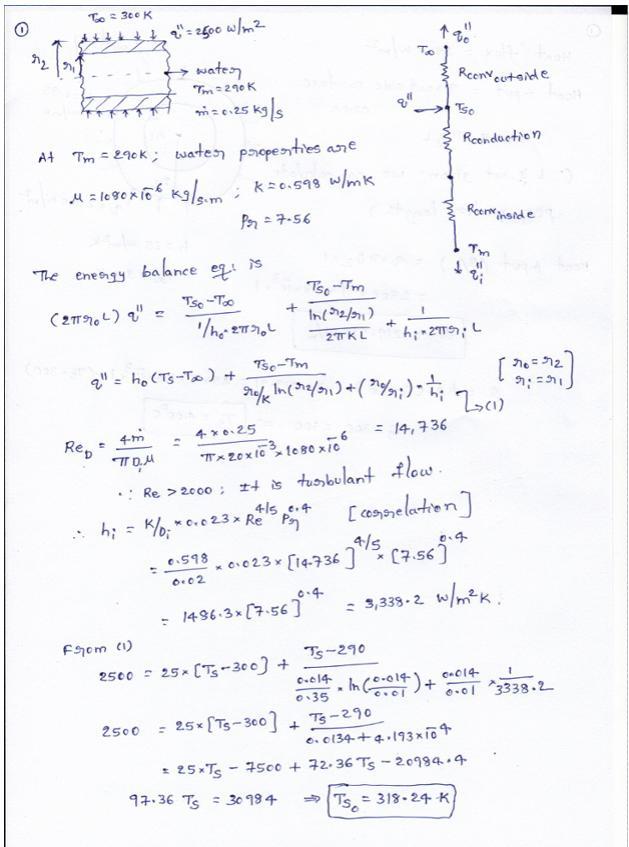
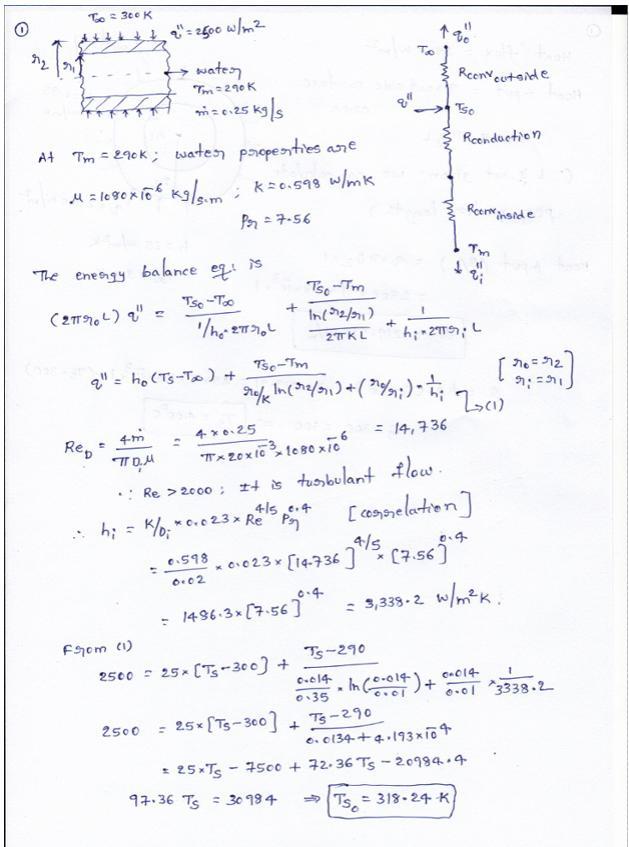
Water at 290 K and 0.25 kg/s flows through a Teflon tube of inner and outer radii equal to 10 and 14 mm, respectively. A thin el

ectrical heating tape wrapped around the outer surface of the tube delivers a uniform surface heat flux of 2500 W/m2 , while a convection coefficient of 25 W/m2 ·K is maintained on the outer surface of the tape by ambient air at 300 K. What is the fraction of the power dissipated by the tape, which is transferred to the water? What is the outer surface temperature of the Teflon tube? (Hint: draw a thermal circuit and consider where the various "currents" are flowing.)

Engineering
1 answer:
Bogdan [553]2 years ago
7 0

Answer:

A) 333.82w/m³

b) 0.817

Explanation:

check attached files below for explanation

You might be interested in
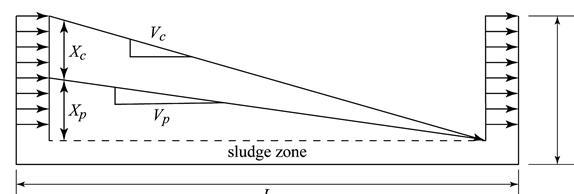
The rate of flow through an ideal clarifier is 8000m3 /d, the detention time is 1h and the depth is 3m. If a full-length movable
Fittoniya [83]

Answer:

a) 35%

b) yes it can be improved by moving the tray near the top

   Tray should be located ( 1 to 2 meters below surface )

   max removal efficiency ≈ 70%

c) The maximum removal will drop as the particle settling velocity = 0.5 m/h

Explanation:

Given data:

flow rate = 8000 m^3/d

Detention time = 1h

depth = 3m

Full length movable horizontal tray :  1m below surface

<u>a) Determine percent removal of particles having a settling velocity of 1m/h</u>

velocity of critical sized particle to be removed = Depth / Detention time

= 3 / 1 = 3m/h

The percent removal of particles having a settling velocity of 1m/h ≈ 35%

<u>b) Determine if  the removal efficiency of the clarifier can be improved by moving the tray, the location of the tray  and the maximum removal efficiency</u>

The tray should be located near the top of the tray ( i.e. 1 to 2 meters below surface ) because here the removal efficiency above the tray will be 100% but since the tank is quite small hence the

Total Maximum removal efficiency

=  percent removal_{above} + percent removal_{below}

= ( d_{a},v_{p} ) . \frac{d_{a} }{depth}  + ( d_{a},v_{p} ) . \frac{depth - d_{a} }{depth}  = 100

hence max removal efficiency ≈ 70%

<u>c) what is the effect of moving the tray would be if the particle settling velocity were equal to 0.5m/h?</u>

The maximum removal will drop as the particle settling velocity = 0.5 m/h

7 0
2 years ago
A binary star system consists of two stars of masses m1m1m_1 and m2m2m_2. The stars, which gravitationally attract each other, r
d1i1m1o1n [39]

Answer:

          a_c_2=\dfrac{a_c_1\times m_1}{m_2}

Explanation:

The question is: <em>Find the magnitude of the centripetal acceleration of the star with mass m₂</em>

The <em>centripetal acceleration</em> is the quotient of the centripetal force and the mass.

                a_c=\dfrac{F_c}{m}

Thus, you can write the equations for each star:


       a_c_1=\dfrac{F_c_1}{m_1}

       a_c_2=\dfrac{F_c_2}{m_2}

As per Newton's third law, the centripetal forces are equal in magnitude. Then:

       a_c_1\times m_1=a_c_2\times m_2

Now you can clear a_c_2:

          a_c_2=\dfrac{a_c_1\times m_1}{m_2}

6 0
2 years ago
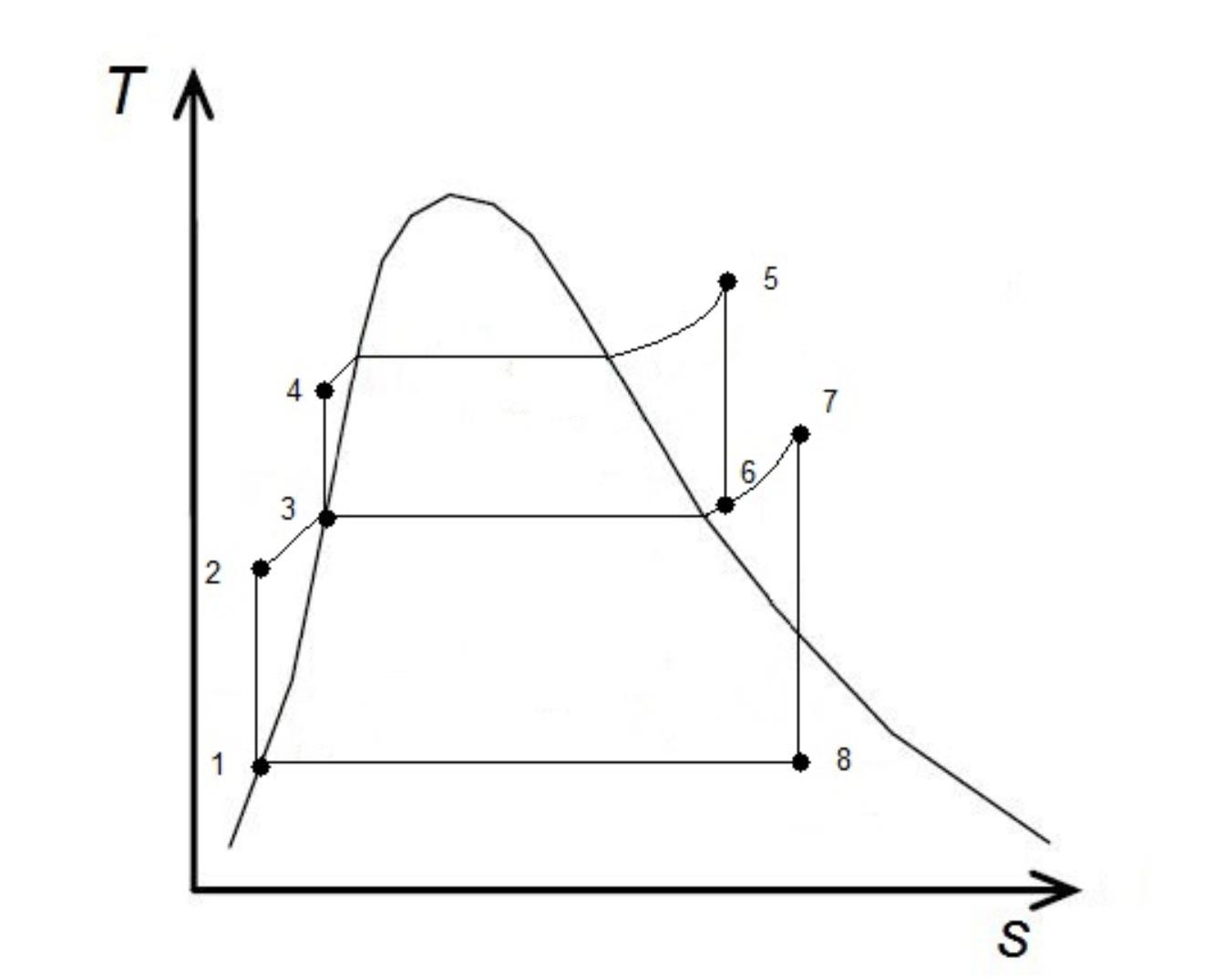
A steam power plant operates on an ideal reheat- regenerative Rankine cycle and has a net power output of 80 MW. Steam enters th
trasher [3.6K]

Answer:

flow(m) = 54.45 kg/s

thermal efficiency u = 44.48%

Explanation:

Given:

- P_1 = P_8 = 10 KPa

- P_2 = P_3 = P_6 = P_7 = 800 KPa

- P_4 = P_5 = 10,000 KPa

- T_5 = 550 C

- T_7 = 500 C

- Power Output P = 80 MW

Find:

-  The mass flow rate of steam through the boiler

-  The thermal efficiency of the cycle.

Solution:

State 1:

P_1 = 10 KPa , saturated liquid

h_1 = 192 KJ/kg

v_1 = 0.00101 m^3 / kg

State 2:

P_2 = 800 KPa , constant volume process work done:

h_2 = h_1 + v_1 * ( P_2 - P_1)

h_2 = 192 + 0.00101*(790) = 192.80 KJ/kg

State 3:

P_3 = 800 KPa , saturated liquid

h_3 = 721 KJ/kg

v_3 = 0.00111 m^3 / kg

State 4:

P_4 = 10,000 KPa , constant volume process work done:

h_4 = h_3 + v_3 * ( P_4 - P_3)

h_4 = 721 + 0.00111*(9200) = 731.21 KJ/kg

State 5:

P_5 = 10,000 KPa , T_5 = 550 C

h_5 = 3500 KJ/kg

s_5 = 6.760 KJ/kgK

State 6:

P_6 = 800 KPa , s_5 = s_6 = 6.760 KJ/kgK

h_6 = 2810 KJ/kg

State 7:

P_7 = 800 KPa , T_7 = 500 C

h_7 = 3480 KJ/kg

s_7 = 7.870 KJ/kgK

State 8:

P_8 = 10 KPa , s_8 = s_7 = 7.870 KJ/kgK

h_8 = 2490 KJ/kg

- Fraction of steam y = flow(m_6 / m_3).

- Use energy balance of steam bleed and cold feed-water:

                                        E_6 + E_2 = E_3

               flow(m_6)*h_6 + flow(m_2)*h_3 = flow(m_3)*h_3

                                    y*h_6 + (1-y)*h_3 = h_3

                                  y*2810 + (1-y)*192.8 = 721

Compute y:                          y = 0.2018

- Heat produced by the boiler q_b:

                             q_b = h_5 - h_4 +(1-y)*(h_7 - h_8)

                    q_b = 3500 -731.21 + ( 1 - 0.2018)*(3480 - 2810)

Compute q_b:               q_b = 3303.58 KJ/ kg

-Heat dissipated by the condenser q_c:

                                       q_c = (1-y)*(h_8 - h_1)

                                 q_c= ( 1 + 0.2018)*(2810 - 192)

Compute q_c:               q_c = 1834.26 KJ/ kg

- Net power output w_net:

                                     w_net = q_b - q_c

                                w_net = 3303.58 - 1834.26

                                    w_net = 1469.32 KJ/kg

- Given out put P = 80,000 KW

                                     flow(m) = P / w_net

compute flow(m)          flow(m) = 80,000 /1469.32 = 54.45 kg/s

- Thermal efficiency u:

                                     u = 1 - (q_c / q_b)

                                     u = 1 - (1834.26/3303.58)

                                     u = 44.48 %
5 0
2 years ago
Chapter 19: Diesel Engine Operation and Diagnosis -Chapter Quiz
Llana [10]

Answer: See explanation

Explanation:

1. How is diesel fuel ignited in a warm diesel engine?

B. Heat compression

2. Which type of diesel injection produces less noise?

A. Indirect injection (IDI)

3. Which diesel injection system requires the use of a glow plug?

A. Indirect injection (IDI)

4. The three phases of diesel ignition include:

C. Ignition delay, repaid combustion, controlled combustion.

5. What fuel system component is used in a vehicle equipped with a diesel engine that is seldom used on the same vehicle when it is equipped with a gasoline engine?

D. Water-fuel separator

6. The diesel injection pump is usually driven by a _________________.

A. Gear off the camshaft

7. Which diesel system supplies high-pressure diesel fuel to all the injectors all of the time?

C. High-pressure common rail

8. Glow plugs should have high resistance when _____________and lower resistance when __________________.

B. Warm/cold

9. Technician A says that glow plugs are used to help start a diesel engine and are shut off as soon as the engine starts. Technician B says that the glow plugs are turned off as soon as a flame is detected in the combustion chamber. Which Technician is correct?

D. Neither Technicians A NOR B

10. What part should be removed to test cylinder compression on a diesel engine?

D. A glow plug

6 0
2 years ago
What is the linear distance traveled in one revolution of a 36-inch wheel
Afina-wow [57]

Answer:

  36π inches ≈ 113.0973 inches

Explanation:

The circumference of the wheel is pi times its diameter.

  C = πd

  C = π(36 in) = 36π in ≈ 113.0973 in

The distance around the wheel is 36π inches, about 113.0973 inches.

7 0
2 years ago
Other questions:
  • Mary is interested in developing new machines that would increase the productivity of small scale farmers. After high school, wh
    8·1 answer
  • A rod is 2m long at temperature of 10oC. Find the expansion of the rod, when the temperature is raised to 80oC. If this expansio
    7·1 answer
  • 1. Create a class called Name that represents a person's name. The class should have fields named firstName representing the per
    8·2 answers
  • The atomic radii of a divalent cation and a monovalent anion are 0.77 nm and 0.136 nm, respectively.1- Calculate the force of at
    11·1 answer
  • Oil enters a counterflow heat exchanger at 600 K with a mass flow rate of 10 kg/s and exits at 200 K. A separate stream of liqui
    12·1 answer
  • A rectangular beam having b=300 mm and d=575 mm, spans 5.5 m face to face of simple supports. It is reinforced for flexure with
    14·1 answer
  • Technician A says that TSBs are typically updates to the owner's manual. Technician B says that TSBs are generally
    11·1 answer
  • Who can work on a fixed ladder that extends more than 24 feet?
    11·1 answer
  • 1. A _____ is applied to a wall or roof rafters to add strength and keep the building straight and plumb.
    9·1 answer
  • Use the drop -down menus to select the appropriate question type. Picking between two possible alternatives: Showing an understa
    7·1 answer
Add answer
Login
Not registered? Fast signup
Signup
Login Signup
Ask question!