answer.
Ask question
Login Signup
Ask question
All categories
  • English
  • Mathematics
  • Social Studies
  • Business
  • History
  • Health
  • Geography
  • Biology
  • Physics
  • Chemistry
  • Computers and Technology
  • Arts
  • World Languages
  • Spanish
  • French
  • German
  • Advanced Placement (AP)
  • SAT
  • Medicine
  • Law
  • Engineering
klio [65]
2 years ago
15

Interpret the following Arterial Blood Gases 1. pH 7.33 PaCO2 60 HCO3 34 A. Normal ABG values B. Respiratory acidosis without co

mpensation C. Respiratory acidosis with partial compensation D. Respiratory acidosis with full compensation 2. pH 7.48 PaCO2 42 HCO3 30 A. Metabolic acidosis without compensation B. Respiratory alkalosis with partial compensation C. Respiratory alkalosis with full compensation D. Metabolic alkalosis without compensation 3. pH 7.38 PaCO2 38 HCO3 24 A. Respiratory alkalosis B. Normal C. Metabolic Alkalosis D. None of the above 4. pH 7.21 PaCO2 60 HCO3 24 A. Normal B. Respiratory acidosis without compensation C. Metabolic acidosis with partial compensation D. Respiratory acidosis with complete compensation 5. pH 7.48 PaCO2 28 HCO3 20 A. Respiratory alkalosis with partial compensation B. Respiratory alkalosis with complete compensation C. Metabolic alkalosis without compensation D. Metabolic alkalosis with complete compensation
Chemistry
1 answer:
kicyunya [14]2 years ago
4 0

Answer: 1) C; 2)D; 3)B; 4)B; 5) A

Explanation:Interpreting the following Arterial Blood gases, we have

1. pH 7.33 PaCO2 60 HCO3  34----Respiratory acidosis with partial compensation----C

2. pH 7.48 PaCO2 42 HCO3 30------. Metabolic alkalosis without compensation----D

3. pH 7.38 PaCO2 38 HCO3 24 ----- Normal---B

4. pH 7.21 PaCO2 60 HCO3 24------ Respiratory acidosis without compensation-----B

5. pH 7.48 PaCO2 28 HCO3 20 ----Respiratory alkalosis with partial compensation

The Arterial blood gas interpretation  from analysis shows  the pH and the partial pressures of oxygen and carbon dioxide in the arterial blood of an individual which can detect how well the lungs are functioning thereby making a physician make a diagnosis, estimate  the severity of a condition and profer treatment.

You might be interested in
Rank the following acids in order of increasing acid strength. Key: Weakening of hydrogen bond and stability of resulting anion.
raketka [301]

Explanation:

The given compounds are oxyacids and in these compounds more is the electronegativity of the central atom more will be its acidic strength.

This is because more is the electronegativity of the central atom more will be the polarity of OH bond. As a result, the compound can readily lose H^{+} ion.

Also, more is the electronegativity of central atom more will be the stability of conjugate base formed.

Thus, we can conclude that given compounds are arranged in increasing acid strength as follows.

       HOI < HOBr_{2} < HOCl_{3} < HOF

8 0
2 years ago
ethylene glycol used in automobile antifreeze and in the production of polyester. The name glycol stems from the sweet taste of
Luden [163]

<u>Answer:</u> The empirical and molecular formula for the given organic compound is CH_3O and C_4H_{12}O_4

<u>Explanation:</u>

The chemical equation for the combustion of hydrocarbon having carbon, hydrogen and oxygen follows:

C_xH_yO_z+O_2\rightarrow CO_2+H_2O

where, 'x', 'y' and 'z' are the subscripts of Carbon, hydrogen and oxygen respectively.

We are given:

Mass of CO_2=9.06g

Mass of H_2O=5.58g

We know that:

Molar mass of carbon dioxide = 44 g/mol

Molar mass of water = 18 g/mol

  • <u>For calculating the mass of carbon:</u>

In 44g of carbon dioxide, 12 g of carbon is contained.

So, in 9.06 g of carbon dioxide, \frac{12}{44}\times 9.06=2.47g of carbon will be contained.

  • <u>For calculating the mass of hydrogen:</u>

In 18g of water, 2 g of hydrogen is contained.

So, in 5.58 g of water, \frac{2}{18}\times 5.58=0.62g of hydrogen will be contained.

  • Mass of oxygen in the compound = (6.38) - (2.47 + 0.62) = 3.29 g

To formulate the empirical formula, we need to follow some steps:

  • <u>Step 1:</u> Converting the given masses into moles.

Moles of Carbon =\frac{\text{Given mass of Carbon}}{\text{Molar mass of Carbon}}=\frac{2.47g}{12g/mole}=0.206moles

Moles of Hydrogen = \frac{\text{Given mass of Hydrogen}}{\text{Molar mass of Hydrogen}}=\frac{0.62g}{1g/mole}=0.62moles

Moles of Oxygen = \frac{\text{Given mass of oxygen}}{\text{Molar mass of oxygen}}=\frac{3.29g}{16g/mole}=0.206moles

  • <u>Step 2:</u> Calculating the mole ratio of the given elements.

For the mole ratio, we divide each value of the moles by the smallest number of moles calculated which is 0.206 moles.

For Carbon = \frac{0.206}{0.206}=1

For Hydrogen  = \frac{0.62}{0.206}=3

For Oxygen  = \frac{0.206}{0.206}=1

  • <u>Step 3:</u> Taking the mole ratio as their subscripts.

The ratio of C : H : O = 1 : 3 : 1

Hence, the empirical formula for the given compound is C_1H_{3}O_1=CH_3O

For determining the molecular formula, we need to determine the valency which is multiplied by each element to get the molecular formula.

The equation used to calculate the valency is:

n=\frac{\text{molecular mass}}{\text{empirical mass}}

We are given:

Mass of molecular formula = 124 amu = 124 g/mol

Mass of empirical formula = 31 g/mol

Putting values in above equation, we get:

n=\frac{124g/mol}{31g/mol}=4

Multiplying this valency by the subscript of every element of empirical formula, we get:

C_{(1\times 4)}H_{(3\times 4)}O_{(1\times 4)}=C_4H_{12}O_4

Thus, the empirical and molecular formula for the given organic compound is CH_3O and C_4H_{12}O_4

3 0
2 years ago
Using your data above, draw conclusions about the d-splitting for each ligand (H2O, en, phen). Order the complexes from least to
Delvig [45]

Answer:

H2O<en<phen

Explanation:

The degree of d- splitting is observed from the intensity of colour. The order of d splitting from least to greatest is H2O<en<phen. Phen shows the greatest d-splitting. The degree of splitting of d- orbitals by ligands depends on their relative positions in the spectrochemical series. The spectrochemical series is an experimentally determined series. The series separates the ligands into strong field and weak field ligands. Strong field ligands are found towards the end of the series. Strong field ligands such as en and phen can participate in metal to ligand or ligand to metal pi-bonding. Hence they cause more d-splitting. Ethylendiamine and phenanthroline occur towards the end of the spectrochemical series hence the higher order of d-splitting.

7 0
2 years ago
If the symbol X represents a central atom, Y represents outer atoms, and Z represents lone pairs on the central atom, the struct
MA_775_DIABLO [31]

Answer:

1. sp  = XY₂

2. sp²  = XY₂Z, XY₃

3. sp3³ = XY₄, XY₂Z₂, XY₃Z

4. sp³d  = XY₅, XY₂Z₃, XY₃Z₂, XY₄Z

5. sp³d² = XY₆, XY₄Z₂, XY₅Z

Explanation:

this is quite dicey, so it should be looked into carefully.

we would classify each of the abbreviation according to their  hybridization and it electron domain.

⇒ sp hybridization = XY₂

in this, we can see that the central atom X is bonded to two outer atoms Y.

this makes the no of hybrid orbitals and the no of sigma bonds both 2.

electron domain = 2.

⇒ sp² hybridization = XY₂Z, XY₃

Here we can see the central atom X bonded with three outer atoms Y in XY₂Z and in XY₃. For XY₂Z molecule, the no of sigma bonds is 2 and the no of hybrid orbitals is 3. While for XY₃ molecule, the no of sigma bonds is 3 while the no of hybrid orbital is 3.

electron domain = 3.

⇒ sp³ hybridization = XY₄, XY₂Z₂, XY₃Z

for XY₄ molecule, the central atom X is bonded with four outer atoms Y. It has 4 numbers of both the sigma and orbital atoms.

In XY₂Z₂, the central atom X is bonded to 2 outer atoms Y, and has 2 lone pairs Z. From this, the no of hybrid orbitals is 4 and the no of sigma bonds is 2, with 2 lone pairs causing the sp³ hybridization.

⇒ sp³d hybridization = XY₅, XY₂Z₃, XY₃Z₂, XY₄Z

for all the molecules listed above, the sum of both the lone pairs and the outer atoms both give a total of 5, hence have the sp³d structure, viz;

XY₂Z₃:

total electron domain = 2+3 = 5  

XY₃Z₂:

total electron domain = 2+3 = 5

XY₄Z:

total electron domain = 1+4 = 5

⇒ sp³d² hybridization = XY₆, XY₄Z₂, XY₅Z

Same thing goes for the above molecule, where the sum of both the outer atoms and the lone pairs gives a total of 6 as can be seen in the example below.

XY4Z2:

total electron domain = 2+4 = 6

cheers, i hope this helps.

5 0
2 years ago
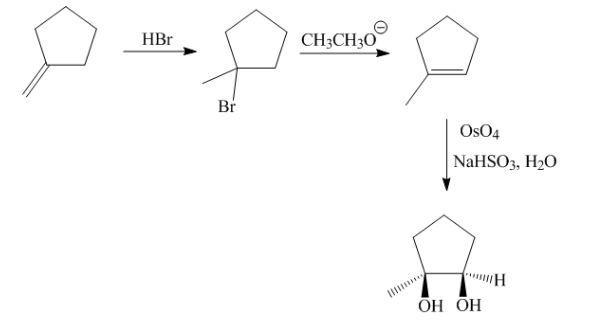
The target diol is synthesized in one step from 1-methylcyclopentene, but your lab partner exhausted the supply of that alkene.
andrezito [222]

Answer:

The reagents are CH_{3}CH_{3}O^{-},OsO_{4},NaHSO_{3}and H_{2}O.

Explanation:

1-Methylenecyclopentene is treated with HBr form 1-bromo-1-methylcyclopentane, which is treated with strong base ethoxide ion and forms 1-methylcyclopent-1-ene.

This alkene is treated with osmium tetraoxide in the presence of sodium bisulfite to form target product.

The chemical reaction is as follows.

4 0
2 years ago
Other questions:
  • What does the number represent in the isotope platinum-194?
    5·1 answer
  • Write one scientific question about the organism in the photo
    8·2 answers
  • If your lungs were filled with air containing this level of lead, how many lead atoms would be in your lungs? (Assume a total lu
    5·2 answers
  • Match each type of titration to its ph at the equivalence point for solutions at 25 ∘c. drag each item to the appropriate bin. v
    12·1 answer
  • a block of iron has a mass of 826g. what is the mass of a block of magnesium that has the same volume as the block of iron? the
    14·1 answer
  • Victoria has a crate of vegetables that weighs 100 newtons. She exerts a force of 100 newtons to lift the crate with a pulley. W
    9·2 answers
  • Consider the reaction below. 2H2O 2H2 + O2 How many moles of hydrogen are produced when 6.28 mol of oxygen form?
    7·1 answer
  • A piston containing 0.120moles of methane gas, CH4, has a volume of 2.12liters. If methane is added until the volume is increase
    6·1 answer
  • A piece of silver releases 202.8 J of heat while cooling 65.0 °C. What is the mass of the sample? Silver has a specific heat of
    10·1 answer
  • In the top row labeled Before Collision, the left billiard ball labeled 3 meters per second approaches the right billiard ball l
    14·2 answers
Add answer
Login
Not registered? Fast signup
Signup
Login Signup
Ask question!