answer.
Ask question
Login Signup
Ask question
All categories
  • English
  • Mathematics
  • Social Studies
  • Business
  • History
  • Health
  • Geography
  • Biology
  • Physics
  • Chemistry
  • Computers and Technology
  • Arts
  • World Languages
  • Spanish
  • French
  • German
  • Advanced Placement (AP)
  • SAT
  • Medicine
  • Law
  • Engineering
zhannawk [14.2K]
2 years ago
9

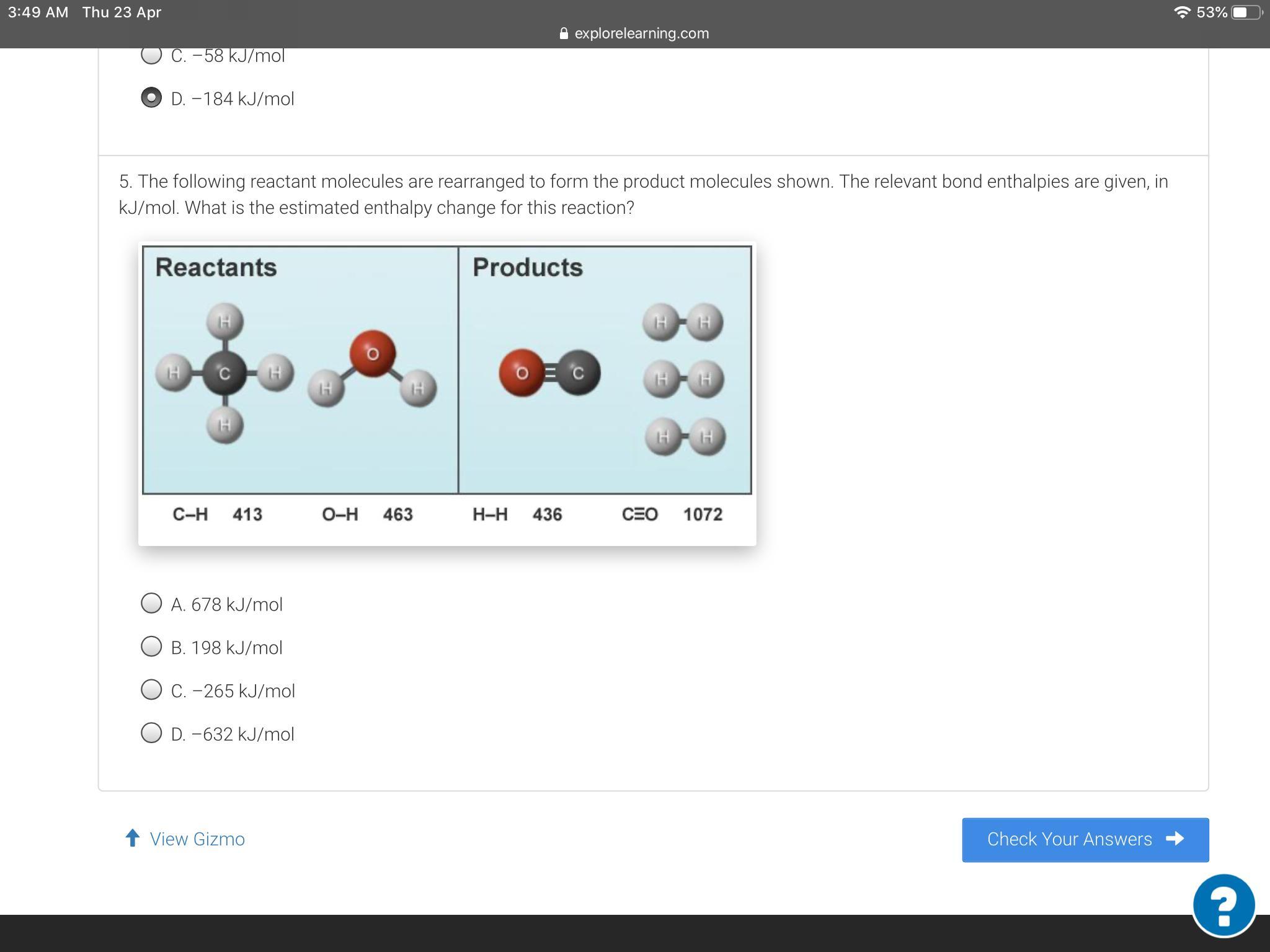
The following reactant molecules are rearranged to form the product molecules shown. The relevant bond enthalpies are given, in

kJ/mol. What is the estimated enthalpy change for this reaction?
ReactionEnergy

A. 678 kJ/mol

B. 198 kJ/mol

C. –265 kJ/mol

D. –632 kJ/mol

Chemistry
1 answer:
umka2103 [35]2 years ago
3 0

Answer:

Correct Answer: B. 198 kJ/mol

Explanation:

In this reaction, four C–H bonds and two O–H bonds are broken, so the total energy absorbed is 4 · 413 + 2 · 463 = 1,652 + 926 = 2,578 kJ/mol. For the products, one C=O bond and three H–H bonds are formed, so the energy released is 1,072 + 3 · 436 = 1,072 + 1,308 = 2,380 kJ/mol. The total enthalpy change is equal to the energy absorbed minus the energy released, so we have 2,578 – 2,380 = 198 kJ/mol. The enthalpy change is positive, so the reaction is endothermic.

You might be interested in
Daniel is developing a model of the light-independent reactions of photosynthesis, also known as the Calvin cycle. How should th
marshall27 [118]

Answer:

*The model should show the carbon compounds enter as carbon dioxide

*The model should show the carbon compounds exit as 3-carbon molecules

Explanation:

In plants, carbon dioxide (CO2) enters the chloroplast through the stomata and diffuses into the stroma of the chloroplast—the site of the Calvin cycle reactions where sugar is synthesized. The reactions are named after the scientist who discovered them, and reference the fact that the reactions function as a cycle.

8 0
2 years ago
HA and HB are two strong monobasic acids. 25.0cm3 of 6.0mol/dm3 HA is mixed with 45.0cm3 of 3.0mol/dm3 HB.
Lostsunrise [7]

Answer:

The H+ (aq) concentration of the resulting solution is 4.1 mol/dm³

(Option C)

Explanation:

Given;

concentration of HA, C_A = 6.0mol/dm³

volume of HA, V_A  = 25.0cm³, = 0.025dm³

Concentration of HB, C_B = 3.0mol/dm³

volume of HB, V_B = 45.0cm³ = 0.045dm³

To determine the H+ (aq) concentration in mol/dm³ in the resulting solution, we apply concentration formula;

C_iVi = C_fV_f

where;

C_i is initial concentration

V_i is initial volume

C_f is final concentration of the solution

V_f is final volume of the solution

C_iV_i = C_fV_f\\\\Based \ on \ this\ question, we \ can \ apply\ the \ formula\ as;\\\\C_A_iV_A_i + C_B_iV_B_i = C_fV_f\\\\C_A_iV_A_i + C_B_iV_B_i = C_f(V_A_i\ +V_B_i)\\\\6*0.025 \ + 3*0.045 = C_f(0.025 + 0.045)\\\\0.285 = C_f(0.07)\\\\C_f = \frac{0.285}{0.07} = 4.07 = 4.1 \ mol/dm^3

Therefore, the H+ (aq) concentration of the resulting solution is 4.1 mol/dm³

7 0
2 years ago
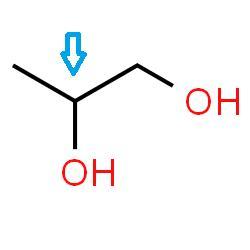
How many possible stereoisomers are there of propylene glycol, an organic compound found in clearasil acne cream, caladryl, colg
vova2212 [387]

Answer:

2

Explanation:

Isomers are molecules with the same molecular formula, but with some difference. If that difference is in the manner the atoms are distributed in the molecule, they are called structural isomers; if the difference is the way the molecule is in space, they're called space isomers (cis/trans); and there are the stereoisomers, which the molecules are images that can be overlapping.

The stereoisomers have the property to deviate the polarized light, and, when a molecule has a chiral carbon, it means that it has stereoisomers. The number of stereoisomers is 2ⁿ, where n is the number of chiral carbons.

Chiral carbon is a carbon that bonds with four different structures. So, below is represented the molecule of propylene glycol, and it has only one chiral carbon (see the blue arrow), so, it has only 2 stereoisomers.

6 0
2 years ago
while your finger is still pushing the coin, there are four forces acting on the coin: what are they?
Viefleur [7K]
Is there some kind of diagram? how is your finger pushing the coin, and where? It may be:
1)friction against a surface
2)push from the finger
3)gravity
4)air resistance behind the coin
8 0
2 years ago
Read 2 more answers
Neither dry soil nor pure water conducts electricity. But wet soil will conduct electricity. Explain why this happens?
kipiarov [429]

Pure water does not have enough ions to conduct electricity. A mixture of metals such as iron, zinc and copper in the wet soil can trigger electrolysis that requires excess energy in the form of over potential to conduct electricity. The excess energy is needed due to limited self-ionization of water. The wet soil then can conduct current when positive and negative ions are present. The water ions begin to flow from anode (positive electrode) to cathode (negative electrode) to be oxidize and produce electricity.

<span> </span>
4 0
2 years ago
Other questions:
  • Which statement describes the transfer of heat energy that occurs when an ice cube is added to an insulated container with 100 m
    7·1 answer
  • A solution contains cr3+ ions. the addition of 0.063 l of 1.50 m naf solution was needed to completely precipitate the chromium
    14·1 answer
  • Which of the following compounds has the lowest boiling point?
    8·1 answer
  • Write the balanced molecular and net ionic equation for the reaction that occurs when the contents of the two beakers are added
    14·1 answer
  • Industrial production of nitric acid, which is used in many products including fertilizers and explosives, approaches 10 billion
    9·1 answer
  • A 200.-milliliter sample of CO2(g) is placed in a sealed, rigid cylinder with a movable piston at 296 K and 101.3 kPa. Determine
    5·1 answer
  • A student constructs an electrochemical cell. A diagram of the operating cell and the unbalanced ionic equation representing the
    12·1 answer
  • 5. Rubbing alcohol is a commonly used disinfectant and has a cooling effect when applied to the skin. The active ingredient in r
    12·1 answer
  • You mix 500.0 mL of 0.250 M iron(III) chloride solution with 425.0 mL of 0.350 M barium chloride solution. Assuming the volumes
    13·1 answer
  • Acetylenic fatty acids are found in many tropical plants. Compound B, C18H32O2, is one such compound; it absorbs 2 equivalents o
    9·1 answer
Add answer
Login
Not registered? Fast signup
Signup
Login Signup
Ask question!