answer.
Ask question
Login Signup
Ask question
All categories
  • English
  • Mathematics
  • Social Studies
  • Business
  • History
  • Health
  • Geography
  • Biology
  • Physics
  • Chemistry
  • Computers and Technology
  • Arts
  • World Languages
  • Spanish
  • French
  • German
  • Advanced Placement (AP)
  • SAT
  • Medicine
  • Law
  • Engineering
MArishka [77]
2 years ago
7

Nicolaas constructed a working model of the hydrologic cycle during science class. He used an open flame, liquid water, two larg

e glass bulbs, and some glass tubing.Which of the following processes does Nicolaas' model demonstrate?
Chemistry
2 answers:
kumpel [21]2 years ago
7 0

Answer: heat energy and gravity

Explanation:

Nastasia [14]2 years ago
3 0

Surface, condensation, evaporation, precipitation

You might be interested in
What elements of paint can help forensic scientists compare samples to each other?
saul85 [17]
It would have to be paints consists of pigments,solvents, and binders. Once the [paint has been applied and has dried, the pigments are still able to determine the matched samples.
4 0
2 years ago
Describe a single measurement that you could make that shows that a kettle is less than 100% efficient (providing evidence that
alexgriva [62]

Answer:

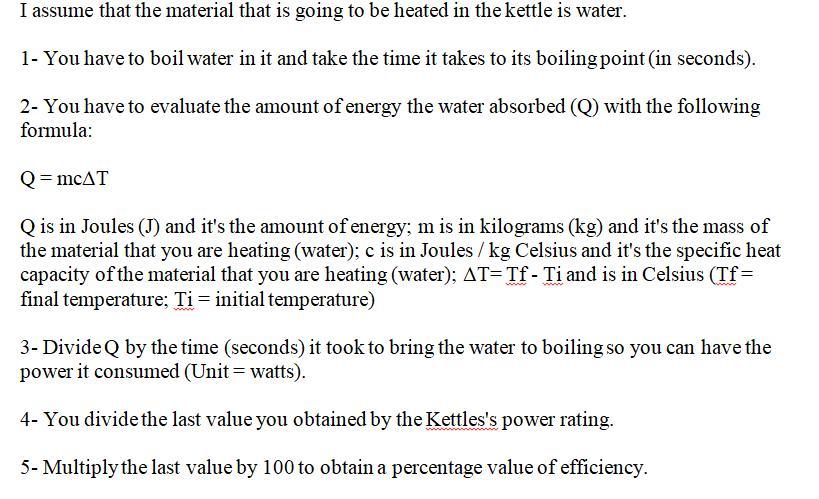
As you haven't explained what measurements you took before solving this problem, I will explain the general procedure to evaluate the efficiency of a kettle. I hope it helps you. I´ll send an attachement file with the full answer, since I couldn't write it here.

I assume that the material that is going to be heated in the kettle is water.

1- You have to boil water in it and take the time it takes to its boiling point (in seconds).  

2- You have to evaluate the amount of energy the water absorbed Q with the efficiency formula which I explain in the attachement file.

3- Divide Q by the time it took to bring the water to boiling so you can have the power it consumed.

4- You divide the last value you obtained by the Kettles's power rating.  

5- Multiply the last value by 100 to obtain a percentage value of efficiency.

Explanation:

Efficiency is the ration of a machine's useful work, in this case how much energy the water absorbed to get to its boiling point divided by the time it took to get to this point, and the total energy expended, in this case the kettles's power rating.

7 0
2 years ago
What mass of powdered drink mix is needed to make a 0.5 M solution of 100 mL?
Maru [420]

Answer:

There is 17,114825 g of powdered drink mix needed

Explanation:

<u>Step 1 :</u> Calculate moles

As given, the concentration of the drink is 0.5 M, this means 0.5 mol / L

Since the volume is 100mL, we have to convert the concentration,

⇒0.5 / 1   =  x /0.1    ⇒ 0.5* 0.1  = x = 0.05 M

This means there is 0.05 mol per 100mL

e

<u>Step 2 </u>: calculate mass of the powdered drink

here we use the formula n (mole) = m(mass) / M (Molar mass)

⇒ since powdered drink mix is usually made of sucrose (C12H22O11) and has a molar mass of 342.2965 g/mol.

0.05 mol = mass / 342.2965 g/mol

To find the mass, we isolate it ⇒0.05 mol * 342.2965 g/mol = 17,114825g

There is 17,114825 g of powdered drink mix needed

3 0
2 years ago
Read 2 more answers
The terms motif (fold) and domain describe levels of protein organization more complicated than primary or secondary structure.
posledela

Answer:

Each specific property of motif and domain is explained.

Explanation:

Domain;

  • May retain a 3D structure when separated from rest of the protein.          
  • Unit of tertiary structure because alpha helix and beta sheets are units of secondary structure.
  • Stable globular units like pyruvate kinase
  • May be distinct functional units in a protein

Motif;

  • Repetetive supersecondary structure because they contain cluster of secondary structure.
  • Beta Alpha Beta unit is an example of motif
  • Clusters of secondary structure

Both Motif and Domain;

  • Stabilized by hydrophobic interactions like hydrogen bonding stabilize the both.
  • Depends on primary structure like the arrangement of amino acid in polypeptide chain determine the secondary and tertiary structure of proteins.

8 0
2 years ago
When 1.00 g of boron is burned in o2(g) to form b2o3(s), enough heat is generated to raise the temperature of 733 g of water fro
Bas_tet [7]
<span>Answer: For this problem, you would need to know the specific heat of water, that is, the amount of energy required to raise the temperature of 1 g of water by 1 degree C. The formula is q = c X m X delta T, where q is the specific heat of water, m is the mass and delta T is the change in temperature. If we look up the specific heat of water, we find it is 4.184 J/(g X degree C). The temperature of the water went up 20 degrees. 4.184 x 713 x 20.0 = 59700 J to 3 significant digits, or 59.7 kJ. Now, that is the energy to form B2O3 from 1 gram of boron. If we want kJ/mole, we need to do a little more work. To find the number of moles of Boron contained in 1 gram, we need to know the gram atomic mass of Boron, which is 10.811. Dividing 1 gram of boron by 10.811 gives us .0925 moles of boron. Since it takes 2 moles of boron to make 1 mole B2O3, we would divide the number of moles of boron by two to get the number of moles of B2O3. .0925/2 = .0462 moles...so you would divide the energy in KJ by the number of moles to get KJ/mole. 59.7/.0462 = 1290 KJ/mole.</span>
7 0
2 years ago
Other questions:
  • If a runner completes a 10 kilometer race in 32.50 minutes, what is the 10.0 km pace in miles per hour? (1.609 km = 1 mile appro
    8·1 answer
  • When potassium bromate (kbro3 ) is heated, it decomposes into potassium bromide and a gas that supports the combustion of a glow
    8·1 answer
  • Question 3 options: how many moles of argon atoms are present in 11.2 l of argon gas at stp?
    13·1 answer
  • An article about half-lives describes a daughter isotope. What is a daughter isotope?
    10·1 answer
  • Precipitation will increase in areas where there is A) less transpiration and less run-off. B) lower temperatures and more evapo
    11·2 answers
  • Industrial production of nitric acid, which is used in many products including fertilizers and explosives, approaches 10 billion
    9·1 answer
  • The amount of energy that must be absorbed or lost to raise or lower the temperature of 1 g of liquid water by 1°C _____.
    14·1 answer
  • The density of an unknown crystal is 2.65gmL. If a 4.46 g sample of the crystal is added to a graduated cylinder containing 25.0
    6·1 answer
  • what would the total pressure of a mixture of fluorine, chlorine, and bromine gases be if the partial pressure are 2.20 atm, 6.7
    11·1 answer
  • 1.00 g of a compound is combusted in oxygen and found to give 3.14g of CO2 and 1.29 g of H2O. From these data we can tell thatA.
    6·1 answer
Add answer
Login
Not registered? Fast signup
Signup
Login Signup
Ask question!