answer.
Ask question
Login Signup
Ask question
All categories
  • English
  • Mathematics
  • Social Studies
  • Business
  • History
  • Health
  • Geography
  • Biology
  • Physics
  • Chemistry
  • Computers and Technology
  • Arts
  • World Languages
  • Spanish
  • French
  • German
  • Advanced Placement (AP)
  • SAT
  • Medicine
  • Law
  • Engineering
Morgarella [4.7K]
2 years ago
11

A paint company produces glow in the dark paint with an advertised glow time of 15 min. A painter is interested in finding out i

f the product behaves worse than advertised. She sets up her hypothesis statements as H0 : µ ≤ 15 and Ha : µ > 15, then calculates a test statistic of z = −2.30. What would be the conclusions of her hypothesis test at significance levels of α = 0.05, α = 0.01, and α = 0.001?
Engineering
1 answer:
andrew11 [14]2 years ago
3 0

Answer:

p_v = P(z

Now we can decide based on the significance level \alpha. If p_v we reject the null hypothesis and in other case we FAIL to reject the null hypothesis.

\alpha=0.05 we see that p_v< \alpha so then we have enough evidence to reject the null hypothesis and we can conclude that the true mean is significantly less than 15

\alpha=0.01 we see that p_v> \alpha so then we have enough evidence to FAIL to reject the null hypothesis and we can conclude that the true mean is NOT significantly less than 15

\alpha=0.001 we see that p_v> \alpha so then we have enough evidence to FAIL to reject the null hypothesis and we can conclude that the true mean is NOT significantly less than 15

Explanation:

For this case they conduct the following system of hypothesis for the ture mean of interest:

Null hypothesis: \mu \leq 15

Alternative hypothesis: \mu >15

The statistic for this hypothesis is:

z = \frac{\bar X -\mu}{\frac{\sigma}{\sqrt{n}}}

And on this case the value is given z = -2.30

For this case in order to take a decision based on the significance level we need to calculate the p value first.

Since we have a lower tailed test the p value would be:

p_v = P(z

Now we can decide based on the significance level \alpha. If p_v we reject the null hypothesis and in other case we FAIL to reject the null hypothesis.

\alpha=0.05 we see that p_v< \alpha so then we have enough evidence to reject the null hypothesis and we can conclude that the true mean is significantly less than 15

\alpha=0.01 we see that p_v> \alpha so then we have enough evidence to FAIL to reject the null hypothesis and we can conclude that the true mean is NOT significantly less than 15

\alpha=0.001 we see that p_v> \alpha so then we have enough evidence to FAIL to reject the null hypothesis and we can conclude that the true mean is NOT significantly less than 15

You might be interested in
A single crystal of a metal that has the FCC crystal structure is oriented such that a tensile stress is applied parallel to the
morpeh [17]

The magnitude of applied stress in the direction of 101 is 12.25 MPA and in the direction of 011, it is not defined.                                          

<u>Explanation</u>:        

<u>Given</u>:

tensile stress is applied parallel to the [100] direction

Shear stress is 0.5 MPA.

<u>To calculate</u>:

The magnitude of applied stress in the direction of [101] and [011].

<u>Formula</u>:

zcr=σ cosФ cosλ

<u>Solution</u>:

For in the direction of 101

cosλ = (1)(1)+(0)(0)+(0)(1)/√(1)(2)

cos λ = 1/√2

The magnitude of stress in the direction of 101 is 12.25 MPA

In the direction of 011

We have an angle between 100 and 011

cosλ = (1)(0)+(0)(-1)+(0)(1)/√(1)(2)

cosλ  = 0

Therefore the magnitude of stress to cause a slip in the direction of 011 is not defined.                                                                                                                                                                      


5 0
2 years ago
Refrigerant-134a enters a diffuser steadily as saturated vapor at 600 kPa with a velocity of 160 m/s, and it leaves at 700 kPa a
Zina [86]

Answer:

a) V_2 = 82.1 m/s

b) m = 0.298 Kg/s

Explanation:

from A-11 to A-13 we have the following data

P_1 = 600 kpa

V_1 = 0.033925 m^3/kg

h_1 = 262.52 kJ/kg

P_2 = 700 kpa

V_2 = 0.0313 m^3/kg

T_2 = 40°C = 313K

h_2 = 278.66 kJ/kg

Now, from the conversation of mass,

A_2*V_2/u_2 = A_1*V_1/u_1

V_2 = A_1/A_2*u_2/u_1*V_1

V_2 = A_1/1.8*A_1 * 0.0313 /0.033925*160

V_2 = 82.1 m/s

now from the energy balance equation

E_in = E_out

Q_in + m(h_1 + V_1^2/2) =  m(h_2 + V_2^2/2)

m = 0.298 Kg/s

4 0
2 years ago
Read 2 more answers
The radial component of acceleration of a particle moving in a circular path is always:________ a. negative. b. directed towards
lesya [120]

Answer:

d. all of the above

Explanation:

There are two components of acceleration for a particle moving in a circular path, radial and tangential acceleration.

The radial acceleration is given by;

a_r = \frac{V^2}{R}

Where;

V is the velocity of the particle

R is the radius of the circular path

This radial acceleration is always directed towards the center of the path, perpendicular to the tangential acceleration and negative.

Therefore, from the given options in the question, all the options are correct.

d. all of the above

7 0
2 years ago
A 20 mm 3 20 mm silicon chip is mounted such thatthe edges are flush in a substrate. The substrate provides anunheated starting
sasho [114]

Answer:

q= 1.77 W

Explanation:

Given data, Dimensions = 20mm x 20mm, Unheated starting length (ε) = 20 mm, Air flow temperature = 25 C, Velocity of flow = 25m/s, Surface Temperature = 75 C

To find maximum allowed power dissipated use the formula Q = hA(ΔT), where Q = Maximum allowed power dissipated from surface , h = heat transfer coefficiant, A = Area of Surface, ΔT = Temperature difference between surface and surrounding

we need to find h, which is given by (Nu x K)/x, where Nu is the Nusselt's Number, k is the thermal conductivity at film temperature and x is the length of the substrate.

For Nu use the Churchill and Ozoe relation used for parallel flow over the flat plate , Nu = (Nux (ε=0))/[1-(ε/x)^3/4]^1/3

Nux (ε=0) = 0.453 x Re^0.5 x Pr^1/3, where Re is the Reynolds number calculated by [Rex = Vx/v, where V is the velocity and v is the kinematic velocity, x being the length of the substrate] and Pr being the Prandtl Number

The constants, namel Pr, k and v are temperature dependent, so we need to find the film temperature

Tfilm = (Tsubstrate + Tmax)/2 = (25 + 75)/2 = 50 C

At 50 C, Pr = 0.7228, k = 0.02735w/m.k , v = 1.798 x 10^-5 m2/s

First find Rex and keep using the value in the subsequent formulas until we reach Q

Rex = Vx/v = 25 x (0.02 + 0.02)/ 1.798 x 10^-5  = 55617.35 < 5 x 10^5, thus flow is laminar, (x = L + ε)

Nux = (Nux (ε=0))/[1-(ε/x)^3/4]^1/3 = 0.453 x Re^0.5 x Pr^1/3/[1-(ε/x)^3/4]^1/3

= 0.453 x 55617.35 ^0.5 x 0.7228^1/3/ [1 - (0.02/0.04)^3/4]^1/3 = 129.54

h = (Nu x K)/x = (129.54 x 0.02735)/0.04 = 88.75W/m2.k

Q = 88.75 x (0.02)^2 x (75-25) = 1.77 W

7 0
2 years ago
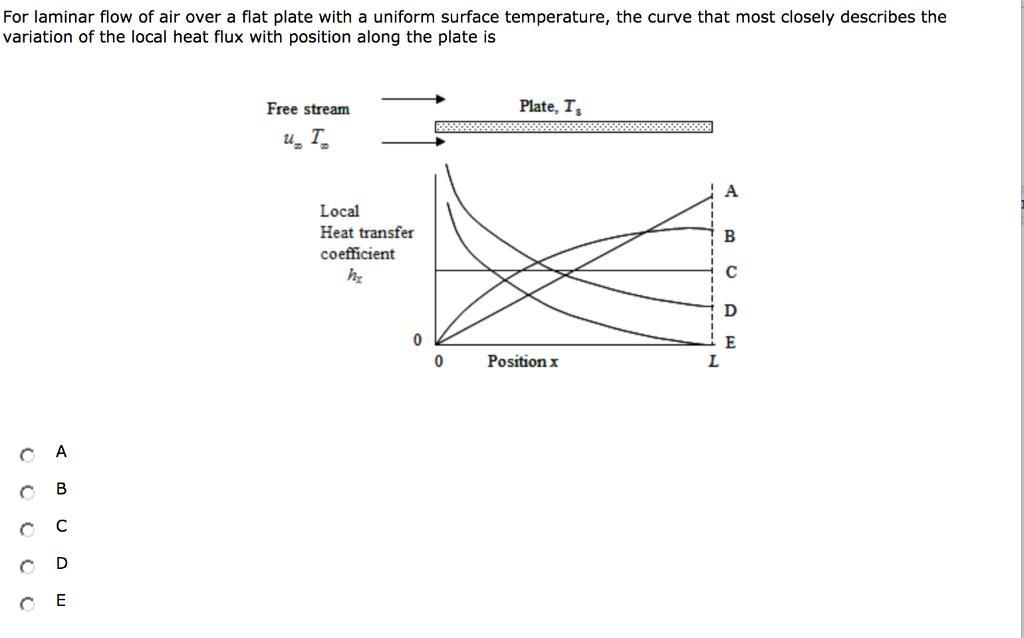
For laminar flow of air over a flat plate that has a uniform surface temperature, the curve that most closely describes the vari
Aliun [14]

This question is incomplete, the missing diagram is uploaded along this answer below;

Answer:

from the diagram, the curve that most closely describes the variation of the local heat transfer coefficient with position along the plate is Option D

Explanation:

Given the data in the question;

We write the expression for the local Nusselt number for Laminar flow over the flat plate;

Nu = C(Re_x)^{0.5 (Pr)^{1/3

Nu = C(\frac{Vx}{v})^{0.5} (Pr)^{1/3

\frac{h_xx}{k} = C(\frac{V}{v})^{0.5}  (Pr)^{1/3  (x)^{0.5

h_x = \frac{1}{x^{1/2}}

Next we write down the expression for the local heat flux from the plate with  uniform surface temperature;

q = h_xA( T_s - T∞ )

q ∝ h_x

∴

q ∝  \frac{1}{x^{1/2}}

The local heat flux decreases with the position as it is inversely proportional to the square root of the position from the leading edge and it will not be zero at the end of the plate.

Therefore, from the diagram, the curve that most closely describes the variation of the local heat transfer coefficient with position along the plate is Option D

3 0
2 years ago
Other questions:
  • Consider insulation on a circular pipe For the same thickness and type of insulation, the thermal resistance of the insulation i
    8·1 answer
  • An electrical utility delivers 6.25E10 kWh of power to its customers in a year. What is the average power required during the ye
    15·1 answer
  • The pressure drop across a valve through which air flows is expected to be 10 kPa. If this differential were applied to the two
    11·1 answer
  • 3. (20 points) Suppose we wish to search a linked list of length n, where each element contains a key k along with a hash value
    7·1 answer
  • You want to determine whether the race of the defendant has an impact on jury verdicts. You assign participants to watch a trial
    9·1 answer
  • A 5-cm-diameter shaft rotates at 4500 rpm in a 15-cmlong, 8-cm-outer-diameter cast iron bearing (k = 70 W/m·K) with a uniform cl
    10·1 answer
  • In this module you learned about searching, sorting and algorithms in C++ and how to implement these elements in your C++ progra
    6·1 answer
  • or a metal pipe used to pump tomato paste, the overall heat- transfer coefficient based on internal area is 2 W/(m2 K). The insi
    14·1 answer
  • The fatigue data for a brass alloy are given as follows: Stress Amplitude (MPa) Cycles to Failure 170 3.7 × 10⁴ 148 1.0 × 10⁵ 13
    9·1 answer
  • An airplane in level flight at an altitude h and a uniform speed v passes directly over a radar tracking station A. Calculate th
    5·1 answer
Add answer
Login
Not registered? Fast signup
Signup
Login Signup
Ask question!