answer.
Ask question
Login Signup
Ask question
All categories
  • English
  • Mathematics
  • Social Studies
  • Business
  • History
  • Health
  • Geography
  • Biology
  • Physics
  • Chemistry
  • Computers and Technology
  • Arts
  • World Languages
  • Spanish
  • French
  • German
  • Advanced Placement (AP)
  • SAT
  • Medicine
  • Law
  • Engineering
lianna [129]
2 years ago
14

Cold feedwater enters a 200-kPa open feedwater heater of a regenerative Rankine cycle at 70°C with a flow rate of 20 kg/s. Bleed

steam is available from the turbine at 200 kPa and 160°C. At what rate must the bleed steam be supplied to the open feedwater heater so that the feedwater leaves this unit as a saturated liquid?
The mass flow rate of bleed steam to be supplied to the open feedwater heater so that the feedwater leaves this unit as a saturated liquid is ___________ kg/s.

Engineering
1 answer:
Anni [7]2 years ago
8 0

Answer:

The mass flow rate of bleed steam to be supplied is; m'_s = 1.85 Kg/s

Explanation:

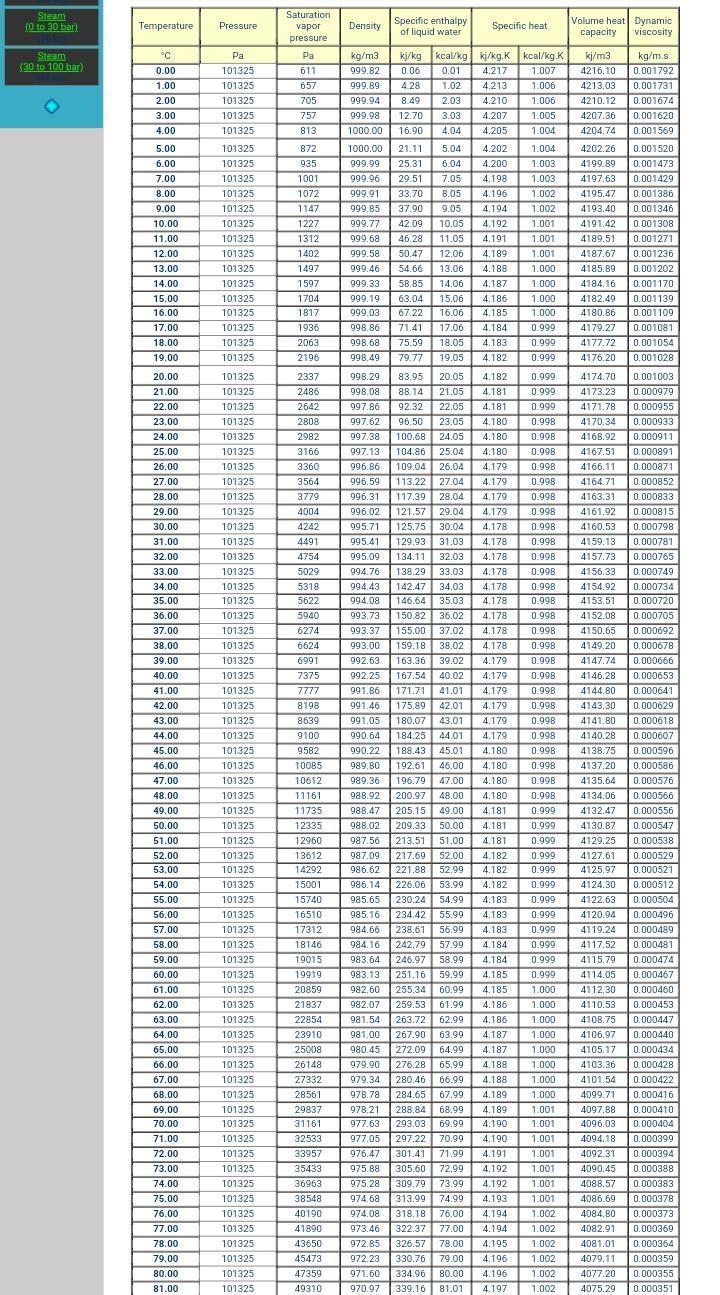
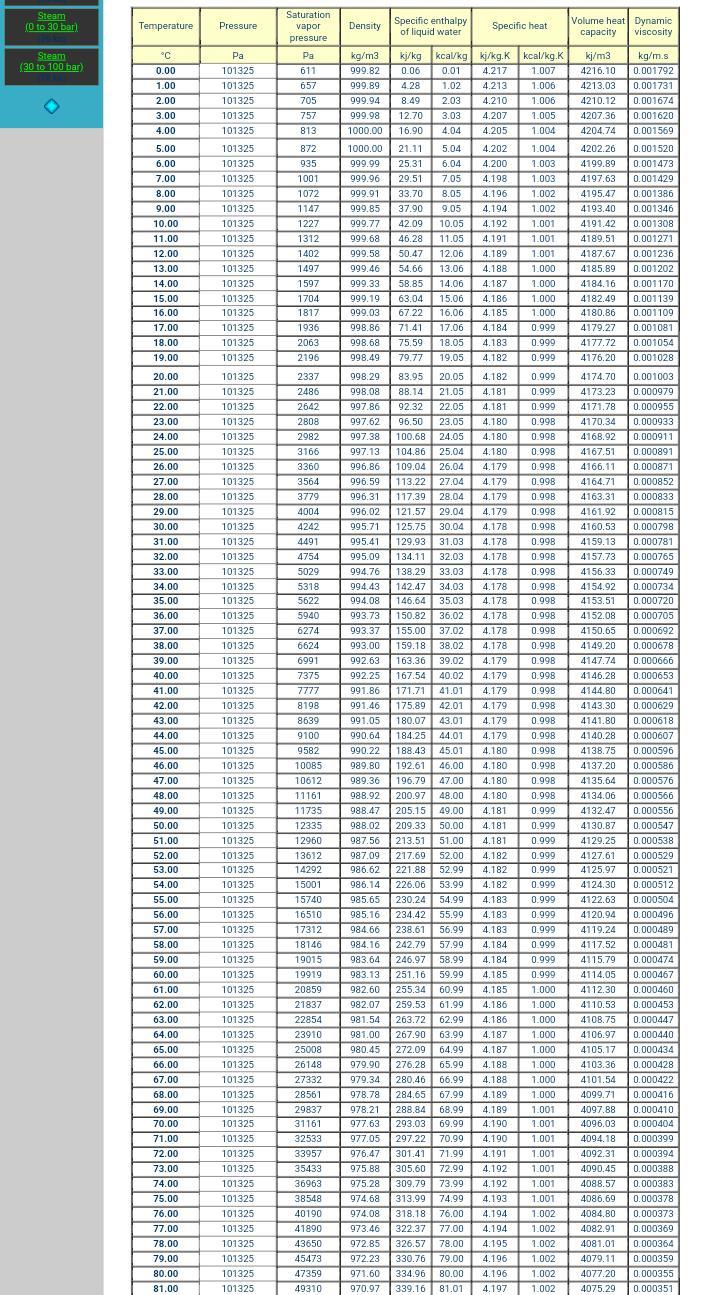
From the first table i attached, at temperature of 70°C, the enthalpy of the cold water feed is;

h_c = 293 KJ/Kg

Also from the same table, at a temperature of 160°C and by interpolation, the enthalpy of the steam is;

h_s = 2790 KJ/Kg

Now, the exiting water is leaving the water heater at a combined rate of m'_c + m'_s and we know that it is a saturated liquid at Pressure of 200 KPa.

Where m'_c is mass flow rate of cold water feed while m'_s is mass flow rate of bleed steam.

Thus, from the second table attached and at 200KPa,the enthalpy of the saturated liquid is;

h_e = 504.71 KJ/kg

Now, from energy balance equation, we have;

E'_e = E'_c + E'_s

(m'_c + m'_s)h_e = (m'_c)h_c + (m'_s)h_s

Plugging in the relevant values, we have;

(20 + m'_s)504.71 = (20)293 + (m'_s)2790

10094.2 + 504.71m'_s = 5860 + 2790m'_s

2790m'_s - 504.71m'_s = 10094.2 - 5860

2285.29m'_s = 4234.2

m'_s = 4234.2/2285.29

m'_s = 1.85 Kg/s

You might be interested in
A spherical balloon with a diameter of 9 m is filled with helium at 20°C and 200 kPa. Determine the mole number and the mass of
SIZIF [17.4K]

Answer:

<em>number of mole is 31342.36 moles</em>

<em>mass is 125.369 kg</em>

<em></em>

Explanation:

Diameter of the spherical balloon d = 9 m

radius r = d/2 = 9/2 = 4.5 m

The volume pf the sphere balloon ca be calculated from

V = \frac{4}{3} \pi r^3

V = \frac{4}{3}* 3.142* 4.5^3 = 381.75 m^3

Temperature of the gas T = 20 °C = 20 + 273 = 293 K

Pressure of the helium gas = 200 kPa = 200 x 10^3 Pa

number of moles n = ?

Using

PV = nRT

where

P is the pressure of the gas

V is the volume of the gas

n is the mole number of the gas

R is the gas constant = 8.314 m^3⋅Pa⋅K^−1⋅mol^−1

T is the temperature of the gas (must be converted to kelvin K)

substituting values, we have

200 x 10^3 x 381.75 = n x 8.314 x 293

number of moles n  = 76350000/2436 = <em>31342.36 moles</em>

We recall that n = m/MM

or m = n x MM

where

n is the number of moles

m is the mass of the gas

MM is the molar mass of the gas

For helium, the molar mass = 4 g/mol

substituting values, we have

m = 31342.36 x 4

m = 125369.44 g

m =<em> 125.369 kg</em>

3 0
2 years ago
4. Determine the size of the contact patch, relative displacement and the maximum contact pressure for a 20-mm-dia steel ball ro
wel

Answer:

0.0806 mm

735.588 MPa

Explanation:

Given data:

Esteel = 200 GPa

vsteel = 0.3,

EAI = 70 GPa,  vAI = 1/3

diameter of steel ball = 20-mm

Applied force = 1 kN force

density of steel ( ρ ) = 8050 kg/m^3

weight of steel =  ρvg = 0.33 N

<u>Calculate the size of </u>

<u><em>i) contact patch</em></u>

size of contact patch  = \sqrt[3]{\frac{3FR}{4E} } ----------- ( 1 )

where: F = 1000 + 0.33 = 1000.33 N , r = 0.01 m,

E = 57.26 * 10^9 ( calculated value )  

Input values into equation 1

size of contact patch ( a ) = 0.0806 mm

<u><em>ii) maximum contact pressure </em></u>

P = 3F / 2πa^2

  = ( 3 * 1000.33 ) / 2π(0.0806)^2

  = 735.588 MPa

3 0
2 years ago
A piston-cylinder device with a set of stops initially contains 0.6 kg of steam at 1.0 MPa and 400 C. The location of the stops
ladessa [460]

Answer:

a) 44.316 KJ  

b) 110.3696 KJ

c) 151.83°C

Explanation:

Givens:  

Substance: H20, m = 0.6 kg P1 = 1 MPa, T1 = 400°C   v2 = 0.4 v1  

First We Compute v1 as Following:

P1= 1 MPa, T1= 400°C

From TABLE  we compare T(sat). corresponding to P1 with T1 determine the state phase

T(sat) = 179.88°C < T1

The state phase is Superheated

From TABLE  we get v1 corresponding to P1 and T1

v1 = 0.30661 m^3/kg  

(a) P2 = 1 MPa, T2 = 250°C  

From TABLE we compare T(sat) corresponding to P2 with T2 determine the state phase  

T(sat) = 179.88°C < T2  

The state phase is Superheated

From we get v2 corresponding to P2 and T2

v1 = 0.23275 m^3/kg

P1 = P2 =1 MPa  

The process is isobaric

W 1_2 = mP(v2 — v1) = 0.6 x 1000(0.23275 - 0.30661) = - 44.316 KJ  

The compression work Wb = 44.316 KJ  

(b) P2 = 500 kPa.

the piston reaches the stops so there are two processes

Process 1_2 is isobaric

W 1 _2 = MP(v2 —V1) = 0.6 x 1000(0.4 x 0.30661-0.30660) = -110.3796 KJ  

Process 1_2 is isochoric

W2_3 = zero

The compression work Wb = W 1_2 + W 2_3 = 110.3796+ 0 = 110.3696 KJ

(c) v2 = 0.4v1 = 0.9 x 0.30661 = 0.122649 m^3/kg.

    P2 = 500 kPa

From TABLE we compare vf and vg corresponding to P2 with v2 to determine the state phase

vf = 0.001093 m^3/kg < v2 < vg = 0.37483 m^3/kg

The state phase is Saturated Mixture  

T2 = Tsat = 151.83°C

3 0
2 years ago
One mole of iron (6 1023 atoms) has a mass of 56 grams, and its density is 7.87 grams per cubic centimeter, so thecenter-to-cent
Nezavi [6.7K]

Answer:

(a)

Stiffness of one inter-atomic bond in iron =  5.14*10^-9 N/m

(b)

Spring stiffness of entire wire = 45.37 N/m

Explanation:

Given data:

No of atoms = = 1 mole of iron = 6*10^23

Mass = 56 g

Density = 7.87 g / cm^3

Original Length = 2 m

Hanged mass = 231 kg

Change in length = 1.01 cm

Solution:

Force applied to bar = 231 * 9.8

                                  = 2263.8 N

Change in length = ΔL = 1.01 cm = 0.0101 m

Bar stiffness = F / ΔL = 2263.8 / 0.0101

Bar stiffness  = 2.24*10^5 N/m

Cross sectional area of bar= 0.0015*0.0015

                            = 2.25*10^-6 m^2

No. of atoms in one layer of cross-sectional area

              = Cross-Sectional area of bar / Area of one atom

No. of atoms = 2.25*10^-6 / (2.28*10^-10)^2

No. of atoms in one layer of cross-sectional area = 4.33*10^13

Length of Bar = 2 m

No. of bonds along bar length

              = Bar length / Center to center distance between atoms

No. of bonds = 2 / 2.28*10^-10

No. of bonds = 8.77*10^9

Force applied to each atom

               = Force / ( No. of atoms * No. of bonds )

Force applied to each bond = 2263.8 / ( 4.33*10^13 * 8.77*10^9)

Force applied to each bond = 5.96*10^-21 N

Strain on bar on bar =  ΔL / L = 0.0101 / 2

                      = 0.0051

Strain between atom layers will be same as above.

Bond extension (elongation) = 2.28*10^-10 * 0.0051

                       = 1.16*10^-12 m

Bond stiffness = Force applied to each bond / Bond extension

Bond stiffness = 5.96*10^-21 / 1.16*10^-12

Bond stiffness = 5.14*10^-9 N/m

Stiffness of one inter-atomic bond in iron =  5.14*10^-9 N/m

Part (b)

Spring stiffness of entire wire = (Bar stiffness  * No. of bonds) / No. of atoms

Spring stiffness = (2.24*10^5 * 8.77*10^9) / 4.33*10^13

Spring stiffness = 45.37 N/m
7 0
2 years ago
Two physical properties that have a major influence on the cracking of workpieces, tools, or dies during thermal cycling are the
krok68 [10]

Answer:

Explanation:

It is generally known that the thermal stresses developed during thermal cycle results into cracking, and these thermal stresses are due to temperature gradients .

Stresses will be equivalently lower for a particular temperature gradient when the thermal expansion is low.

It also known that there will be a reduction in the temperature gradient if the thermal conductivity is high, as heat is dissipated faster and more equally and  with it, as well as  when deformation takes place due to thermal stresses, cracking occurs but if the ductility is high, more deformation will be allowed without cracking and thus reduces the tendency for cracking.

7 0
2 years ago
Other questions:
  • 5. A typical paper clip weighs 0.59 g and consists of BCC iron. Calculate (a) the number of
    5·1 answer
  • At a certain college, 30% of the students major in engineering, 20% play club sports, and 10% both major in engineering and play
    14·1 answer
  • A flat-plate solar collector is used to heat water by having water flow through tubes attached at the back of the thin solar abs
    8·1 answer
  • A fully braced structural member in a building is subjected to several different loads, including roof loads of D = 5 k and L_r
    7·1 answer
  • Movies( title, year, length, genre, studioName, producerC#) StarsIn(movieTitle, movie Year, starName) MovieStar(name, address, g
    9·1 answer
  • Compare a series circuit powered by six 1.5-volt batteries to a series circuit powered by a single 9-volt battery. Make sure the
    6·1 answer
  • A certain printer requires that all of the following conditions be satisfied before it will send a HIGH to la microprocessor ack
    12·1 answer
  • Toeboards are usually ___ inches high and used on landings and balconies.
    8·1 answer
  • A refrigeration system was checked for leaks. The system temperature and surroundings were 75°F when the system was charged with
    6·1 answer
  • An unconstrained 10mm thick plate of steel 100mm on a side with a 25mm diameter hole in the center is heated from 20 degrees C t
    14·1 answer
Add answer
Login
Not registered? Fast signup
Signup
Login Signup
Ask question!