answer.
Ask question
Login Signup
Ask question
All categories
  • English
  • Mathematics
  • Social Studies
  • Business
  • History
  • Health
  • Geography
  • Biology
  • Physics
  • Chemistry
  • Computers and Technology
  • Arts
  • World Languages
  • Spanish
  • French
  • German
  • Advanced Placement (AP)
  • SAT
  • Medicine
  • Law
  • Engineering
Harlamova29_29 [7]
2 years ago
6

Compare a series circuit powered by six 1.5-volt batteries to a series circuit powered by a single 9-volt battery. Make sure the

re are equal numbers of light bulbs in each circuit and that the batteries are all in the same orientation.

Engineering
1 answer:
lana [24]2 years ago
3 0

Answer:

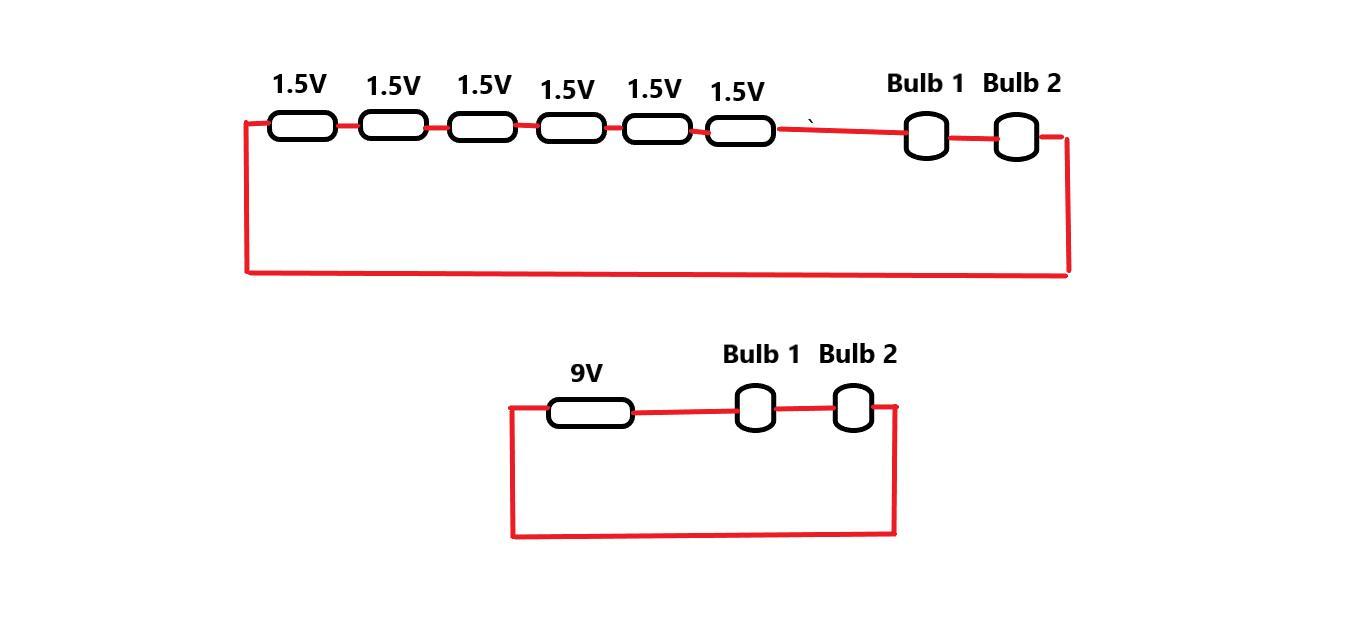
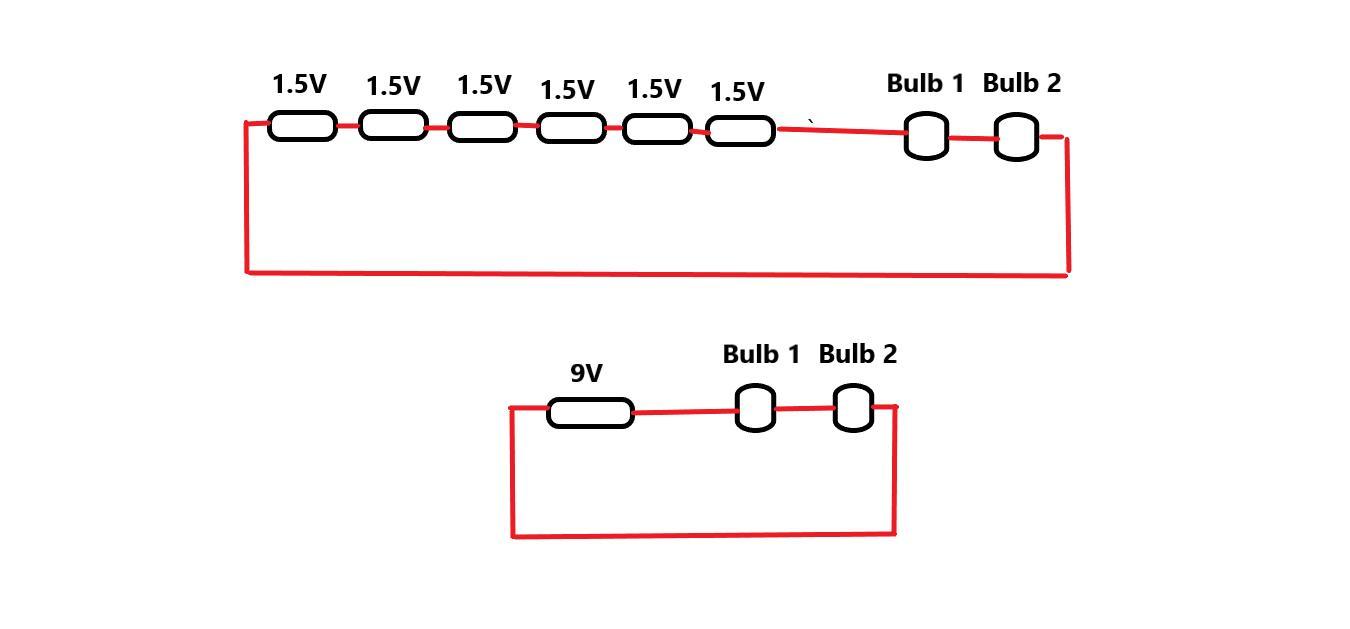
Both series circuits provide a total voltage of 9 volts to the two bulbs connected in series and the voltage will be equally divided among two bulbs and they will have same brightness. Therefore, both circuits will have same characteristics.

Explanation:

We are asked to compare two series circuits having equal number of light bulbs.

1st circuit is powered by 6 batteries each having a voltage of 1.5V

2nd circuit is powered by a single battery having a voltage of 9V.

The six batteries in the 1st circuit can be connected together in series or in parallel.

When the batteries are connected in series (positive terminal of one battery connected to negative terminal of another battery) their voltage gets added which means

Voltage of pack = number of batteries*voltage of each battery

Voltage of pack = 6*1.5

Voltage of pack = 9 volts

But the current remains same in the series connection since there is only path for the current to flow.

On the other hand, when the batteries are connected in parallel, the voltage remains same but the current increases.

Circuit 1:

In this circuit, we have 6 batteries each of 1.5 volts connected in series to provide a voltage of 9 volts.

We have connected 2 bulbs in this series circuit.

The voltage will be equally divided between two bulbs if both bulbs are identical in construction.

So there will be 4.5 volts across each bulb and both bulbs will have same brightness.

Circuit 2:

In this circuit, we have 1 battery which provide a voltage of 9 volts.

We have connected 2 bulbs in this series circuit just like in circuit 1.

The voltage will be equally divided between two bulbs if both bulbs are identical in construction.

So there will be 4.5 volts across each bulb and both bulbs will have same brightness.

Conclusion:

Both series circuits provide a total voltage of 9 volts to the two bulbs connected in series and the voltage will be equally divided among two bulbs and they will have same brightness. Therefore, both circuits will have same characteristics.

You might be interested in
Question 14<br> Which of these is true of a spray wash cabinet?
weqwewe [10]
What are the options to that question. Insufficient question
5 0
2 years ago
Discuss your interpretation of the confidence-precision trade-off, and provide a few examples of how you might make a choice in
LenKa [72]

The given question is incomplete, the complete question is as follows:

Our text describes a trade-off that we must make as engineers between our confidence in the value of a parameter versus the precision with which we know the value of that parameter. That trade-off might be affected by whether we are looking at a two-sided or bounded (one-sided) interval.

Question: Discuss your interpretation of the confidence-precision trade-off, and provide a few examples of how you might make a choice in one direction or the other in an engineering situation.

Answer: A balancing point is required to be reached to obtain a better confidence level in the predicted values.

Explanation:

The confidence interval and precision are the two terms that aims at providing the accurate estimation of the measurability of an object. If the precision increases, we can compromise on the confidence level and if the confidence level increases, then the precision of the predicted value also dilutes.

Thus a balance point is required to be reached between these two variables so that we get better confidence in the values being predicted without losing the correct estimation on precision. Ensuring that both the confidence and precision are maintained.

8 0
2 years ago
Write a program with total change amount as an integer input, and output the change using the fewest coins, one coin type per li
pshichka [43]

Answer:

The C code is given below with appropriate comments

Explanation:

#include<stdio.h>

//defining constants

#define DOLLAR 100

#define QUARTER 25

#define DIME 10

#define NICKEL 5

#define PENNIES 1

//converting method

void ExactChange(int userTotal,int coinVals[])

{

//checking dollars

if (userTotal >=100)

{

coinVals[0]=userTotal/DOLLAR;

userTotal=userTotal-(100*coinVals[0]);

}

//checking quarters

if (userTotal >=25)

{

coinVals[1]=userTotal/QUARTER;

userTotal=userTotal-(25*coinVals[1] );

}

//checking dimes

if (userTotal >=10)

{

coinVals[2]=userTotal/DIME;

userTotal=userTotal-(10*coinVals[2]);

}

//checking nickels

if (userTotal >=5)

{

coinVals[3]=userTotal/NICKEL;

userTotal=userTotal-(5*coinVals[3]);

}

//checking pennies

if (userTotal >=1)

{

coinVals[4]=userTotal/PENNIES;

userTotal=userTotal-coinVals[4];

}

}

//main method

int main() {

//defining the variables

int amount;

//asking for input

printf("Enter the amount in cents :");

//reading the input

scanf("%d",&amount);

//validating the input

if(amount<1)

{

//printing the message

printf("No change..!");

}

//when the input is >0

else

{

int coinVals[5]={0,0,0,0,0};

ExactChange(amount,coinVals);

//checking dollars

if (coinVals[0]>0)

{

//printing dollars

printf("%d Dollar",coinVals[0]);

if(coinVals[0]>1) printf("s");

}

//checking quarters

if (coinVals[1]>0)

{

//printing quarters

printf(" %d Quarter",coinVals[1]);

if(coinVals[1]>1) printf("s");

}

//checking dimes

if (coinVals[2]>0)

{

//printing dimes

printf(" %d Dime",coinVals[2]);

if(coinVals[2]>1) printf("s");

}

//checking nickels

if (coinVals[3]>0)

{

//prinitng nickels

printf(" %d Nickel",coinVals[3]);

if(coinVals[3]>1) printf("s");

}

//checking pennies

if (coinVals[4]>0)

{

//printing pennies

printf(" %d Penn",coinVals[4]);

if(coinVals[4]>1) printf("ies");

else printf("y");

}

}

//end of main method

}

6 0
2 years ago
The rigid bar CDE is attached to a pin support at E and rests on the 30 mm diameter brass cylinder BD. A 22 mm diameter steel ro
Leno4ka [110]

Answer:

stress = 38.84 MPa

Explanation:

S_{D} = \alpha _{brass} * (delta T) *(L_{BD} )\\= (18.8 * 10^(-6) )*(30)*(0.3)\\= 0.0001692 m\\\\E_{BD} = stress / strain\\stress = E_{BD} * S_{D}\\stress = (200 *10^9) * (0.0001692)\\stress = 33.84 MPa

3 0
2 years ago
Which of the following is NOT true about hydraulic valves? A. Directional control valves determine the path of a fluid in a give
Lelechka [254]

Answer: Option D is not true of hydraulic valves. A hydraulic valve is a device that can change the opening degree of liquid flow path

Explanation:

The pilot check valve allows flow of liquid in one direction and blocks flow in the opposite direction

5 0
2 years ago
Other questions:
  • Determine the amount of gamma and alpha phases in a 10-kg, 1060 steel casting as it is being cooled to the following temperature
    6·1 answer
  • 5. A typical paper clip weighs 0.59 g and consists of BCC iron. Calculate (a) the number of
    5·1 answer
  • PDAs with two stacks are strictly more powerful than PDAs with one stack. Prove that 2-stack PDAs are not a valid model for CFLs
    12·1 answer
  • Define a function pyramid_volume with parameters base_length, base_width, and pyramid_height, that returns the volume of a pyram
    10·1 answer
  • A piston-cylinder assembly contains 2 lb of air at a temperature of 540 °R and a pressure of 1 atm. The air compressed to a stat
    5·1 answer
  • Thermal energy generated by the electrical resistance of a 5-mm-diameter and 4-m-long bare cable is dissipated to the surroundin
    12·1 answer
  • Benzene vapor at 480°C is cooled and converted to a liquid at 25°C in a continuous condenser. The condensate is drained into 1.7
    15·1 answer
  • the ____ method is the safest turning technique to use as it does not expose your hands to the airbags deployment area
    15·1 answer
  • According to the EWR specifications, ___ is responsible for picking up and disposing of debris or rubbish from
    15·1 answer
  • Who can work on a fixed ladder that extends more than 24 feet?
    11·1 answer
Add answer
Login
Not registered? Fast signup
Signup
Login Signup
Ask question!