answer.
Ask question
Login Signup
Ask question
All categories
  • English
  • Mathematics
  • Social Studies
  • Business
  • History
  • Health
  • Geography
  • Biology
  • Physics
  • Chemistry
  • Computers and Technology
  • Arts
  • World Languages
  • Spanish
  • French
  • German
  • Advanced Placement (AP)
  • SAT
  • Medicine
  • Law
  • Engineering
kondaur [170]
2 years ago
4

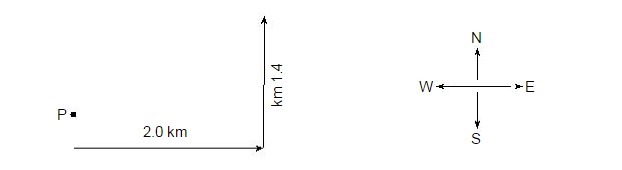
"A hiker starts at point P and walks 2.0 kilometers due east and then 1.4 kilometers due north. The vectors in the diagram below

represent these two displacements.
Determine the magnitude of the hiker’s resultant displacement."

Physics
2 answers:
IrinaVladis [17]2 years ago
5 0

Answer:

2.44 km

Explanation:

The resultant displacement of the hiker is just the hypothenuse of the right triangle whose sides are the displacements of 2.0 km east and 1.4 km north. Therefore, the magnitude of the resultant displacement can be found by using Pythagorean's theorem:

R=\sqrt{(2.0 km)^2+(1.4 km)^2}=2.44 km

svetlana [45]2 years ago
4 0
Here, you need to use your "Protractor" as it is given in the question, but we can calculate the value with the help of our mathematical calculation too:
[ Protractor can be use only in real life, not here ]

Draw an imaginary line from initial position to final position.
Now, In that triangle, tan x = P/B
tan x = 1.4 / 2
tan x = 0.70
x = tan⁻¹ (0.70)
x = 35  [ tan 35 = 0.70 ]

In short, Your Answer would be 35 degrees

Hope this helps!
You might be interested in
A 64.5 kg person steps off a 129 kg rowboat with a force of 34.0 N. What is the force that is applied to the person by the rowbo
Arada [10]
34.0 N which is the force that applied to the person by rowboat.
3 0
2 years ago
Match each projection to its description.
babymother [125]
A goes with 2 and B goes with 1.
6 0
2 years ago
Read 2 more answers
. A lightbulb with a resistance of 2.9 ohms is operated using a 1.5-volt battery. At what rate is
Kobotan [32]

Answer:

Explanation:

Given that,

A light bulb has a resistance of 2.9ohms

R = 2.9 ohms

And a battery of 1.5V is applied

V = 1.5 V

We want to find the rate of energy transformed

First we need to know what rate of energy is

Rate of energy implies that we want to find power. Power is the rate at which work is done

P = Workdone / time

Then,

In electronic, the power dissipated by a resistor is given as

P = V² / R

P = 1.5² / 2.9

P = 0.7759 W

P ≈ 0.776 W

So, the rate at which electrical energy transformed in the lightbulb is 0.776 Watts

8 0
2 years ago
Read 2 more answers
An astronaut weighs 8.00 × 10² newtons on the sur- face of Earth. What is the weight of the astronaut 6.37 × 10⁶ meters above th
kolbaska11 [484]

Answer:

mg=200.4 N.

Explanation:

This problem can be solved using Newton's law of universal gravitation: F=G\frac{m_{1}m_{2}}{r^{2}},

where F is the gravitational force between two masses m_{1} and m_{2}, r is the distance between the masses (their center of mass), and G=6.674*10^{-11}(m^{3}kg^{-1}s^{-2}) is the gravitational constant.

We know the weight of the astronout on the surface, with this we can find his mass. Letting w_{s} be the weight on the surface:

w_{s}=mg,

mg=8*10^{2},

m=(8*10^{2})/g,

since we now that g=9.8m/s^{2} we get that the mass is

m=81.6kg.

Now we can use Newton's law of universal gravitation

F=G\frac{Mm}{r^{2}},  

where m is the mass of the astronaut and M is the mass of the earth. From Newton's second law we know that

F=ma,

in this case the acceleration is the gravity so

F=mg, (<u>becarefull, gravity at this point is no longer</u> 9.8m/s^{2} <u>because we are not in the surface anymore</u>)

and this get us to

mg=G\frac{Mm}{r^{2}}, where mg is his new weight.

We need to remember that the mass of the earth is M=5.972*10^{24}kg and its radius is 6.37*10^{6}m.

The total distance between the astronaut and the earth is

r=(6.37*10^{6}+6.37*10^{6})=2(6.37*10^{6})=12.74*10^{6} meters.

Now we can compute his weigh:

mg=G\frac{Mm}{r^{2}},

mg=(6.674*10^{-11})\frac{(5.972*10^{24})(81.6)}{(12.74*10^{6})^{2}},

mg=200.4 N.

5 0
2 years ago
How many times could Haley fly bewteen the two flowers in 1 minute (60 seconds)​
dmitriy555 [2]
30 seconds is the answer
7 0
2 years ago
Read 2 more answers
Other questions:
  • Water is projected from two rubber pipes at the same speed from one at an angle of 30°and from the other at 60°.why are the rang
    6·1 answer
  • The sensory portion of the pns carries electrical signals ________ the cns; the motor portion carries electrical signals _______
    6·1 answer
  • Light has wavelength 600 nm in a vacuum. it passes into glass, which has an index of refraction of 1.5. what is the frequency of
    5·1 answer
  • A person drives an automobile with a mass of 450 kilograms at a velocity of 26 meters per second. The driver accelerates to a ve
    5·1 answer
  • What is the direction of the current in the loop as the loop rotates clockwise through the magnetic field from as viewed from th
    14·2 answers
  • A car traveling at 91.0 km/h approaches the turn off for a restaurant 30.0 m ahead. If the driver slams on the brakes with the a
    15·1 answer
  • Sharks are generally negatively buoyant; the upward buoyant force is less than the weight force. This is one reason sharks tend
    15·1 answer
  • Short wavelengths, from high-pitched sounds, cause displacement of the basilar membrane near the oval window. true false
    15·2 answers
  • A skateboarder travels on a horizontal surface with an initial velocity of 3.2 m/s toward the south and a constant acceleration
    8·1 answer
  • In some amazing situations, people have survived falling large distances when the surface they land on is soft enough. During a
    15·1 answer
Add answer
Login
Not registered? Fast signup
Signup
Login Signup
Ask question!