answer.
Ask question
Login Signup
Ask question
All categories
  • English
  • Mathematics
  • Social Studies
  • Business
  • History
  • Health
  • Geography
  • Biology
  • Physics
  • Chemistry
  • Computers and Technology
  • Arts
  • World Languages
  • Spanish
  • French
  • German
  • Advanced Placement (AP)
  • SAT
  • Medicine
  • Law
  • Engineering
CaHeK987 [17]
2 years ago
15

Compute the sum with carry-wraparound (sometimes called the one's complement sum) of the following two numbers. Give answer in 8

-bit binary, zero-padded to 8 bits if necessary, with no spaces (e.g. 00101000). Please note this is different than the checksum calculation. NOTE: Canvas will remove any leading zeros from your answer. This will not cause your answer to be marked as incorrect. 10010110 10010000
Engineering
1 answer:
leonid [27]2 years ago
3 0

Answer:

00100111

Explanation:

Given;

10010110

10010000

Add these like normal binary numbers

10010110

10010000

-------------

(1)00100110

-------------

ignore extra (1) on left since it's a carry.

Add 1 to the above result to make it a 1's complement result

00100110 + 1 = 00100111

Answer: 00100111

You might be interested in
A cylindrical drum (2 ft. dia ,3 ft height) is filled with a fluid whose density is 40 lb/ft^3. Determine (a. the total volume o
Ksivusya [100]

Answer:

a)V=9.42\ ft^3

b)Mass in lb = 376.8 lb

Mass in slug = 11.71 slug

c)v=0.025\ ft^3/lb

d)w=1276 \ lb/ft.s^2

Explanation:

Given that

d= 2 ft

r= 1 ft

h= 3 ft

Density

\rho = 40\ lb/ft^3

a)

We know that volume V given as

V=\pi r^2 h

V=\pi \times 1^2\times 3

V=9.42\ ft^3

b)

Mass = Density x volume

mass =40\times 9.42\ lb

mass= 376.8 lb

We know that

1 lb = 0.031 slug

So 376.8 lb= 11.71 slug

Mass in lb = 376.8 lb

Mass in slug = 11.71 slug

c)

we know that specific volume(v) is the inverse of density.

v=\dfrac{1}{\rho}\ ft^3/lb

v=\dfrac{1}{40}\ ft^3/lb

v=0.025\ ft^3/lb

d)

Specific weight(w) is the product of density and the gravity(g).

w= ρ X g

w = 40 x 31.9

w=1276 \ lb/ft.s^2

8 0
2 years ago
A horizontal, cylindrical, tank, with hemispherical ends, is used to store liquid chlorine at 10 bar. The vessel is 4 m internal
sp2606 [1]

Answer: 0.021818m =2.18x10^-²m

Explanation: Using Laplace principle

Design pressure is =12 bar= 1200000N/m²

T = Wall thickness

Design stress=110Mn/m²= 110,000,000N/m²

Radius= diameter/2 =4/2=2m

Design stress=Hoop stress =Pr/t where p=internal pressure or internal pressure, r=radius and t= wall thickness.

As Laplace equation stated.

110,000,000= 1,2000,00 x 2/t

t= 2,400,000/110,000,000.

t= 0.021818m

t=2.18x10^-2m.

3 0
2 years ago
2An oil pump is drawing 44 kW of electric power while pumping oil withrho=860kg/m3at a rate of 0.1m3/s.The inlet and outlet diam
Natasha2012 [34]

Answer:

\eta = 91.7%

Explanation:

Determine the initial velocity

v_1 = \frac{\dot v}{A_1}

    = \frac{0.1}{\pi}{4} 0.08^2

     = 19.89 m/s

final velocity

v_2 =\frac{\dot v}{A_2}

      = \frac{0.1}{\frac{\pi}{4} 0.12^2}

      =8.84 m/s

total mechanical energy is given as

E_{mech} = \dot m (P_2v_2 -P_1v_1) + \dot m \frac{v_2^2 - v_1^2}{2}

\dot v = \dot m v                       ( v =v_1 =v_2)

E_{mech} = \dot mv (P_2 -P_1) + \dot m \frac{v_2^2 - v_1^2}{2}

                = mv\Delta P + \dot m  \frac{v_2^2 -v_1^2}{2}

                 = \dot v \Delta P  + \dot v \rho \frac{v_2^2 -v_1^2}{2}

              = 0.1\times 500 + 0.1\times 860\frac{8.84^2 -19.89^2}{2}\times \frac{1}{1000}

E_{mech} = 36.34 W

Shaft power

W = \eta_[motar} W_{elec}

    =0.9\times 44 =39.6

mechanical efficiency

\eta{pump} =\frac{ E_{mech}}{W}

=\frac{36.34}{39.6} = 0.917  = 91.7%

8 0
2 years ago
The outer surface of an engine is situated in a place where oil leakage can occur. When leaked oil comes in contact with ahot su
VladimirAG [237]

Answer:

TBC thickness of 4 mm is insufficient to prevent fire hazard

Explanation:

Given:

- Temperature of hot-fluid inner surface T_i = 333°C

- The convection coefficient hot-fluid h_i = 7 W/m^2K

- The thermal conductivity of engine cover k_1 = 14 W/mK

- The thickness of engine cover L_1 = 0.01 m

- The thermal conductivity of TBC layer k_2 = 1.1 W/mK  ... (Typing error)

- The thickness of TBC layer L_2 = 0.004 m

- Temperature of ambient air outer surface T_o = 69°C

- The convection coefficient ambient air h_o = 7 W/m^2K

Find:

Would a TBC layer of 4 mm thickness be sufficient to keep the engine cover surface below autoignition temperature of 200°C to prevent fire hazard?

Solution:

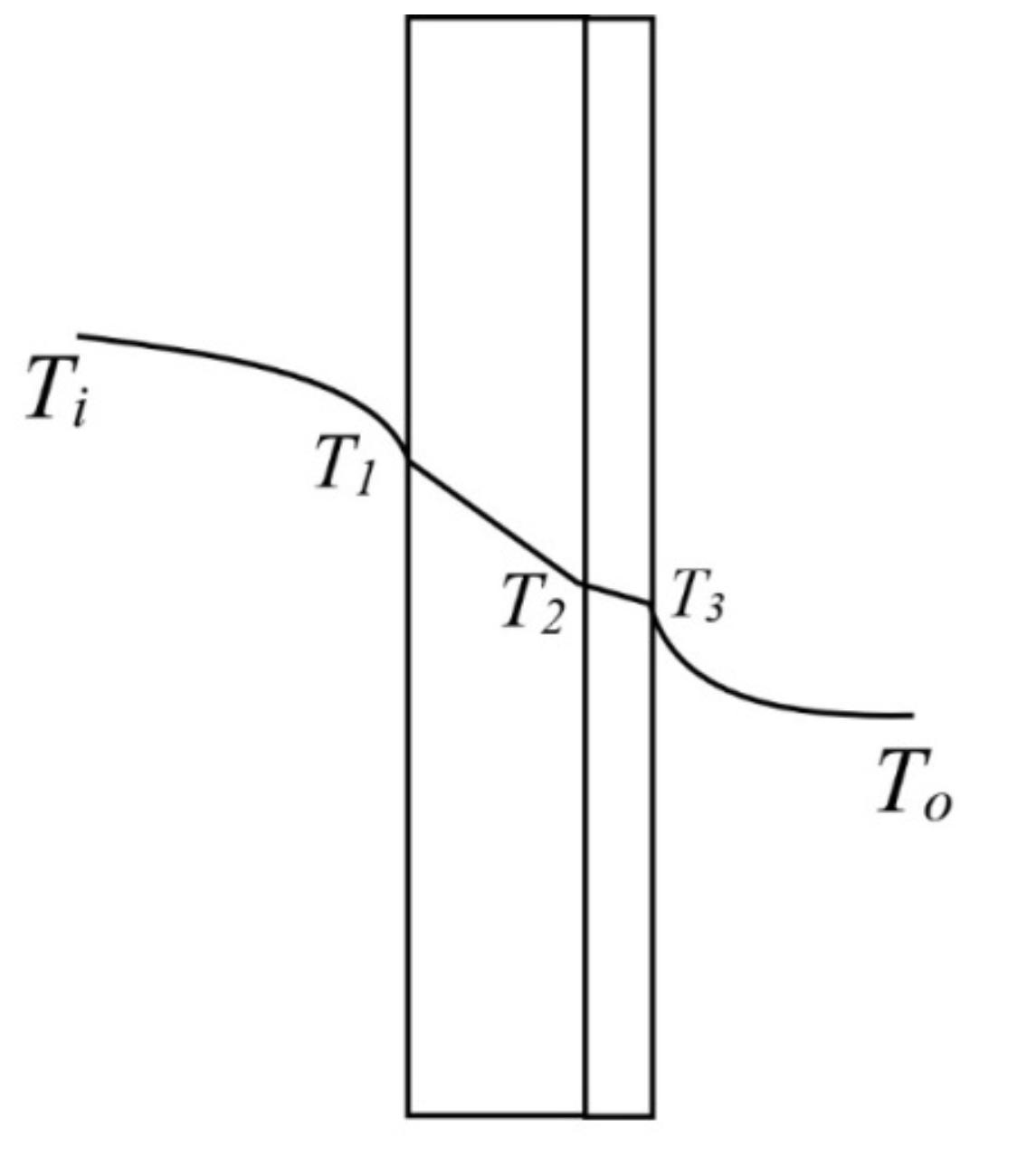
- We will use thermal circuit analogy for the 1-D problem and steady state conduction with no heat generation in the cover or TBC layer.

 The temperature at each medium interface and the Thermal resistance for each medium is given in the attachment schematic and circuit analogy.

 - We will calculate the total heat flux for the entire system q:

                       q = ( T_i - T_o ) / R_total

- R_total is the equivalent thermal resistance of the entire circuit. Since all resistances are in series we have:

                       R_total = 1 / h_i + L_1 / k_1 + L_2 / k_2 + 1 / h_o

- Plug in the values and compute:

                       R_total = 1 / 7 + 0.01 / 14 + 0.004 / 1.1 + 1 / 7

                       R_total = 0.2900649351 T-m^2 / W

- Calculate the Total heat flux q:

                       q = ( 333 - 69 ) / 0.2900649351

                       q = 910.141 W / m^2

- Just like the total current in a circuit remains same, the total heat flux remains same. We will use the total heat flux q to calculate the temperature of outer engine surface T_2 as follows:

                      q = ( T_i - T_2 ) / R_i2

Where,

                      R_i2 = 1 / h_i + L_1 / k_1

                      R_i2 = 1 / 7 + 0.01 / 14 = 0.14357 T-m^2 / W

Hence,

                      ( T_i - T_2 ) = q*R_i2

                        T_2 = T_i - q*R_i2

Plug the values in:

                        T_2 = 333 - 910.141*0.14357

                        T_2 = 202.33°C

- The outer surface of the engine cover has a temperature above T_ignition = 200°C. Hence, the TBC thickness of 4 mm is insufficient to prevent fire hazard


3 0
2 years ago
Preston is checking a voltage of a plug and by mistake instead of touching the black probe to the battery negative , he touches
Yuliya22 [10]
Ok so idk what I’m doing so I imma just say ok
3 0
2 years ago
Other questions:
  • 1. Create a class called Name that represents a person's name. The class should have fields named firstName representing the per
    8·2 answers
  • What can your employer do to protect you from overhead power lines?
    8·1 answer
  • A bankrupt chemical firm has been taken over by new management. On the property they found a 20,000-m3 brine pond containing 25,
    13·1 answer
  • A logic chip used in a computer dissipates 3 W of power in an environment at 120°F, and has a heat transfer surface area of 0.08
    11·1 answer
  • Two physical properties that have a major influence on the cracking of workpieces, tools, or dies during thermal cycling are the
    13·1 answer
  • Consider a normal shock wave in air. The upstream conditions are given by M1=3, p1 = 1 atm, and r1 = 1.23 kg/m3. Calculate the d
    15·1 answer
  • The components of an electronic system dissipating 90 W are located in a 1-m-long circular horizontal duct of 15-cm diameter. Th
    11·1 answer
  • A 2-m3 rigid tank initially contains air at 100 kPa and 22oC. The tank is connected to a supply line through a valve. Air is flo
    9·1 answer
  • A rectangular channel 3.0 m wide has a flow rate of 5.0 m3/s with a normal depth of 0.50 m. The flow then encounters a dam that
    9·1 answer
  • Tech A says that proper footwear may include both leather and steel-toed shoes. Tech B says that when working in the shop, you o
    15·1 answer
Add answer
Login
Not registered? Fast signup
Signup
Login Signup
Ask question!