answer.
Ask question
Login Signup
Ask question
All categories
  • English
  • Mathematics
  • Social Studies
  • Business
  • History
  • Health
  • Geography
  • Biology
  • Physics
  • Chemistry
  • Computers and Technology
  • Arts
  • World Languages
  • Spanish
  • French
  • German
  • Advanced Placement (AP)
  • SAT
  • Medicine
  • Law
  • Engineering
Nesterboy [21]
2 years ago
6

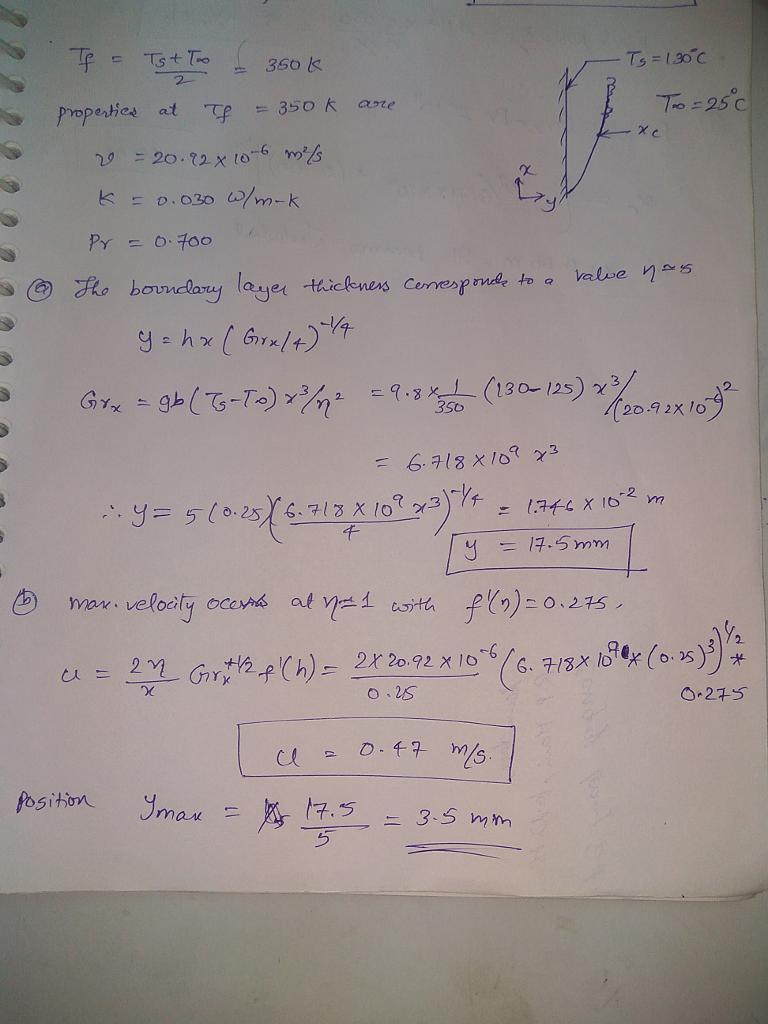
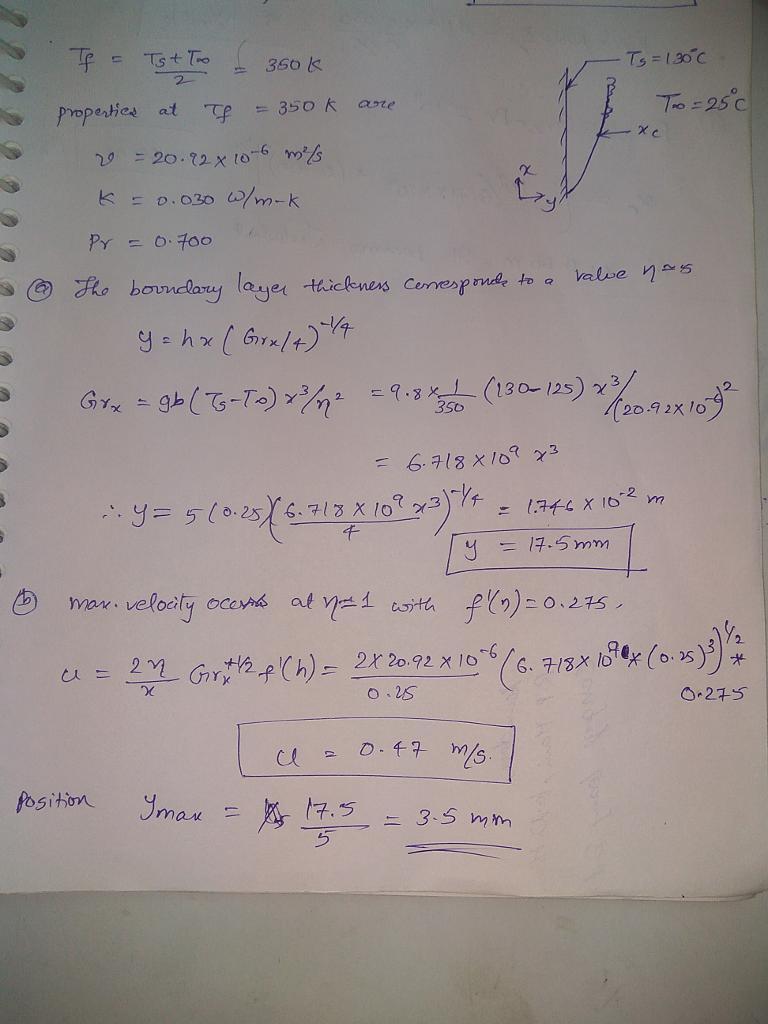
Consider a large vertical plate with a uniform surface temperature of 100°C suspended in quiescent air at 25°C and atmospheric p

ressure. (a) Estimate the boundary layer thickness at a location 0.28 m measured from the lower edge. (b) What is the maximum velocity in the boundary layer at this location and at what position in the boundary layer does the maximum occur? (c) Using the similarity solution result, Equation 9.19, determine the heat transfer coefficient 0.25 m from the lower edge. (d) At what location on the plate measured from the lower edge will the boundary layer become turbulent?

Engineering
1 answer:
Ket [755]2 years ago
4 0

Answer:

Check the explanation

Explanation:

Kindly check the attached images below to see the step by step explanation to the question above.

You might be interested in
1. Which type of sketch most accurately represents what the finished product will look like?
a_sh-v [17]

Answer:

1. The correct answer is B. Ideations Sketch

2. The correct answer is A. How a product actually works  

Explanation:

1. The correct answer is B. Ideations Sketch

Due to the fact that in the process sketch the idea is to show all the steps that need to be followed to achieve or construct the final product, in the persuasive sketch it is intended to know about the possible influence over the audience and make them want the design notion, in the explanatory sketch what is wanted is to communicate about the structure, function and form in a clear way focusing on how it would be possible to use the product or idea design; and finally in the ideations sketch is used to propose solutions to any concer, in this way the concept is to create a prototype of what the final product would be.  

2. The correct answer is A. How a product actually works  

Because the word function comes from the latin function which means “to perform”. This lead us to define function as the capacity to perform an activity that a product or idea has or what it can do for a consumer or customer.

7 0
2 years ago
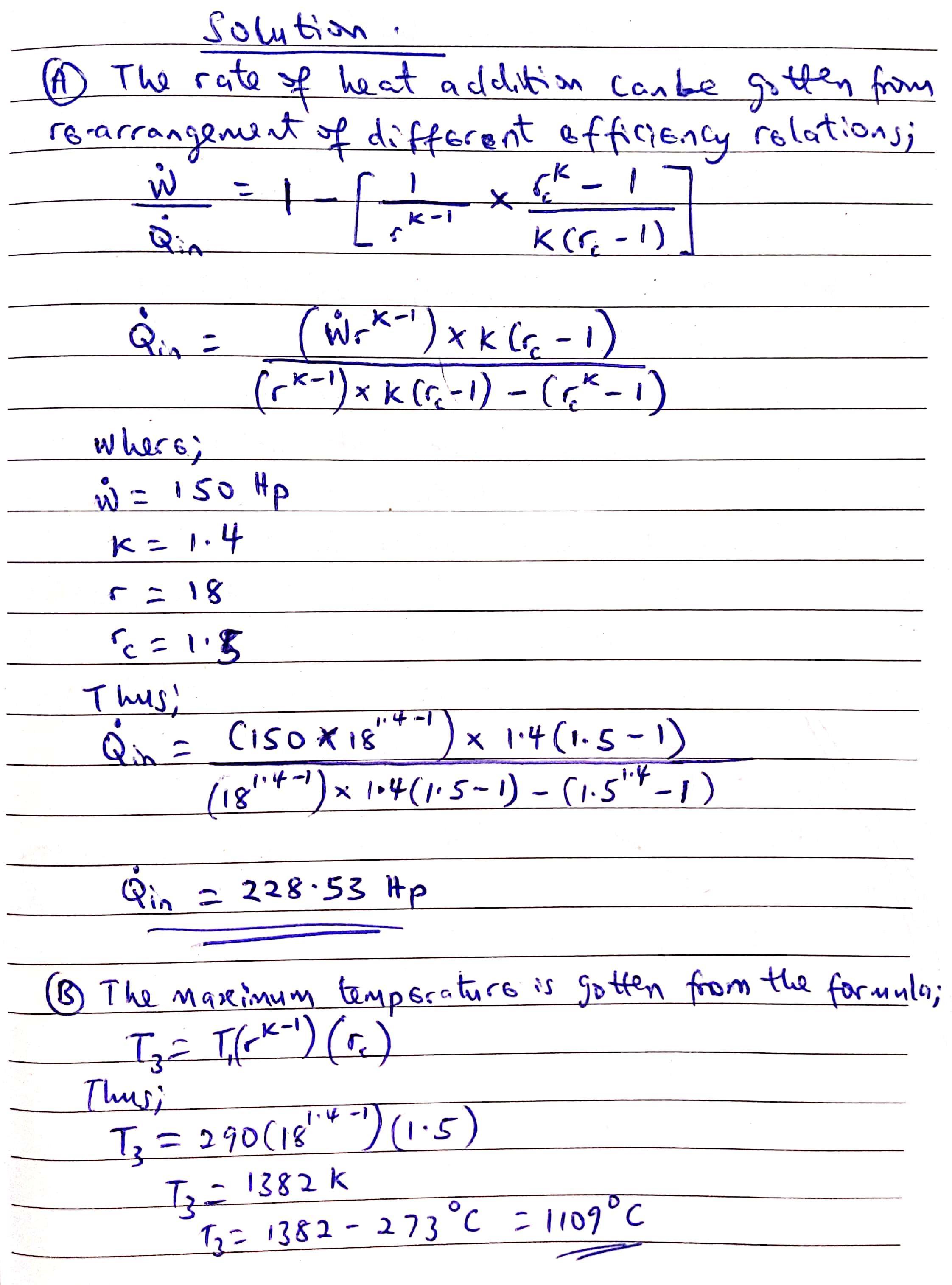
An ideal Diesel cycle has a compression ratio of 18 and a cutoff ratio of 1.5. Determine the maximum air temperature and the rat
defon

Answer:

A) Rate of heat addition = 228.53 Hp

B) Maximum Air temperature = 1109 °C

Explanation:

We are given;

Cut off ratio; r_c = 1.5

Compression ratio; r = 18

Power produced; W` = 150 Hp

cp = 1.005 kJ/kg·K

cv = 0.718 kJ/kg·K

R = 0.287 kJ/kg·K

k = 1.4

Temperature;T1 = 17°C = 17 + 273 K = 290K

I've attached the rest of the explanation below.

8 0
2 years ago
The rigid bar CDE is attached to a pin support at E and rests on the 30 mm diameter brass cylinder BD. A 22 mm diameter steel ro
Leno4ka [110]

Answer:

stress = 38.84 MPa

Explanation:

S_{D} = \alpha _{brass} * (delta T) *(L_{BD} )\\= (18.8 * 10^(-6) )*(30)*(0.3)\\= 0.0001692 m\\\\E_{BD} = stress / strain\\stress = E_{BD} * S_{D}\\stress = (200 *10^9) * (0.0001692)\\stress = 33.84 MPa

3 0
2 years ago
A steady tensile load of 5.00kN is applied to a square bar, 12mm on a side and having a length of 1.65m. compute the stress in t
Shtirlitz [24]

Answer:

The stress in the bar is 34.72 MPa.

The design factor (DF) for each case is:

A) DF=0.17

B) DF=0.09

C) DF=0.125

D) DF=0.12

E) DF=0.039

F) DF=1.26

G) DF=5.5

Explanation:

The design factor is the relation between design stress and failure stress. In the case of ductile materials like metals, the failure stress considered is the yield stress. In the case of plastics or ceramics, the failure stress considered is the breaking stress (ultimate stress). If the design factor is less than 1, the structure or bar will endure the applied stress. By the opposite side, when the DF is higher than 1, the structure will collapse or the bar will break.

we will calculate the design stress in this case:

\displaystyle \sigma_{dis}=\frac{T_l}{Sup}=\frac{5.00KN}{(12\cdot10^{-3}m)^2}=34.72MPa

The design factor for metals is:

DF=\displaystyle \frac{\sigma_{dis}}{\sigma_{f}}=\frac{\sigma_{dis}}{\sigma_{y}}

The design factor for plastic and ceramics is:

DF=\displaystyle \frac{\sigma_{dis}}{\sigma_{f}}=\frac{\sigma_{dis}}{\sigma_{u}}

We now need to know the yield stress or the ultimate stress for each material. We use the AISI and ASTM charts for steels, materials charts for non-ferrous materials and plastics safety charts for the plastic materials.

For these cases:

A) The yield stress of AISI 120 hot-rolled steel (actually is AISI 1020) is 205 MPa, therefore:

DF=\displaystyle\frac{34.72MPa}{205MPa}=0.17

B) The yield stress of AISI 8650 OQT 1000 steel is 385 MPa, therefore:

DF=\displaystyle\frac{34.72MPa}{385MPa}=0.09

C) The yield stress of ductile iron A536-84 (60-40-18) is 40Kpsi, this is 275.8 MPa, therefore:

DF=\displaystyle\frac{34.72MPa}{275.8MPa}=0.125

D) The yield stress of aluminum allot 6061-T6 is 290 MPa, therefore:

DF=\displaystyle\frac{34.72MPa}{290MPa}=0.12

E) The yield stress of titanium alloy Ti-6Al-4V annealed (certified by manufacturers) is 880 MPa, therefore:

DF=\displaystyle\frac{34.72MPa}{880MPa}=0.039

F) The ultimate stress of rigid PVC plastic (certified by PVC Pipe Association) is 4Kpsi or 27.58 MPa, therefore:

DF=\displaystyle\frac{34.72MPa}{27.58 MPa}=1.26

In this case, the bar will break.

F) You have to consider that phenolic plastics are used as matrix in composite materials and seldom are used alone with no reinforcement. In this question is not explained if this material is reinforced or not, therefore I will use the ultimate stress of most pure phenolic plastics, in this case, 6.31 MPa:

DF=\displaystyle\frac{34.72MPa}{6.31 MPa}=5.5

This material will break.

3 0
2 years ago
The ingredient weights for making 1 yd (cyd) of concrete by assuming aggregates in SSD state are given below. The volume of air
Pachacha [2.7K]

Answer:

Explanation:

Ans) Given batch weight of each component :

Cement = 700 lb

Water = 315 lb

Coarse aggregate = 1575 lb

Fine aggregate = 1100 lb

Part 1) Amount of water = 328.5 lb

Amount of water is needed to be increased if the aggregates has absorption capacity, To maintain constant water cement ratio, the mixing water is increased because some of the water is absorbed by aggregates.

Amount of water absorbed = 328.5 lb - 315 lb = 13.5 lb

Total amount of aggregates = 1575 + 1100 = 2675 lb

=> % Absorption capacity = 13.5 x 100 / 2675 = 0.5 %

Hence, new amount of Coarse aggregate = (1 - 0.005) x 1575 lb = 1567.125 lb

New amount of fine aggregate = (1 - 0.005) x 1100 = 1094.5 lb

Since, water cement ratio is maintained constant , amount of cement remains unchanged

=> Volume of water = 328.5 / 62.4 = 5.26 ft3

=> Volume of cement = 700 / (3.15 x 62.4) = 3.56 ft3

=> Volume of coarse aggregate = 1567.125 / (2.4 x 62.4) = 10.46 ft3

=> Volume of fine aggregate = 1100 / (2.4 x 62.4) = 7.34 ft3

Volume of air = 2% = 0.02 x 27 = 0.54 ft3

Total concrete volume = 5.26 + 3.56 + 10.46 + 7.34 + 0.54 \approx 27 ft3 = 1 yd3

Hence, calculated amount of each component is correct

Part 2) We know, minus sign indicated that the aggregate will absorb some moisture from concrete, hence mixing water amount needed to be corrected .

=> Amount of water absorbed by coarse aggregate = 0.01 x 1567.125 lb = 15.67 lb

=> Amount of water absorbed by fine aggregate = 0.02 x 1094.50 lb = 21.89 lb

Total amount of water absorbed = 15.67 + 21.89 = 37.56 lb

To maintain same water cement ratio, amount of mixing water is needed to be increased

=> Corrected amount of mixing water = 328.5 lb + 37.56 lb = 366 lb

=> Corrected amount of coarse aggregate = (1 - 0.01) x 1567.125 = 1551.45 lb

=> Corrected amount of fine aggregate = (1 - 0.02) x 1094.5 = 1072.6 lb

Part 3) We know,

Unit weight = Sum of weight of each material / Total volume

=> Sum of weight = 366 + 700 + 1551.45 + 1072.6 = 3690.05 lb

Total volume = 1 yd3 or 27 ft3

=> Expected Unit Weight = 3690.05 lb / 27 ft3 = 136.67 lb/ft3

Also, Concrete Yield = Weight of all components / Unit weight of concrete

=> Yield = 3690.05 / 136.67 = 27 ft3 or 1 yd3
4 0
2 years ago
Other questions:
  • Oil with a density of 800 kg/m3 is pumped from a pressure of 0.6 bar to a pressure of 1.4 bar, and the outlet is 3 m above the i
    9·1 answer
  • If the electric field just outside a thin conducting sheet is equal to 1.5 N/C, determine the surface charge density on the cond
    9·1 answer
  • Water flows downward through a vertical 10-mm-diameter galvanized iron pipe with an average velocity for 5.0 m/s and exits as a
    5·1 answer
  • An uninsulated, thin-walled pipe of 100-mm diameter is used to transport water to equipment that operates outdoors and uses the
    9·1 answer
  • Define initial set and final set. Briefly discuss one method used to determine them. The following laboratory tests are performe
    12·1 answer
  • Oil enters a counterflow heat exchanger at 600 K with a mass flow rate of 10 kg/s and exits at 200 K. A separate stream of liqui
    12·1 answer
  • An equation used to evaluate vacuum filtration is Q = ΔpA2 α(VRw + ARf) , Where Q ≐ L3/T is the filtrate volume flow rate, Δp ≐
    13·1 answer
  • What is the component called that usually has a dual-voltage selector switch and has cables that connect to the motherboard and
    15·1 answer
  • According to the EWR specifications, ___ is responsible for picking up and disposing of debris or rubbish from
    15·1 answer
  • Which of the following types of protective equipment protects workers who are passing by from stray sparks or metal while anothe
    8·1 answer
Add answer
Login
Not registered? Fast signup
Signup
Login Signup
Ask question!