answer.
Ask question
Login Signup
Ask question
All categories
  • English
  • Mathematics
  • Social Studies
  • Business
  • History
  • Health
  • Geography
  • Biology
  • Physics
  • Chemistry
  • Computers and Technology
  • Arts
  • World Languages
  • Spanish
  • French
  • German
  • Advanced Placement (AP)
  • SAT
  • Medicine
  • Law
  • Engineering
murzikaleks [220]
2 years ago
3

A test is conducted to determine the overall heat transfer coefficient in a shell-and-tube oil-to-water heat exchanger that has

24 tubes of internal diameter 1.2 cm and length 3 m in a single shell. Cold water (cp = 4180 J/kg·K) enters the tubes at 20°C at a rate of 3 kg/s and leaves at 55°C. Oil (cp = 2150 J/kg·K) flows through the shell and is cooled from 120°C to 45°C. Determine the overall heat transfer coefficient Ui of this heat exchanger based on the inner surface area of the tubes.
Engineering
1 answer:
Likurg_2 [28]2 years ago
8 0

Answer:

U = 5.53 kW/m² °C

Explanation:

Given:

N = 24

L = 3m

Di = 1.2 cm = 0.012m

For water:

m = 3 kg/s; Twin = 20°C; Twout= 55°C

Cp = 4180 J/kg·K

For oil:

To_in= 120°C; To_out = 45°C;

For change in temperature

ΔT1 = To_in - Twout

120° - 55° = 65°C

ΔT2 = To_out - Twin

= 45 - 20 = 25°C

For the rate of heat transfer from water to oil:

Q = m*Cp(Twout - Twin)

Q = (3kg/s)*(4180J/kg.k)(55°C -20°C)

Q = 439800 ≈ 439.8 KW

The total surface area, A, of the tube =

A = N*pi*Di*L

A = 24*3.142*0.012*3

A = 2.714m²

Let's find the overall transfer coefficient, U, using the formula :

Q = U * A * F * ΔTlm

Where F= correction factor.

ΔTlm = logarithmic mean temperature

Average temperature difference =

\delta T_lm = \frac{\delta T_1 - \delta T_2}{ln [\frac{\delta T_1}{\delta T_2}]}

\delta T_lm = \frac{65 - 25}{ln [\frac{65}{25}]} = 41.862

P = \frac{Tw_out - Tw_in}{To_in - Tw_in}

P = \frac{55 - 20}{120 - 20} = 0.35

R = \frac{To_in - To_out}{Tw_out - Tw_in}

P = \frac{120 - 45}{55 - 20} = 2.15

Using the correction factor chart, at P and R = 0.35 and 2.15 respectively, F = 0.7

From the equation, let's make U the subject,

U = \frac{Q}{A*F* \delta T_lm}

U = \frac{439.8}{2.714*0.7* 41.862}

U = 5.53 kW/m² °C

You might be interested in
The wall of drying oven is constructed by sandwiching insulation material of thermal conductivity k = 0.05 W/m°K between thin me
masha68 [24]

Answer:

86 mm

Explanation:

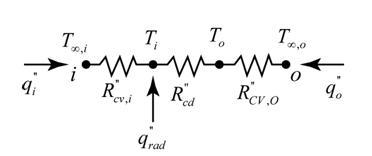
From the attached thermal circuit diagram, equation for i-nodes will be

\frac {T_ \infty, i-T_{i}}{ R^{"}_{cv, i}} + \frac {T_{o}-T_{i}}{ R^{"}_{cd}} + q_{rad} = 0 Equation 1

Similarly, the equation for outer node “o” will be

\frac {T_{ i}-T_{o}}{ R^{"}_{cd}} + \frac {T_{\infty, o} -T_{o}}{ R^{"}_{cv, o}} = 0 Equation 2

The conventive thermal resistance in i-node will be

R^{"}_{cv, i}= \frac {1}{h_{i}}= \frac {1}{30}= 0.033 m^{2}K/w Equation 3

The conventive hermal resistance per unit area is

R^{"}_{cv, o}= \frac {1}{h_{o}}= \frac {1}{10}= 0.100 m^{2}K/w Equation 4

The conductive thermal resistance per unit area is

R^{"}_{cd}= \frac {L}{K}= \frac {L}{0.05} m^{2}K/w Equation 5

Since q_{rad}  is given as 100, T_{o}  is 40 T_ \infty  is 300 T_{\infty, o}  is 25  

Substituting the values in equations 3,4 and 5 into equations 1 and 2 we obtain

\frac {300-T_{i}}{0.033} +\frac {40-T_{i}}{L/0.05} +100=0  Equation 6

\frac {T_{ i}-40}{L/0.05}+ \frac {25-40}{0.100}=0

T_{i}-40= \frac {L}{0.05}*150

T_{i}-40=3000L

T_{i}=3000L+40 Equation 7

From equation 6 we can substitute wherever there’s T_{i} with 3000L+40 as seen in equation 7 hence we obtain

\frac {300- (3000L+40)}{0.033} + \frac {40- (3000L+40)}{L/0.05}+100=0

The above can be simplified to be

\frac {260-3000L}{0.033}+ \frac {(-3000L)}{L/0.05}+100=0

\frac {260-3000L}{0.033}=50

-3000L=1.665-260

L= \frac {-258.33}{-3000}=0.086*10^{-3}m= 86mm

Therefore, insulation thickness is 86mm

8 0
2 years ago
A well-insulated tank in a vapor power plant operates at steady state. Saturated liquid water enters at inlet 1 at a rate of 125
kompoz [17]

Answer:

a. The mass flow rate (in lbm/s) is 135lbm/s

b. The temperature (in o F) is 200.8°F

Explanation:

We assume that potential energy and kinetic energy are negligible and the control volume operates at a steady state.

Given

a. The mass flow rate (in lbm/s) is 135lbm/s

b.

m1 = Rate at inlet 1 = 125lbm/s

m2 = Rate at inlet 2 = 10lbm/s

The mass flow rate (in lbm/s) is calculated as m1 + m2

Mass flow rate = 125lbm/s + 10lbm/s

Mass flow rate = 135lbm/s

Hence, the mass flow rate (in lbm/s) is 135lbm/s

b. To calculate the temperature.

First we need to determine the enthalpy h1 at 14.7psia

Using table A-3E (thermodynamics)

h1 = 180.15 Btu/Ibm

h2 at 14.7psia and 60°F = 28.08 Btu/Ibm

Calculating h3 using the following formula

h3 = (h1m1 + h2m2) / M3

h3 = (180.15 * 125 + 28.08 * 10)/135

h3 = 168.8855555555555

h3 = 168.89 Btu/Ibm

To get the final temperature; we make use of table A-2E of thermodynamics.

Because h3 < h1, it means the liquid is at a compressed state.

The corresponding temperature at h3 = 168.89 is 200.8°F

The temperature (in o F) is 200.8°F

6 0
2 years ago
The total floor area of a building, including below-grade space but excluding unenclosed areas, measured from the exterior of th
alex41 [277]

Answer:

Gross building area

Explanation:

The Gross building area refers to the entire area of a building covering all the floors. The measurement is expressed in square feet. The Gross building area also includes basements, penthouses, and mezzanines. It is calculated by estimating the exterior dimension of the building. Storage rooms, laundries, staircases are also a part of the gross building area.

6 0
2 years ago
Outline an algorithm in **pseudo code** for checking whether an array H[1..n] is a heap and determine its time efficiency.
svlad2 [7]

Answer:

Condition to break: H[j] \geq max {H[2j] , H[2j+1]}

Efficiency: O(n).

Explanation:

Previous concepts

Heap algorithm is used to create all the possible permutations with K possible objects. Was created by B. R Heap in 1963.

Parental dominance condition represent a condition that is satisfied when the parent element is greater than his children.

Solution to the problem

We assume that we have an array H of size n for the algorithm.

It's important on this case analyze the parental dominance condition in order to the algorithm can work and construc a heap.

For this case we can set a counter j =1,2,... [n/2] (We just check until n/2 since in order to create a heap we need to satisfy minimum n/2 possible comparisionsand we need to check this:Break condition: [tex]H[j] \geq max {H[2j] , H[2j+1]}

And we just need to check on the array the last condition and if is not satisfied for any value of the counter j we need to stop the algorithm and the array would not a heap. Otherwise if we satisfy the condition for each j =1,2,.....,[n/2]p then we will have a heap.

On this case this algorithm needs to compare 2*(n/2) times the values and the efficiency is given by O(n).

3 0
2 years ago
what is the advantage of decreasing the field current of a separately excited dc motor below its nominal value
enyata [817]

Answer:

Ability to rotate at higher speeds

Explanation:

Constant K1 becomes greater than the other constant K2

This translates to that the motor being able to rotate at high speeds, without necessarily exceeding the nominal armature voltage.

The armature voltage is the voltage that is developed around the terminals of the armature winding of an Alternating Current, i.e AC or a Direct Current, i.e DC machine during the period in which it tries to generate power.

6 0
2 years ago
Other questions:
  • generally compound curves are not filtered recommended for A. Road B. water way C. underground road D. rail way​
    12·1 answer
  • A rod is 2m long at temperature of 10oC. Find the expansion of the rod, when the temperature is raised to 80oC. If this expansio
    7·1 answer
  • Pipe (2) is supported by a pin at bracket C and by tie rod (1). The structure supports a load P at pin B. Tie rod (1) has a diam
    15·1 answer
  • Two physical properties that have a major influence on the cracking of workpieces, tools, or dies during thermal cycling are the
    13·1 answer
  • A flexural member is fabricated from two flange plates 7-1/2 x ½ and a web plate 17 x 3/8. The yield stress of steel is 50 ksi.
    8·1 answer
  • Refrigerant-134a is compressed from 2 bar, saturated vapor, to 10 bar, 90o C in a compressor operating at steady state. The mass
    11·1 answer
  • An air standard cycle with constant specific heats is executed in a closed pistoncylinder system and is composed of the followin
    10·1 answer
  • A rectangular beam having b=300 mm and d=575 mm, spans 5.5 m face to face of simple supports. It is reinforced for flexure with
    14·1 answer
  • Technician A says that weld-through primer can be removed from the immediate weld area to improve weld quality. Technician B say
    7·1 answer
  • 11 Notează, în caiet, trăsăturile personajelor ce se pot
    13·1 answer
Add answer
Login
Not registered? Fast signup
Signup
Login Signup
Ask question!