answer.
Ask question
Login Signup
Ask question
All categories
  • English
  • Mathematics
  • Social Studies
  • Business
  • History
  • Health
  • Geography
  • Biology
  • Physics
  • Chemistry
  • Computers and Technology
  • Arts
  • World Languages
  • Spanish
  • French
  • German
  • Advanced Placement (AP)
  • SAT
  • Medicine
  • Law
  • Engineering
Ierofanga [76]
2 years ago
3

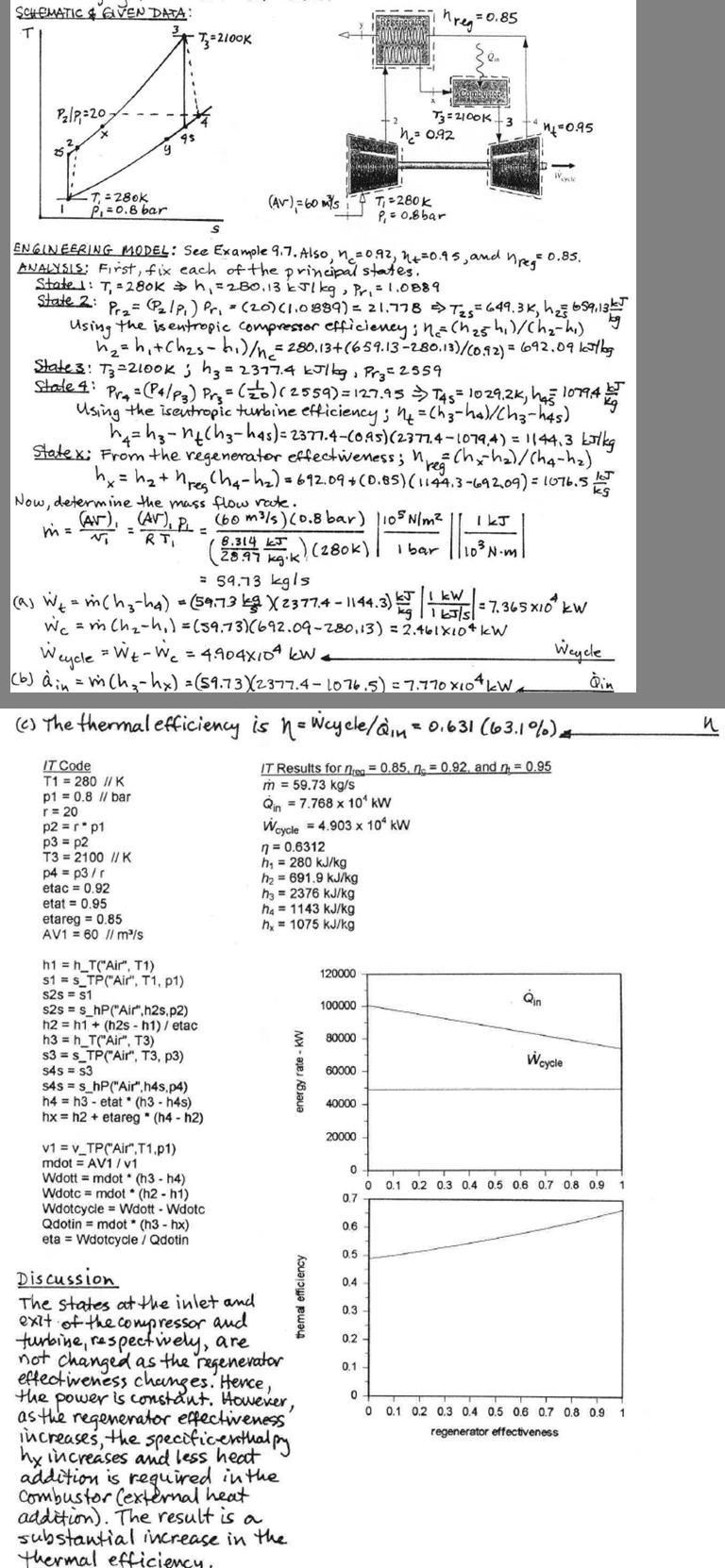
9.63 Air enters the compressor of a regenerative air-standard Brayton cycle with a volumetric flow rate of 60 m3/s at 0.8 bar, 2

80 K. The compressor pressure ratio is 20, and the maximum cycle temperature is 2100 K. For the compressor, the isentropic efficiency is 92% and for the turbine the isentropic efficiency is 95%. For a regenerator effectiveness of 85%, determine (a) the net power developed, in MW. (b) the rate of heat addition in the combustor, in MW. (c) the thermal efficiency of the cycle. (d) Plot the quantities calculated in parts (a) through (c) for regenerator effectiveness values ranging from 0 to 100%. Discuss.

Engineering
1 answer:
nika2105 [10]2 years ago
7 0

Answer:

See explaination

Explanation:

Please kindly check attachment for the step by step solution of the given problem.

You might be interested in
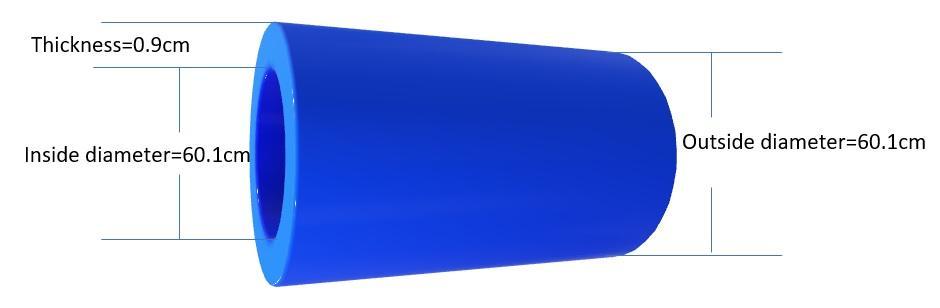
Water is flowing in a metal pipe. The pipe OD (outside diameter) is 61 cm. The pipe length is 120 m. The pipe wall thickness is
Yuki888 [10]

Answer:

1113kN

Explanation:

The ouside diameter OD of the pipe is 61cm and the thickness T is 0.9cm, so the inside diameter ID will be:

Inside Diameter = Outside Diameter - Thickness

Inside Diameter = 61cm - 0.9cm = 60.1cm

Converting this diameter to meters, we have:

60.1cm*\frac{1m}{100cm}=0.601m

This inside diameter is useful to calculate the volume V of water inside the pipe, that is the volume of a cylinder:

V_{water}=\pi  r^{2}h

V_{water}=\pi (\frac{0.601m}{2})^{2}*120m

V_{water}=113.28m^{3}

The problem gives you the water density d as 1.0kg/L, but we need to convert it to proper units, so:

d_{water}=1.0\frac{Kg}{L}*\frac{1L}{1000cm^{3}}*(\frac{100cm}{1m})^{3}

d_{water}=1000\frac{Kg}{m^{3}}

Now, water density is given by the equation d=\frac{m}{V}, where m is the water mass and V is the water volume. Solving the equation for water mass and replacing the values we have:

m_{water}=d_{water}.V_{water}

m_{water}=1000\frac{Kg}{mx^{3}}*113.28m^{3}

m_{water}=113280Kg

With the water mass we can find the weight of water:

w_{water}=m_{water} *g

w_{water}=113280kg*9.8\frac{m}{s^{2}}

w_{water}=1110144N

Finally we find the total weight add up the weight of the water and the weight of the pipe,so:

w_{total}=w_{water}+w_{pipe}

w_{total}=1110144N+2500N

w_{total}=1112644N

Converting this total weight to kN, we have:

1112644N*\frac{0.001kN}{1N}=1113kN

7 0
2 years ago
What is the physical significance of the Reynolds number?. How is defined for external flow over a plate of length L.
yanalaym [24]

Answer:

Re=\dfrac{\rho\ v\ l}{\mu }

Explanation:

Reynolds number:

  Reynolds number describe the type of flow.If Reynolds number is too high then flow is called turbulent flow and Reynolds is  low then flow is called laminar flow .

Reynolds number is a dimensionless number.Reynolds number given is the ratio of inertia force to the viscous force.

Re=\dfrac{F_i}{F_v}

For plate can be given as

Re=\dfrac{\rho\ v\ l}{\mu }

Where  ρ is the density of fluid , v is the average velocity of fluid and μ is the dynamic viscosity of fluid.

Flow on plate is a external flow .The values of Reynolds number for different flow given as

Reynolds\ number\is \ >\ 5 \times 10 ^5\ then\ flow\ will\ be\ turbulent.

Reynolds\ number\is \

7 0
2 years ago
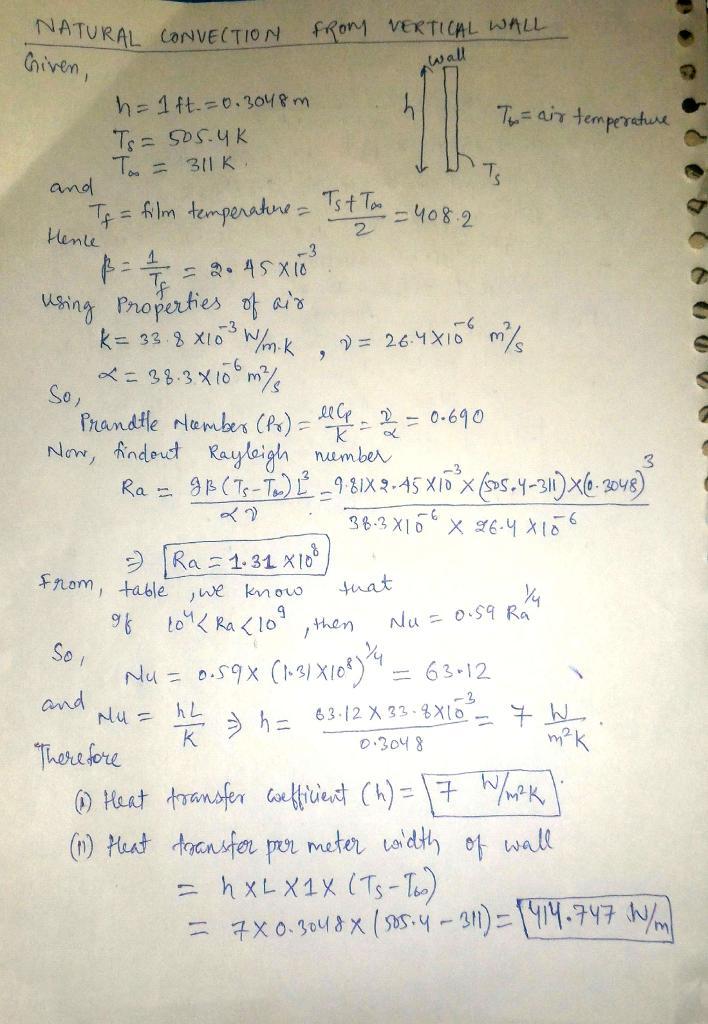
Natural Convection from an Oven Wall. The oven wall in Example 4.7-1 is insulated so that the surface temperature is 366.5 K ins
lukranit [14]

Answer:

i) Heat transfer coefficient (h) = 7 w/m²k

ii) Heat transfer per meter width of wall

      = h x L x 1 x (Ts - T₆₀)

        = 7 x 0.3048 x (505.4 - 322) = 414.747 w/m

Explanation:

see attached image

8 0
2 years ago
Peter the postman became bored one night and, to break the monotony of the night shift, he carried out the following experiment
aleksandrvk [35]

Answer:

//This Program is written in C++

// Comments are used for explanatory purpose

#include <iostream>

using namespace std;

enum mailbox{open, close};

int box[149];

void closeAllBoxes();

void OpenClose();

void printAll();

int main()

{

closeAllBoxes();

OpenClose();

printAll();

return 0;

}

void closeAllBoxes()

{

for (int i = 0; i < 150; i++) //Iterate through from 0 to 149 which literarily means 1 to 150

{

box[i] = close; //Close all boxes

}

}

void OpenClose()

{

for(int i = 2; i < 150; i++) {

for(int j = i; j < 150; j += i) {

if (box[j] == close) //Open box if box is closed

box[j] = open;

else

box[j] = close; // Close box if box is opened

}

}

// At the end of this test, all boxes would be closed

}

void printAll()

{

for (int x = 0; x < 150; x++) //use this to test

{

if (box[x] = 1)

{

cout << "Mailbox #" << x+1 << " is closed" << endl;

// Print all close boxes

}

}

}

Explanation:

7 0
2 years ago
A heat pump operates on a Carnot heat pump cycle with a COP of 12.5. It keeps a space at 24°C by consuming 2.15 kW of power. Det
Vinil7 [7]

Answer:

a) T_{L} = 273.378\,K\,(0.228\,^{\textdegree}C), b) \dot Q_{H} = 26.875\,kW

Explanation:

a) The Coefficient of Performance of the Carnot Heat Pump is:

COP_{HP} = \frac{T_{H}}{T_{H}-T_{L}}

After some algebraic handling, the temperature of the cold reservoir is determined:

T_{H}-T_{L} = \frac{T_{H}}{COP_{HP}}

T_{L} = T_{H}\cdot \left(1-\frac{1}{COP_{HP}}  \right)

T_{L} = (297.15\,K)\cdot \left(1-\frac{1}{12.5}\right)

T_{L} = 273.378\,K\,(0.228\,^{\textdegree}C)

b) The heating load provided by the heat pump is:

\dot Q_{H} = COP_{HP}\cdot \dot W

\dot Q_{H} = (12.5)\cdot (2.15\,kW)

\dot Q_{H} = 26.875\,kW

4 0
2 years ago
Other questions:
  • What properties should the head of a carpenter’s hammer possess? How would you manufacture a hammer head?
    6·1 answer
  • Use Lagrange multiplier techniques to find the local extreme values of the given function subject to the stated constraint. If a
    15·1 answer
  • 2. A ¼ in. diameter rod must be machined on a lathe to a smaller diameter for use as a specimen in a tension test. The rod mater
    9·1 answer
  • Can crushers help us recycle in a space efficient way which is good for saving the earth and for giving you more room in your ap
    7·1 answer
  • With thermodynamics, one cannot determine ________.
    14·1 answer
  • or a metal pipe used to pump tomato paste, the overall heat- transfer coefficient based on internal area is 2 W/(m2 K). The insi
    14·1 answer
  • Which of the following describes boundaries?
    10·1 answer
  • Solid spherical particles having a diameter of 0.090 mm and a density of 2002 kg/m3 are settling in a solution of water at 26.7C
    8·1 answer
  • If you have power steering and you are able to __________, you should have your vehicle checked out by a qualified technician.
    7·1 answer
  • 1. A _____ is applied to a wall or roof rafters to add strength and keep the building straight and plumb.
    9·1 answer
Add answer
Login
Not registered? Fast signup
Signup
Login Signup
Ask question!