answer.
Ask question
Login Signup
Ask question
All categories
  • English
  • Mathematics
  • Social Studies
  • Business
  • History
  • Health
  • Geography
  • Biology
  • Physics
  • Chemistry
  • Computers and Technology
  • Arts
  • World Languages
  • Spanish
  • French
  • German
  • Advanced Placement (AP)
  • SAT
  • Medicine
  • Law
  • Engineering
ValentinkaMS [17]
2 years ago
8

Natural Convection from an Oven Wall. The oven wall in Example 4.7-1 is insulated so that the surface temperature is 366.5 K ins

tead of 505.4 K. Calculate the natural convection heat-transfer coefficient and the heat-transfer rate per m of width. Use both Eq. (4.7-4) and the simplified equation. (Note: Radiation is being neglected in this calculation.) Use both SI and English units.

Engineering
1 answer:
lukranit [14]2 years ago
8 0

Answer:

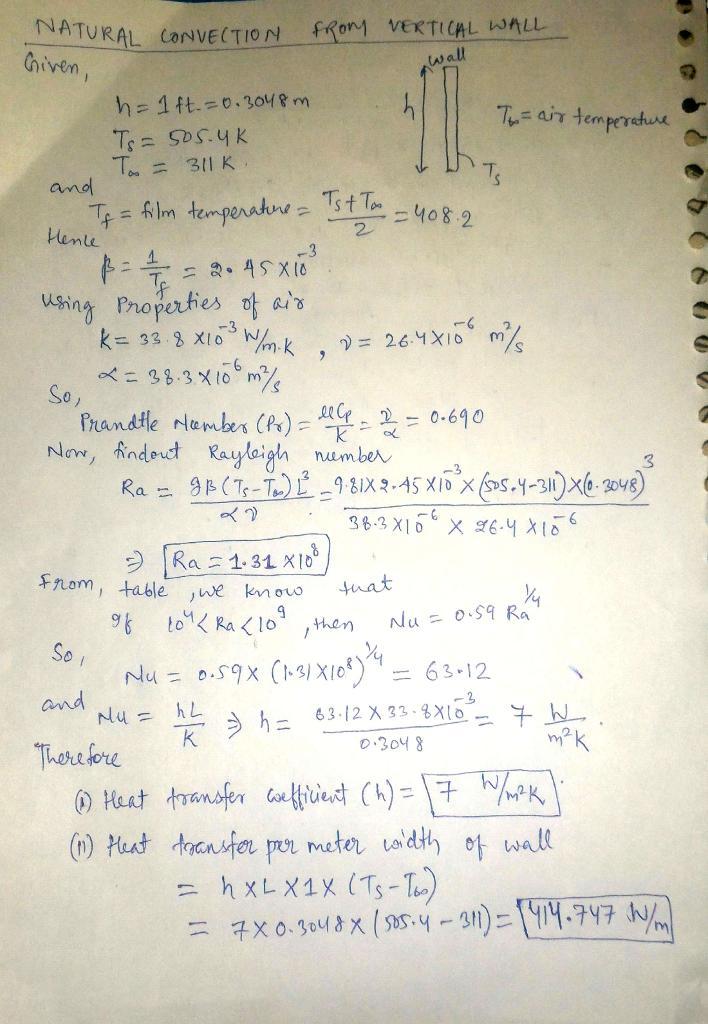
i) Heat transfer coefficient (h) = 7 w/m²k

ii) Heat transfer per meter width of wall

      = h x L x 1 x (Ts - T₆₀)

        = 7 x 0.3048 x (505.4 - 322) = 414.747 w/m

Explanation:

see attached image

You might be interested in
Determine F12 and F21 for the following configurations: (a) A long semicircular duct with diameter of 0.1 meters: (b) A hemisphe
uysha [10]

Answer:

long duct: 1.0 and 0.424

Hemisphere 1.0 ; 0.125; 0.5

Explanation:

For a long duct:

By inspection, F_{12} = 1.0

Calculating by reciprocity, F_{21} = \frac{A_{1} }{A_{2}F_{12}  }  = \frac{2RL}{\frac{3}{4}*2\pi RL  }* 1.0\\                                                         = 0.424

Hemisphere:

By reciprocity gives = 0.125

using the summation rule: F_{21} + F_{22} + F_{23} = 1

However, because this is a hemisphere, the value will be= 0.5 * 1

                                                                                               = 0.5

6 0
2 years ago
A curve in a speed track has a radius of 1000 ft and a rated speed of 120 mi/h. (From Sample Prob. 12.7 is the definition of rat
forsale [732]

Answer:

tan \theta = \frac{(176ft/s)^2}{1000 ft 32.2 ft/s^2}= 0.962

\theta = tan^{-1} (0.962) = 43.89

Explanation:

If the question is: Determine the banking angle θ

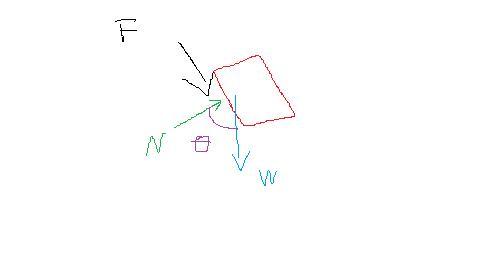
We have the forces involved on the figure attached.

For this case we know that the weight is given by:

W = mg

And for this case the centripetal acceleration would be given by:

a=\frac{v^2}{r}

If we analyze the sum of forces on x and y we have:

\sum F_x = m a_x

F + W sin \theta = ma cos theta

And if we solve for the force we got:

F = ma cos \theta - mg sin \theta = \frac{mv^2}{r} cos \theta - mg sin \theta

\sum F_y = m a_y

N - W cos \theta = ma sin \theta

If we solve for the normal force we got:

N =W cos \theta + ma sin \theta = \frac{mv^2}{r} sin \theta + mg cos \theta

In order to find the banking angle we use the fact that F =0

0 = \frac{mv^2}{r} cos \theta - mg sin \theta

tan \theta= \frac{v^2}{rg}

The velocity on this case is 120 mi/h if we convert this into ft/ s we got:

120 mi/h * \frac{5280 ft}{1mi} *\frac{1hr}{3600 s}= 176 ft/s

And then we have this:

tan \theta = \frac{(176ft/s)^2}{1000 ft 32.2 ft/s^2}= 0.962

\theta = tan^{-1} (0.962) = 43.89

5 0
2 years ago
Two metallic terminals protrude from a device. The terminal on the left is the positive reference for a voltage called vx (the o
tresset_1 [31]

Answer:

Vx = 6.242 x 10raised to power 15

Vy = -6.242 x 10raised to power 15

Explanation:

from E = IVt

but V = IR from ohm's law and Q = It from faraday's first law

I = Q/t

E = Q/t x V x t = QV

hence, E =QV

V = E/Q

3 0
2 years ago
Read 2 more answers
The pump of a water distribution system is powered by a 6-kW electric motor whose efficiency is 95 percent. The water flow rate
Sonja [21]

Answer:

a) Mechanical efficiency (\varepsilon)=63.15%  b) Temperature rise= 0.028ºC

Explanation:

For the item a) you have to define the mechanical power introduced (Wmec) to the system and the power transferred to the water (Pw).

The power input (electric motor) is equal to the motor power multiplied by the efficiency. Thus, Wmec=0.95*6kW=5.7 kW.

Then, the power transferred (Pw) to the fluid is equal to the flow rate (Q) multiplied by the pressure jump \Delta P. So P_W = Q*\Delta P=0.018m^3/s * 200x10^3 Pa=3600W.

The efficiency is defined as the ratio between the output energy and the input energy. Then, the mechanical efficiency is \varepsilon=3.6kW/5.7kW=0.6315=63.15\%

For the b) item you have to consider that the inefficiency goes to the fluid as heat. So it is necessary to use the equation of the heat capacity but in a "flux" way. Calling <em>H</em> to the heat transfered to the fluid, the specif heat of the water and \rho the density of the water:

[tex]H=(5.7-3.6) kW=\rho*Q*c*\Delta T=1000kg/m^3*0.018m^3/s*4186J/(kg \ºC)*\Delta T[/tex]

Finally, the temperature rise is:

\Delta T=2100/75348 \ºC=0.028 \ºC

7 0
2 years ago
Water is flowing in a metal pipe. The pipe OD (outside diameter) is 61 cm. The pipe length is 120 m. The pipe wall thickness is
Yuki888 [10]

Answer:

1113kN

Explanation:

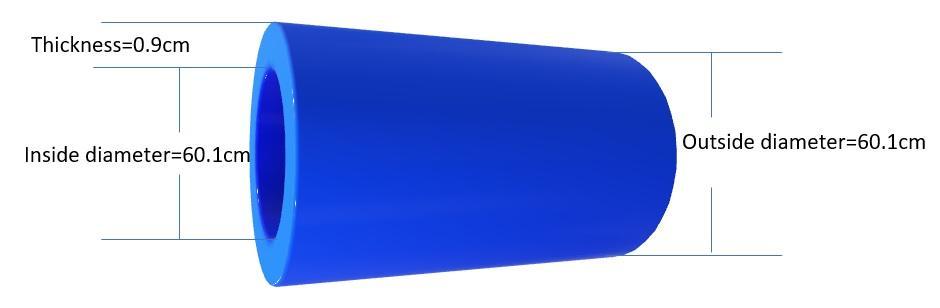
The ouside diameter OD of the pipe is 61cm and the thickness T is 0.9cm, so the inside diameter ID will be:

Inside Diameter = Outside Diameter - Thickness

Inside Diameter = 61cm - 0.9cm = 60.1cm

Converting this diameter to meters, we have:

60.1cm*\frac{1m}{100cm}=0.601m

This inside diameter is useful to calculate the volume V of water inside the pipe, that is the volume of a cylinder:

V_{water}=\pi  r^{2}h

V_{water}=\pi (\frac{0.601m}{2})^{2}*120m

V_{water}=113.28m^{3}

The problem gives you the water density d as 1.0kg/L, but we need to convert it to proper units, so:

d_{water}=1.0\frac{Kg}{L}*\frac{1L}{1000cm^{3}}*(\frac{100cm}{1m})^{3}

d_{water}=1000\frac{Kg}{m^{3}}

Now, water density is given by the equation d=\frac{m}{V}, where m is the water mass and V is the water volume. Solving the equation for water mass and replacing the values we have:

m_{water}=d_{water}.V_{water}

m_{water}=1000\frac{Kg}{mx^{3}}*113.28m^{3}

m_{water}=113280Kg

With the water mass we can find the weight of water:

w_{water}=m_{water} *g

w_{water}=113280kg*9.8\frac{m}{s^{2}}

w_{water}=1110144N

Finally we find the total weight add up the weight of the water and the weight of the pipe,so:

w_{total}=w_{water}+w_{pipe}

w_{total}=1110144N+2500N

w_{total}=1112644N

Converting this total weight to kN, we have:

1112644N*\frac{0.001kN}{1N}=1113kN

7 0
2 years ago
Other questions:
  • The uniform 8–ft board is pushed down into the water so it makes an angle of θ = 30o with the water surface. If the cross sectio
    14·1 answer
  • 4.9 Given that I 4 amps when Vs 40 volts and Is 4 amps and I 1 amp when Vs 20 volts and Is 0, use superposition and linearity to
    5·1 answer
  • The small 5-oz slider A moves without appreciable friction in the hollow tube, which rotates in a horizontal plane with a consta
    7·1 answer
  • 1. Saturated steam at 4 bars absolute pressure with a mean velocity of 3 m/s flows through a horizontal SS304 stainless-steel pi
    6·1 answer
  • Steam at 40 bar and 500o C enters the first-stage turbine with a volumetric flow rate of 90 m3 /min. Steam exits the turbine at
    9·1 answer
  • The mass fractions of a mixture of gases are 15 percent nitrogen, 5 percent helium, 60 percent methane, and 20 percent ethane. T
    9·1 answer
  • John was a high school teacher earning $ 80,000 per year. He quit his job to start his own business in pizza catering. In order
    11·1 answer
  • 10. A maker of micromechanical systems can reduce product recalls by 10% with the installation of new packaging equipment. If th
    9·1 answer
  • According to the EWR specifications, ___ is responsible for picking up and disposing of debris or rubbish from
    15·1 answer
  • Air ows steadily in a thermally insulated pipe with a constant diameter of 6.35 cm, and an average friction factor of 0.005. At
    5·1 answer
Add answer
Login
Not registered? Fast signup
Signup
Login Signup
Ask question!