answer.
Ask question
Login Signup
Ask question
All categories
  • English
  • Mathematics
  • Social Studies
  • Business
  • History
  • Health
  • Geography
  • Biology
  • Physics
  • Chemistry
  • Computers and Technology
  • Arts
  • World Languages
  • Spanish
  • French
  • German
  • Advanced Placement (AP)
  • SAT
  • Medicine
  • Law
  • Engineering
Gala2k [10]
2 years ago
3

After spraying water on a waxed surface, a student notices that the water beads up to form many individual drops rather than bei

ng spread out evenly across the surface. What property of water causes it to bead up like this?
A.The high boiling point of water
B.The strong adhesion to other substances
C. The high density of liquid water
D.The ability to dissolve many other substances
E. The strong cohesion between water molecules
Chemistry
2 answers:
zimovet [89]2 years ago
8 0

Answer:

B. The strong adhesion to other substances

Explanation:

hope this helps!

egoroff_w [7]2 years ago
3 0

Answer:

E. The strong cohesion between water molecules

Explanation:

Water is a very special molecule because of its hydrogen bonds. And, because of these hydrogen bonds, water has many properties that make it unique compared to other substances.

One such property is that it is cohesive, which means water molecules are attracted to each other. This is due to the polar bonds and hydrogen bonds that water molecules have. Because of the polar and hydrogen bonds, the molecules attract each other and stick together, creating that bead-like phenomenon that the student sees on the table.

Thus, the answer is E.

You might be interested in
3. According to the label on a bottle of concentrated hydrochloric acid, the contents are 36.0% HCl by mass and have a density o
velikii [3]

Answer:

a) 11.64 M

b) 43 mL

c) 1.7 kg

Explanation:

a) Let's use a basis of the calculus of 1000 mL (1 L) of the concentrated solution. If the solution has 1.18 g/mL, it has:

1.18*1000 = 1180 g.

The mass of HCl will be then:

mHCl = 1180*0.36 = 424.8 g

The molar mass of HCl is 36.5 g/mol, so the number of moles is the mass divided by the molar mass:

nHCl = 424.8/36.5 = 11.64 mol

The molarity is the number of moles divided by the volume in L:

Molarity = 11.64 M

b) To prepare a solution by dilution of a concentrated one, we can use the equation:

C1V1 = C2V2

Where C is the concentration, V is the volume, 1 is the concentrated solution, and 2 the final solution. So:

11.64*V1 = 2.00*0.250

V1 = 0.0429 L ≅ 43 mL

c) The neutralization will happen by the equation:

HCl + NaHCO₃ → NaCl + CO₂ + H₂O

So, 1 mol of NaHCO₃ is needed to react with 1 mol of HCl. At 1.75 L, the number of moles of the acid is:

nHCl = 1.75*11.64 = 20.37 mol

The molar mass of NaHCO₃ is 84 g/mol so the mass needed is the molar mass multiplied by the number of moles:

m = 84*20.37 = 1,711.08 g

m = 1.7 kg

6 0
2 years ago
The normal boiling point of acetic acid is 118.1°C. If a sample of the acetic acid is at 125.2°C, predict the signs of ΔH, ΔS, a
Nostrana [21]

The question is incomplete, the complete question is;

The normal boiling point of acetic acid is 118.1°C. If a sample of the acetic acid is at 125.2°C, predict the signs of ∆H, ∆S, and ∆G for the boiling process at this temperature.

A. ∆H > 0, ∆S > 0, ∆G < 0

B. ∆H > 0, ∆S > 0, ∆G > 0

C. ∆H > 0, ∆S < 0, ∆G < 0

D. ∆H < 0, ∆S > 0, ∆G > 0

E. ∆H < 0, ∆S < 0, ∆G > 0

Answer:

A. ∆H > 0, ∆S > 0, ∆G < 0

Explanation:

During boiling, a liquid is converted to vapour. This is a phase change for which heat is absorbed because energy must be taken in to break the intermolecular bonds in the liquid before it can be converted to a gas. Hence ∆H>0

Secondly, a phase change from liquid to gas leads to an increase in entropy hence ∆S>0.

Thirdly, the process is spontaneous. For every spontaneous process ∆G<0

3 0
2 years ago
Why are salt and sugar both able to dissolve in water, even though the solutes have different types of chemical bonding?
Serjik [45]

Answer:Water is polar molecule, ionic compound dissolves in it as like dissolves like.

there is ionic interaction between a salt and water

Sugar has hydroxyl group in it. These hydroxyl group are able to form hydrogen bond with water molecule.

[Hydrogen bond : the interaction between a hydrogen, bonded with a highly electro-negative element (F,O,N) and other highly electro-negative element (F,O,N)]

Thus due to hydrogen bond sugar is soluble in water.

Explanation:The water molecules, , are polar, with positive partial charges on the hydrogen and a negative partial charge on the oxygen. This makes it possible to interact with ionic compounds such as salt (NaCl). This interaction occurs through the partially positive and negative ends of the water, so that the positive charges attract the negative ones. The NaCl salt in water dissociates (separates) into  and  ions. ions are surrounded by negative partial charges of water oxygen, while  ions are surrounded by hydrogen ends with positive partial charge. In this way the salt is dissolved in water.

Sugar is a molecular compound formed by covalent bonds. In a polar covalent bond, electrons are shared unevenly. This creates a slightly negatively charged end and a slightly positively charged end. This is what happens with sugar. These extremes are those that interact with the positive and negative extremes of water, mentioned previously. Then it is possible to say that sugar dissolves in water because both substances are polar substances.

In short, water dissolves most of the substances that are polar or ionic, as in the case of sugar and salt.

6 0
2 years ago
Read 2 more answers
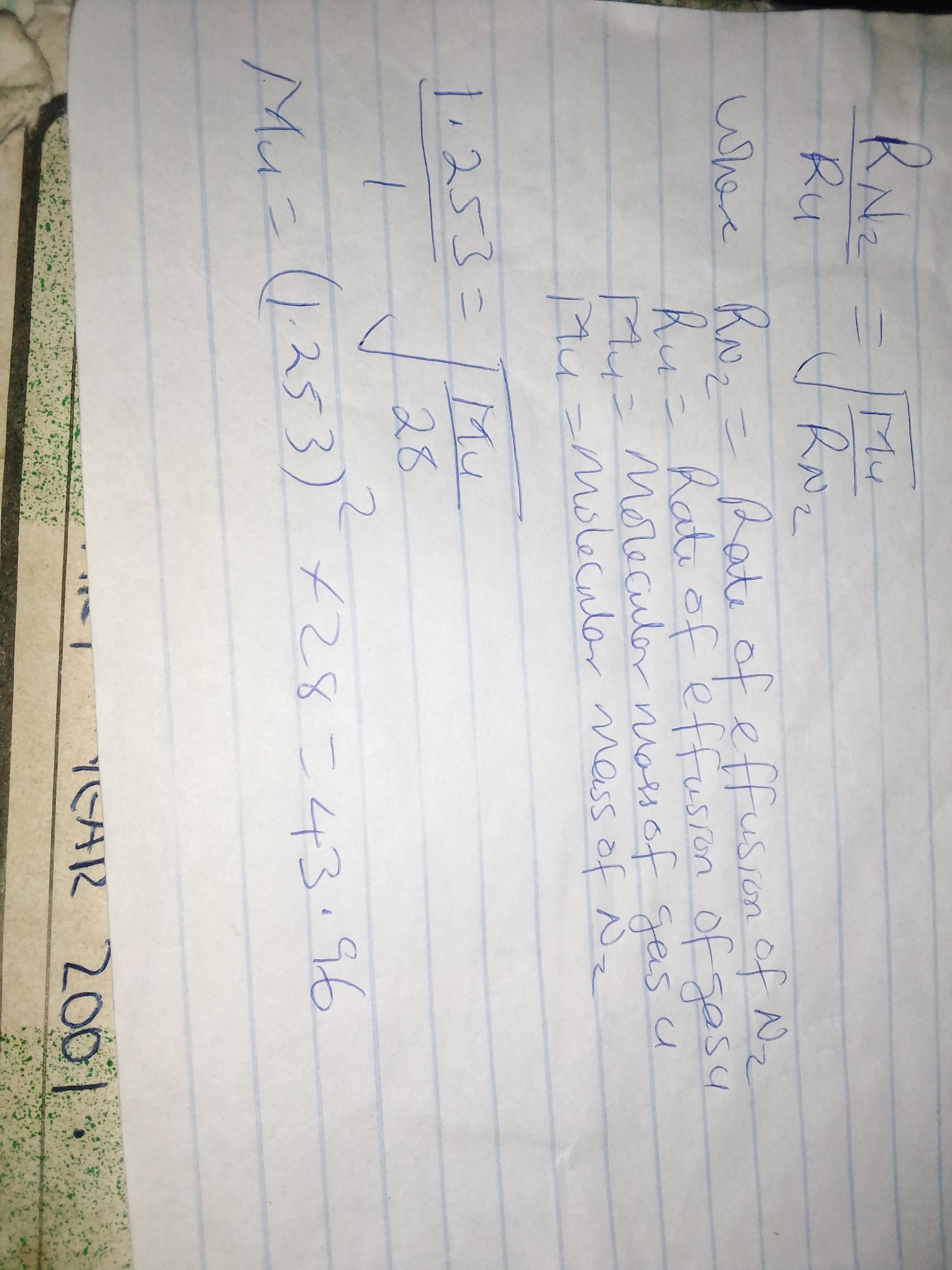
The rate of effusion of nitrogen gas (N2) is 1.253 times faster than that of an unknown gas. What is the molecular weight of the
ollegr [7]

Answer:

43.96

Explanation:

Graham's law was applied and the rates of effusion of nitrogen and the unknown gas were compared as shown in the image. The unknown gas is heavier than hydrigen hence it effuses slower than hydrogen as anticipated by Graham's law.

5 0
2 years ago
Baking soda is a critical component of chemical
Lostsunrise [7]
Baking soda is a critical component of chemical spill kits because baking soda has neutralizing agents. Baking soda is a sodium bicarbonate, a natural substance that maintains the ph balance. Baking soda neutralizes org acids and bases. It eliminates odors instead of covering them up.
8 0
2 years ago
Other questions:
  • Tanks of compressed gas must be kept away from heat sources. If a compressed–gas tank is heated too much, it may explode and cau
    7·2 answers
  • Magnesium oxide decomposes into magnesium and oxygen. if 12.09 g of magnesium oxide decomposes to form 7.29 g of magnesium, what
    14·1 answer
  • How many moles of libr are contained in 347 g of water in a 0.175 m libr solution?
    7·1 answer
  • If 3.45 grams of Mg are burned how many grams of MgO are produced
    15·2 answers
  • Identify all actions that you should take if you have chipped or broken glassware. Notify your teacher. Have the custodian clean
    8·2 answers
  • A car moves at a speed of 50 kilometers/hour. Its kinetic energy is 400 joules. If the same car moves at a speed of 100 kilomete
    10·1 answer
  • Problem Page A chemist measures the amount of bromine liquid produced during an experiment. He finds that of bromine liquid is p
    12·1 answer
  • Players 1, 2, 3 are playing a tournament. Two of these three players are randomly chosen to play a game in round one, with the w
    6·1 answer
  • What are the empirical formulas of a) ethylene glycol, a radiator antifreeze, molecular formula C2H6O2 b) peroxodisulfuric acid,
    12·1 answer
  • Two students are working together to build two models. Both models will represent the molecular structure of sodium bicarbonate,
    10·1 answer
Add answer
Login
Not registered? Fast signup
Signup
Login Signup
Ask question!