answer.
Ask question
Login Signup
Ask question
All categories
  • English
  • Mathematics
  • Social Studies
  • Business
  • History
  • Health
  • Geography
  • Biology
  • Physics
  • Chemistry
  • Computers and Technology
  • Arts
  • World Languages
  • Spanish
  • French
  • German
  • Advanced Placement (AP)
  • SAT
  • Medicine
  • Law
  • Engineering
My name is Ann [436]
2 years ago
11

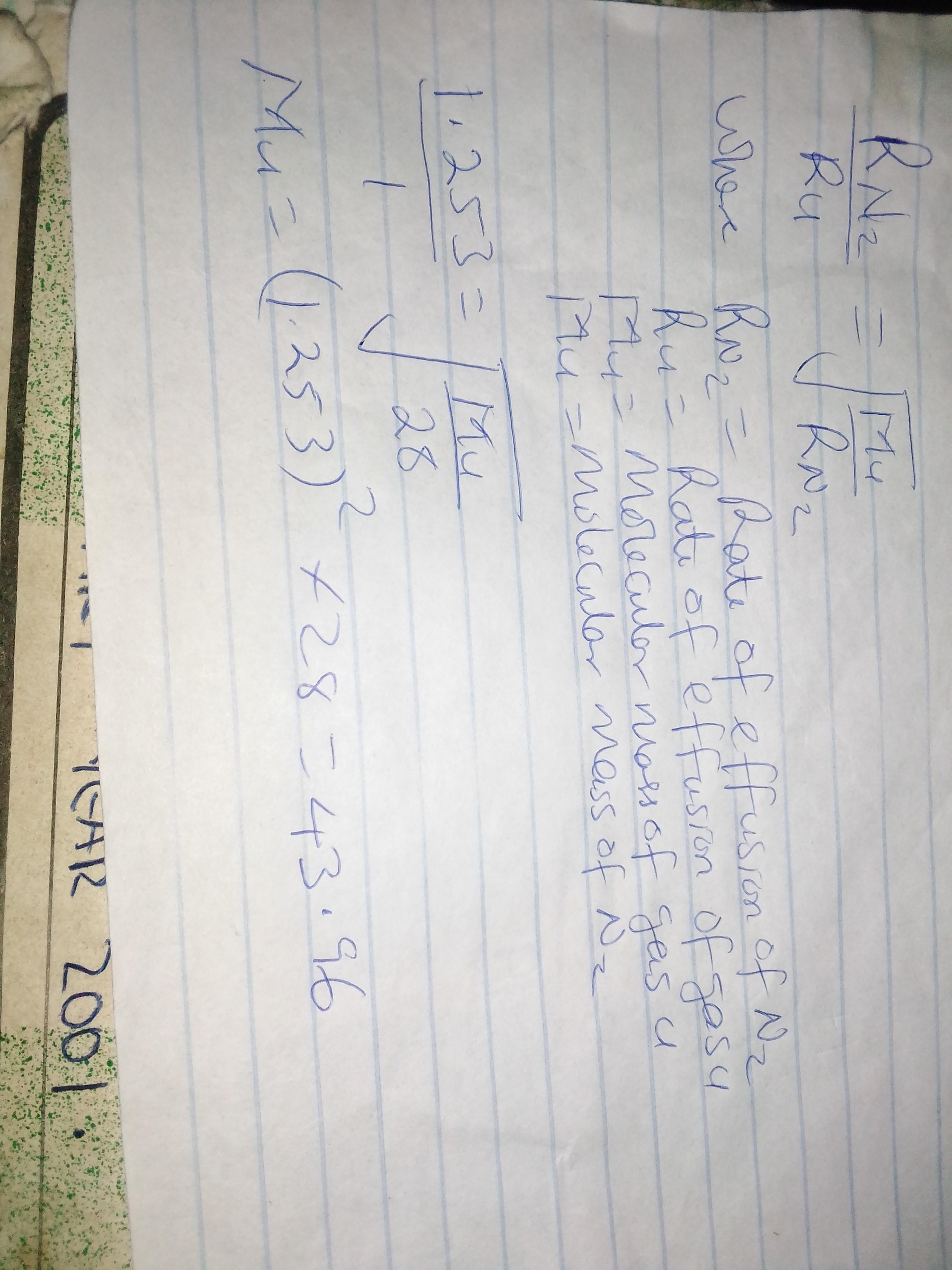
The rate of effusion of nitrogen gas (N2) is 1.253 times faster than that of an unknown gas. What is the molecular weight of the

unknown gas?

Chemistry
1 answer:
ollegr [7]2 years ago
5 0

Answer:

43.96

Explanation:

Graham's law was applied and the rates of effusion of nitrogen and the unknown gas were compared as shown in the image. The unknown gas is heavier than hydrigen hence it effuses slower than hydrogen as anticipated by Graham's law.

You might be interested in
Which best describes the process of convection?
Goryan [66]

Answer:

Convection is the primary way heat travels through appliances. Convection is the primary way heat travels through liquids and gasses. Convection is the primary way heat travels through rays.

Explanation:

8 0
1 year ago
Read 2 more answers
A precipitate of zinc hydroxide can be formed using the reaction below.
worty [1.4K]

Answer:

Option B is correct. KOH is the limiting reagent, and 0.27 mole of Zn(OH)2 precipitate is produced.

Explanation:

Step 1: Data given

Number of moles ZnCl2 = 0.36 moles

Number of moles KOH  = 0.54 moles

Step 2: The balanced equations

ZnCl2(aq) + 2 KOH(aq) → Zn(OH)2(s) + 2 KCl(aq)

For 1 mol ZnCl2 we need 2 moles KOH to produce 1 mol Zn(OH)2 and 2 moles KCl

Step 3: Calculate the limiting reactant.

KOH is the limiting reactant. It will completely be consumed (0.54 moles). ZnCl2 is in excess. There will react 0.54/2 = 0.27 moles

There will remain 0.36 - 0.27 = 0.09 moles.

Step 4: The products

There will be produced 2 moles KCl and 1 mol Zn(OH)2. Zn(OH)2 is the precipitate produced.

For 1 mol ZnCl2 we need 2 moles KOH to produce 1 mol Zn(OH)2 and 2 moles KCl

For 0.54 moles KOH, we will produce 0.27 moles precipitate (Zn(OH)2)

Option A is not correct because 0.27 mol of Zn(OH)2 will precipitate, not 0.54 mol

Option B is correct

Option C is not correct because ZnCl2 is not the limiting reactant, but the excess reactant

Option D is not correct because ZnCl2 is not the limiting reactant, but the excess reactant

7 0
2 years ago
One liter of ocean water contains 35.06 g of salt. What volume of ocean water would contain 1.00 kg of salt? Express your answer
sweet [91]

Answer:

28.52 L

Explanation:

First, let's calculate the density of the ocean, which is the mass divided by the volume:

d = m/V

d = 35.06/1

d = 35.06 g/L

So, for a mass of 1.00 kg = 1000.00 g

d = m/V

35.06 = 1000.00/V

V = 1000.00/35.06

V = 28.52 L

How all the data are expressed with two significant figures, the volume must also be expressed with two.

7 0
2 years ago
Which two statements explain how a cell's parts help it get nutrients?
olchik [2.2K]

Answer:

A and i think D

Explanation:

8 0
2 years ago
The graph below shows the electronegativities of the elements in the periodic table. A graph with the horizontal axis labeled pe
kow [346]

Answer:

The elements in group one

Explanation:

8 0
2 years ago
Read 2 more answers
Other questions:
  • What elements of paint can help forensic scientists compare samples to each other?
    14·1 answer
  • Hydrogen has three isotopes with mass numbers of 1, 2, and 3 and has an average atomic mass of 1.00794 amu. This information ind
    10·2 answers
  • If the coefficient 2 is placed in front of the product tetraiodine nonaoxide (I4O9), then, how many atoms of each element must b
    14·1 answer
  • 3 ways of improving the quality of an indigenous soap
    10·1 answer
  • What is the empirical formula of a compound containing 90 grams carbon, 11 grams hydrogen, and 35 grams nitrogen? A. C3H4N B. C2
    6·1 answer
  • The Lewis structures of four compounds are given. In the first molecule sufur is the central atom. There are two oxygen atoms bo
    11·1 answer
  • the electron affinity of nitrogen is lower (less negative) than that of both carbon and oxygen. This trend is best explained by
    6·1 answer
  • A gas balloon has a volume of 80.0 mL at 300K , and a pressure of 50.0 kPa. if the pressure changes to 80.0 kPa and the temperat
    14·1 answer
  • How many total bond are in the Lewis structure for HSIN?
    14·1 answer
  • A student in a chemistry laboratory has access to two acid solutions. The first one is 20% acid and the second solution is 45% a
    12·1 answer
Add answer
Login
Not registered? Fast signup
Signup
Login Signup
Ask question!