answer.
Ask question
Login Signup
Ask question
All categories
  • English
  • Mathematics
  • Social Studies
  • Business
  • History
  • Health
  • Geography
  • Biology
  • Physics
  • Chemistry
  • Computers and Technology
  • Arts
  • World Languages
  • Spanish
  • French
  • German
  • Advanced Placement (AP)
  • SAT
  • Medicine
  • Law
  • Engineering
ANTONII [103]
2 years ago
6

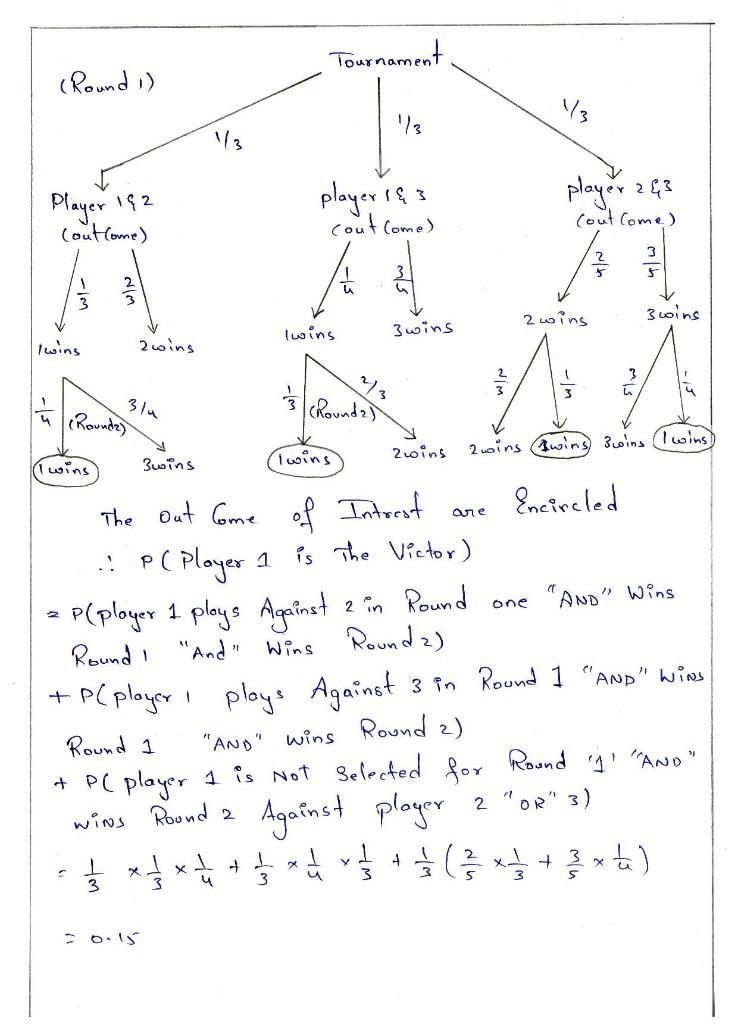
Players 1, 2, 3 are playing a tournament. Two of these three players are randomly chosen to play a game in round one, with the w

inner then playing the remaining player in round two. The winner of round two is the tournament victor. Assume that all games are independent and that i wins when playing against j with probability is i/( i+j)
(a) Find the probability that 1 is the tournament victor. (Hint: A tree diagram should be helpful, considering whether player 1 plays in round one.)

(b) If 1 is the tournament victor, find the conditional probability that 1 did not play in round one.

Chemistry
1 answer:
Anastasy [175]2 years ago
6 0

The answer & explanation for this question is given in the attachment below.

You might be interested in
Suppose a layer of oil is on the top of a beaker of water. Water in many oils is slightly soluble, so its concentration is so lo
rodikova [14]

Explanation:

It is given that energy to transfer one water molecule is 2.208 \times 10^{-20} J/molecule

As it is known that in 1 mole there are 6.022 \times 10^{23} atoms.

So, energy in 1 mole = 2.208 \times 10^{-20} \times 6.022 \times 10^{23} J/mol

                                  = 13.3 kJ/mol

As,    log \frac{k_{2}}{k_{1}} = \frac{E_{a}}{2.303 \times 8.314 atm L/mol K} \times \frac{T_{2} - T_{1}}{T_{1}T_{2}}

Putting the given values in the above formula as follows.

                log \frac{k_{2}}{k_{1}} = \frac{E_{a}}{2.303 \times 8.314 atm L/mol K} \times \frac{T_{2} - T_{1}}{T_{1}T_{2}}

               log \frac{k_{2}}{k_{1}} = \frac{13.3 kJ/mol}{2.303 \times 8.314 atm L/mol K} \times \frac{293 K - 283 K}{283K \times 293 K}

                  log \frac{k_{2}}{k_{1}} = 0.08377

                       \frac{k_{2}}{k_{1}} = 1.213 = \frac{Concentration_{2}}{Concentration_{1}}

                 Concentration_{2} = 1.213 \times Concentration_{1}

                                             = 1.213 \times 9 \times 10^{-4}

                                             = 10.915 \times 10^{-4} water molecules per oil molecule

Thus, we can conclude that the equilibrium concentration at 293 K, assuming that nothing else changes is 10.915 \times 10^{-4}.


4 0
2 years ago
Given six molecules, identify the molecules with polar bonds and the molecules that are polar.CCl4, CH3Cl, H20, CO2, O2
Nikitich [7]

Answer:

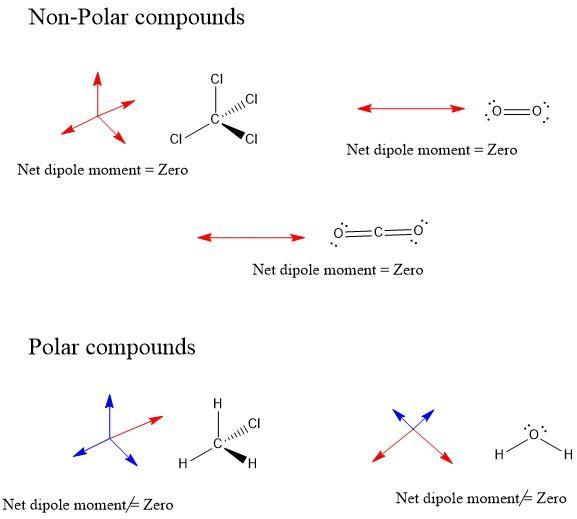
Non-polar compounds: CCl_4, O_2, CO_2

Polar compounds: CH_3Cl, H_2O

Explanation:

For this question, we must start with the <u>Lewis structure</u> for each molecule and then we can do their respective analysis:

-) CCl_4

In this case, we have 4 equal atoms attached to the central atom. Therefore, we have the <u>same magnitude</u> of electronegativity. Chlorine atoms have <u>different and opposite directions.</u> Therefore due to the orientation the dipole moments cancel and the <u>net dipole moment will be zero</u> and the molecule will be non-polar.

-) O_2

In this case, we have a linear structure in which the magnitude of the dipole moment is the same, but the direction is the <u>opposite</u>. Therefore the dipole moments are canceled and the molecule will be <u>non-polar</u>.

-) CO_2

In this case, we also have a linear structure in which the magnitude of the dipole moment is the same, but the direction is the <u>opposite</u>. Therefore the dipole moments are canceled and the molecule will be <u>non-polar</u>.

-) CH_3Cl

For this molecule, we have a <u>different atom</u>. The hydrogen atom, therefore the magnitude of one of the atoms attached to the central atom is different and the magnitude of the <u>net dipole moment will be different from zero</u> and the molecule will be <u>polar</u>.

-) H_2O

For this molecule, due to the structure of the molecule, the dipole moments of oxygens <u>will not have a totally opposite configuration</u>. Therefore, the net dipole moment will be different from zero and the molecule will be <u>polar</u>.

See figure 1 to further explanations

I hope it helps!

5 0
2 years ago
Recall that your hypothesis is that these values are the fraction of atoms that are still radioactive after n half-life cycles.
jolli1 [7]

Answer : A= 0.5, B = 0.25 , C = 0.125, D = 0.015625 and E = 0.00390625

Explanation :

Half life of a substance is defined as the amount of time taken by the substance to reduce to half of its original amount.

Here n represents the number of half lives.

The amount of substance that remains after n half lives can be calculated using the given formula, 0.5^{n}

So when we have n =1,

Fraction of substance that remains = 0.5¹ = 0.5.

That means after first half life over, the amount of substance that remains is 0.5 times that of original.

Therefore we have A = 0.5

When n = 2, we have 0.5² = 0.25

So when 2 half lives are over, the amount of substance that remains is 0.25 times that of original

Therefore B = 0.25

When n = 3, we have 0.5³ = 0.125

So when 3 half lives are over, the amount of substance that remains is 0.125 times that of original.

Therefore we have C = 0.125

When n = 6 , we have 0.5⁶ = 0.015625

So D = 0.015625

When n = 8, we have 0.5⁸ = 0.00390625

Therefore E = 0.00390625

The values for A, B, C, D and E are 0.5, 0.25, 0.125, 0.015625 and 0.00390625 respectively.

8 0
2 years ago
Read 2 more answers
The highest principal enegy level of period 2 elements is 2. Period 3 elements all have six 3p electrons. Period 4 elements have
Dmitrij [34]

Explanation:

The highest principal energy level of period 2 elements is 2. (True)

The highest principle energy level of elements of any period is equal to period number. So the given statement is true.

Period 3 elements all have six 3p electrons – (False)  

For example, sodium and sulfur are period 3 elements but do not contain six 3p electrons. Only Argon of period possesses six p-electrons.

Period 4 elements have an inner electron configuration of [Ar]- (True)

Atomic number of elements belonging to period 4 have atomic number more than 18 (atomic number of Ar). So they must have an inner electron configuration of [Ar]

The valence electrons of group 5A elements are in the 6s subshell – [FALSE]

Elements of group 5A are nitrogen, arsenic, antimony and bismuth. They are p-block elements. Therefore, valence electrons are present in p-subshell.

Group 8A elements have full outer principal s and p subshells –(True)  

Group 8A elements are also known as noble gas element. Octets of noble gases are complete and hence, have full outer principal s and p subshells.

The valence electrons of group 2A elements are in an s subshell – (True)

Elements of group 2A are barium, magnesium, calcium, etc. They belong to s-block elements. Therefore, their valence electrons will be in s-subshell.

The highest principal energy level of period 3 elements is 4 – (False)

The highest principle energy level of elements of any period is equal to period number.

For example, sodium is present in 3rd period, so its principle quantum number will be 3.

Period 5 elements have an inner electron configuration of [Xe] – (False)

Period 5 elements have an inner electron configuration of [Kr]. The first member of this period is rubidium. 37 and that of Kr is 36.  
6 0
2 years ago
In every balanced chemical equation, each side of the equation has the same number of _____.
Ber [7]

The correct answer is option d, that is, atoms of the element.  

As the atoms are neither destroyed nor created in a chemical reaction, the sum of the mass of the products in a reaction must be equivalent to the sum of the mass of the reactants.  

The chemical reactions must be balanced, they must exhibit a similar number of atoms of each element on both the sides of the equation. As a consequence, the mass of the reactants must be equivalent to the mass of the products of the reaction.  


7 0
2 years ago
Read 2 more answers
Other questions:
  • A compound is 80.0% carbon and 20.0% hydrogen by mass. assume you have a 100.-g sample of this compound. how many grams of each
    11·1 answer
  • Food deteriorates more slowly in a refrigerator because
    10·2 answers
  • 131i has a half-life of 8.04 days. assuming you start with a 1.53 mg sample of 131i, how many mg will remain after 13.0 days ___
    6·1 answer
  • Complete the chemical formula for each ionic compound. Consult the periodic table to help you answer the question. beryllium nit
    9·2 answers
  • A 8.5-liter sample of a gas at 2.0 atm and 300.0 K has 1.2 moles of the gas. If 0.65 mole of the gas is added to the sample at t
    15·2 answers
  • Which sentence best explains the high melting point, boiling point, and surface tension of water? A. The hydrogen atom on each w
    15·2 answers
  • What mass of NH3 can be made from 1221g of H2 and excess N2
    8·1 answer
  • A scientist discovers a deep bowl-like divot under the ocean off the coast of eastern Mexico that is many kilometers across. The
    10·2 answers
  • the image above shows a chamber with a fixed volume filled with gas at a pressure of 1560 mmHg and a temperature of 445.0 K. If
    11·1 answer
  • The elements chlorine and iodine have similar chemical properties because they _____. Group of answer choices have the same numb
    7·1 answer
Add answer
Login
Not registered? Fast signup
Signup
Login Signup
Ask question!