Answer:
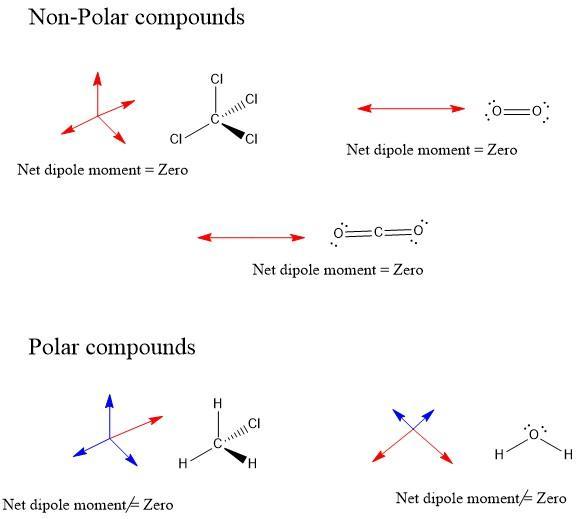
Non-polar compounds:  ,
,  ,
, 
Polar compounds:  ,
, 
Explanation:
For this question, we must start with the <u>Lewis structure</u> for each molecule and then we can do their respective analysis:
-)
In this case, we have 4 equal atoms attached to the central atom. Therefore, we have the <u>same magnitude</u> of electronegativity. Chlorine atoms have <u>different and opposite directions.</u> Therefore due to the orientation the dipole moments cancel and the <u>net dipole moment will be zero</u> and the molecule will be non-polar.
-)
In this case, we have a linear structure in which the magnitude of the dipole moment is the same, but the direction is the <u>opposite</u>. Therefore the dipole moments are canceled and the molecule will be <u>non-polar</u>.
-)
In this case, we also have a linear structure in which the magnitude of the dipole moment is the same, but the direction is the <u>opposite</u>. Therefore the dipole moments are canceled and the molecule will be <u>non-polar</u>.
-)
For this molecule, we have a <u>different atom</u>. The hydrogen atom, therefore the magnitude of one of the atoms attached to the central atom is different and the magnitude of the <u>net dipole moment will be different from zero</u> and the molecule will be <u>polar</u>.
-)
For this molecule, due to the structure of the molecule, the dipole moments of oxygens <u>will not have a totally opposite configuration</u>. Therefore, the net dipole moment will be different from zero and the molecule will be <u>polar</u>.
See figure 1 to further explanations
I hope it helps!