answer.
Ask question
Login Signup
Ask question
All categories
  • English
  • Mathematics
  • Social Studies
  • Business
  • History
  • Health
  • Geography
  • Biology
  • Physics
  • Chemistry
  • Computers and Technology
  • Arts
  • World Languages
  • Spanish
  • French
  • German
  • Advanced Placement (AP)
  • SAT
  • Medicine
  • Law
  • Engineering
kherson [118]
2 years ago
12

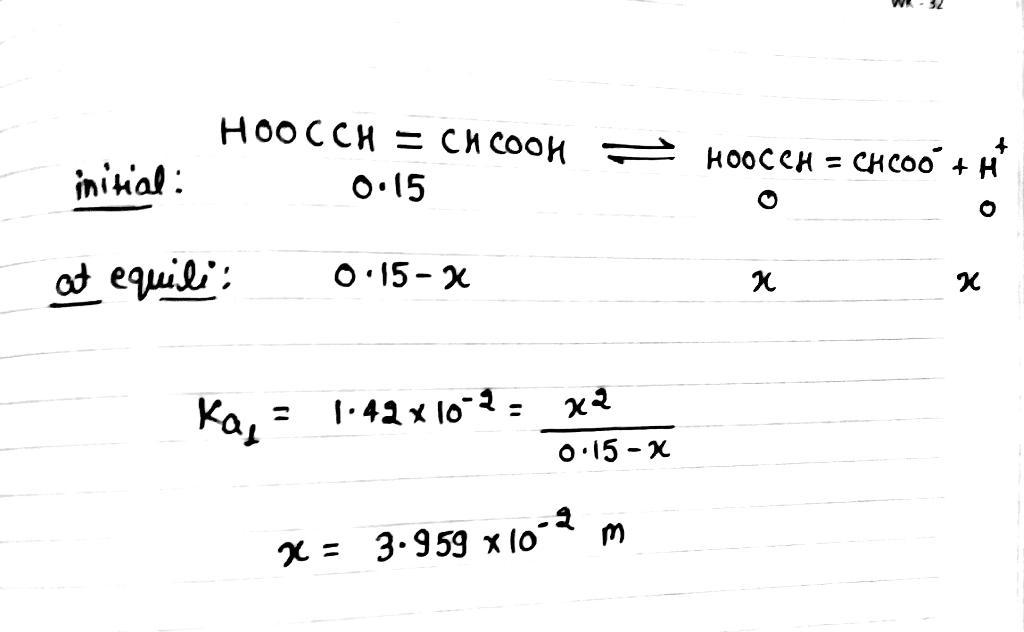
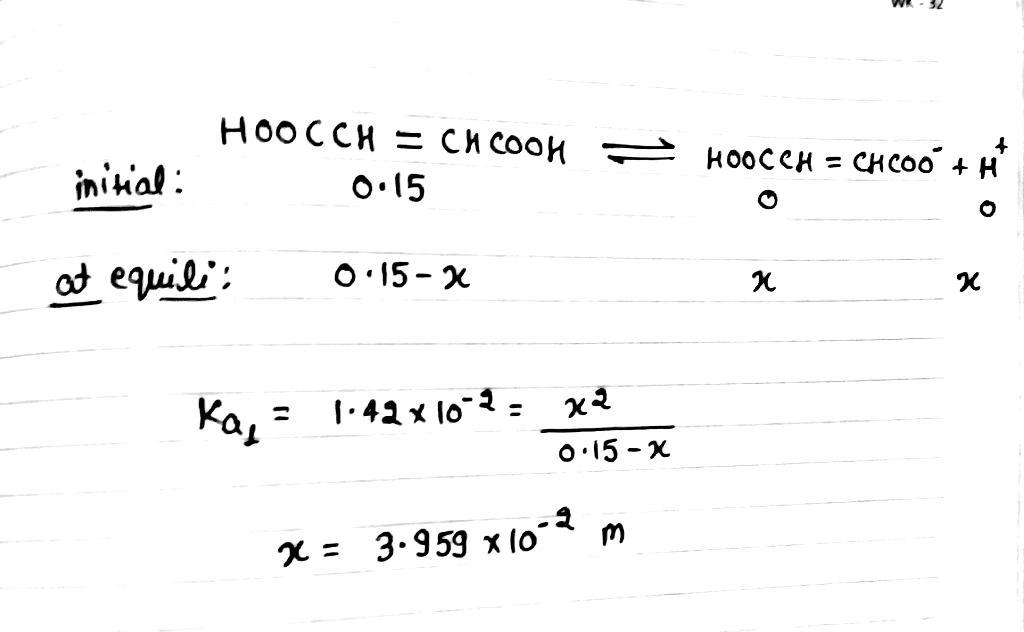
For maleic acid, hoocch=chcooh, ka1 = 1.42  10–2 and ka2 = 8.57  10–7 . what is the concentration of maleate ion (–oocch=chcoo

– ) in a 0.150 m aqueous solution of maleic acid?

Chemistry
2 answers:
uranmaximum [27]2 years ago
7 0

ANSWER

Find the attachment

Talja [164]2 years ago
6 0

Answer:

Explanation:

solution to the question

You might be interested in
24 how many moles are in 2.04 × 1024 molecules of h2o?
Sergeeva-Olga [200]
The answer is 3.39 mol.

<span>Avogadro's number is the number of molecules in 1 mol of substance.
</span><span>6.02 × 10²³ molecules per 1 mol.
</span>2.04 × 10²⁴<span> molecules per x.

</span>6.02 × 10²³ molecules : 1 mol = 2.04 × 10²⁴ molecules : x
x = 2.04 × 10²⁴ molecules * 1 mol : 6.02 × 10²³ molecules
x = 2.04/ 6.02 × 10²⁴⁻²³ mol
x = 0.339 × 10 mol
<span>x = 3.39 mol
</span>
8 0
2 years ago
Copper(II) sulfide, CuS, is used in the development of aniline black dye in textile printing. What is the maximum mass of CuS wh
Naya [18.7K]

Answer:

1.82 g   is the maximum mass of CuS.

Explanation:

Considering:

Molarity=\frac{Moles\ of\ solute}{Volume\ of\ the\ solution}

Or,

Moles =Molarity \times {Volume\ of\ the\ solution}

Given :

<u>For CuCl_2 : </u>

Molarity = 0.500 M

Volume = 38.0 mL

The conversion of mL to L is shown below:

1 mL = 10⁻³ L

Thus, volume = 38.0×10⁻³ L

Thus, moles of CuCl_2 :

Moles=0.500 \times {38.0\times 10^{-3}}\ moles

<u>Moles of CuCl_2  = 0.019 moles </u>

<u>For (NH_4)_2S : </u>

Molarity = 0.600 M

Volume = 42.0 mL

The conversion of mL to L is shown below:

1 mL = 10⁻³ L

Thus, volume = 42.0×10⁻³ L

Thus, moles of (NH_4)_2S :

Moles=0.600 \times {42.0\times 10^{-3}}\ moles

<u>Moles of (NH_4)_2S  = 0.0252 moles </u>

According to the given reaction:

CuCl_2_{(aq)}+(NH_4)_2S_{(aq)}\rightarrow CuS_{(s)}+2NH_4Cl_{(aq)}

1 mole of CuCl_2 reacts with 1 mole of (NH_4)_2S

So,  

0.019 mole of CuCl_2 reacts with 0.019 mole of (NH_4)_2S

Moles of (NH_4)_2S = 0.019 mole

Available moles of (NH_4)_2S = 0.0252 mole

<u>Limiting reagent is the one which is present in small amount. Thus, CuCl_2 is limiting reagent.</u>

The formation of the product is governed by the limiting reagent. So,

1 mole of CuCl_2 gives 1 mole of CuS

0.019 mole of CuCl_2 gives 0.019 mole of CuS

Moles of CuS formed = 0.019 moles

Molar mass of CuS = 95.611 g/mol

Mass of CuS = Moles × Molar mass = 0.019 × 95.611 g = 1.82 g

<u>1.82 g   is the maximum mass of CuS.</u>

5 0
2 years ago
SEP Use Models Why does the number of electrons in each principal energy shell increase as the number of the shell increases?
zlopas [31]

Answer:

See explanation

Explanation:

The number of electrons in each principal energy shell increases as the number of shells increases because more electronic orbitals become available to accommodate the electrons.

For instance, the n= 2 level only accommodates eight electrons in the s and p orbitals whereas the n=3 level accommodates 18 electrons in s, p and d orbitals respectively.

Each principal level accommodates 2n^2 electrons where n= the principal energy shell.

4 0
1 year ago
A sample taken from a layer of mica in a canyon has 2.10 grams of potassium-40. A test reveals it to be 2.6 billion years old. H
DanielleElmas [232]

Answer:

\boxed{ \text{8.40 g}} 

Explanation:

The half-life of K-40 (1.3 billion years) is the time it takes for half of it to decay.  

After one half-life, half (50 %) of the original amount will remain.  

After a second half-life, half of that amount (25 %) will remain, and so on.  

We can construct a table as follows:  

 No. of                                 Fraction

<u>half-lives</u>      <u>    t/yr      </u>       <u>Remaining</u>  

      0               0                          1

      1                1.3  billion              ½

      2              2.6                          ¼

      3              3.9                          ⅛

We see that after 2 half-lives, ¼ of the original mass remains.

Conversely, if two half-lives have passed, the original mass must have been four times the mass we have now.

Original  mass = 4 × 2.10 g = \boxed{ \text{8.40 g}}

7 0
2 years ago
To test how fertilizer affects aquatic animals, a student prepared four identical containers with water fleas. the student then
Vera_Pavlovna [14]

The control group in this experiment is the one with just distilled water. It is plain so they can use it to compare the other tests against.

5 0
2 years ago
Read 2 more answers
Other questions:
  • A chemist heats 100.0 g of FeSO4 x 7H2O in a crucible to drive off the water. If all the water is driven off, what is the mass o
    5·2 answers
  • A certain gas is present in a 12.0 L cylinder at 4.0 atm pressure. If the pressure is increased to 8.0 atm the volume of the gas
    13·2 answers
  • Given the equilibrium constants for the following two reactions in aqueous solution at 25 ∘C HNO2(aq)H2SO3(aq)⇌⇌H+(aq) + NO2−(aq
    11·1 answer
  • The density of phosphorus vapor at 310 degrees celcius and 775 mmHg is 2.64g/L. what is the molecular formula of the phosphorus
    14·1 answer
  • A chamber with a fixed volume is shown above. The temperature of the gas inside the chamber before heating is 25.2 C and it’s pr
    15·1 answer
  • 2 M n O 2 + 4 K O H + O 2 + C l 2 → 2 K M n O 4 + 2 K C l + 2 H 2 O , there are 100.0 g of each reactant available. Which reacta
    8·2 answers
  • If for a particular process, ΔH=308 kJmol and ΔS=439 Jmol K, in what temperature range will the process be spontaneous?
    10·1 answer
  • The next two questions provide some more practice on calculations using half-lives. The isotope 64Cu has t1/2 of 12.7 hours. If
    15·1 answer
  • A 14.3-cm3 sample of tin has a mass of 0.104 kg.
    14·1 answer
  • The mass of radium-226 in a sample is found to have decreased from 45.00g to 5.625g in a period of 4800 years.From this informat
    13·1 answer
Add answer
Login
Not registered? Fast signup
Signup
Login Signup
Ask question!