answer.
Ask question
Login Signup
Ask question
All categories
  • English
  • Mathematics
  • Social Studies
  • Business
  • History
  • Health
  • Geography
  • Biology
  • Physics
  • Chemistry
  • Computers and Technology
  • Arts
  • World Languages
  • Spanish
  • French
  • German
  • Advanced Placement (AP)
  • SAT
  • Medicine
  • Law
  • Engineering
Levart [38]
2 years ago
6

cubical tank 1 meter on each edge is filled with water at 20 degrees C. A cubical pure copper block 0.46 meters on each edge wit

h an initial temperature of 100 degrees C is quickly submerged in the water, causing an amount of water equal to the volume of the smaller cube to spill from the tank. An insulated cover is placed on the tank. The tank is adiabatic. Estimate the equilibrium temperature of the system (block + water). Be sure to state all applicable assumptions.
Engineering
1 answer:
bixtya [17]2 years ago
3 0

Answer:

<em>final temperature = 26.5°</em>

Explanation:

Initial volume of water is 1 x 1 x 1 = 1 m^{3}

Initial temperature of water = 20° C

Density of water = 1000 kg/m^{3}

volume of copper block = 0.46 x 0.46 x 0.46 = 0.097 m^{3}

Initial temperature of copper block = 100° C

Density of copper = 8960 kg/m^{3}

Final volume of water = 1 - 0.097 = 0.903 m^{3}

Assumptions:

  • since tank is adiabatic, there's no heat gain or loss through the walls
  • the tank is perfectly full, leaving no room for cooling air
  • total heat energy within the tank will be the summation of the heat energy of the copper and the water remaining in the tank.

mass of water remaining in the tank will be density x volume = 1000 x 0.903 = 903 kg

specific heat capacity of water c = 4186 J/K-kg

heat content of water left Hw = mcT = 903 x 4186 x 20 = 75.59 Mega-joules

mass of copper will be density x volume = 8960 x 0.097 = 869.12 kg

specific heat capacity of copper is 385 J/K-kg

heat content of copper Hc = mcT = 869.12 x 385 x 100 = 33.46 Mega-joules

total heat in the system = 75.59 + 33.46 = 109.05 Mega-joules

this heat will be distributed in the entire system

heat energy of water within the system = mcT

where T is the final temperature

= 903 x 4186 x T = 3779958T

for copper, heat will be

mcT = 869.12 x 385 = 334611.2T

these component heats will sum up to the final heat of the system, i.e

3779958T + 334611.2T = 109.05 x 10^{6}

4114569.2T = 109.05 x 10^{6}

final temperature T = (109.05 x 10^{6})/4114569.2 = <em>26.5°</em>

You might be interested in
The ingredient weights for making 1 yd (cyd) of concrete by assuming aggregates in SSD state are given below. The volume of air
Pachacha [2.7K]

Answer:

Explanation:

Ans) Given batch weight of each component :

Cement = 700 lb

Water = 315 lb

Coarse aggregate = 1575 lb

Fine aggregate = 1100 lb

Part 1) Amount of water = 328.5 lb

Amount of water is needed to be increased if the aggregates has absorption capacity, To maintain constant water cement ratio, the mixing water is increased because some of the water is absorbed by aggregates.

Amount of water absorbed = 328.5 lb - 315 lb = 13.5 lb

Total amount of aggregates = 1575 + 1100 = 2675 lb

=> % Absorption capacity = 13.5 x 100 / 2675 = 0.5 %

Hence, new amount of Coarse aggregate = (1 - 0.005) x 1575 lb = 1567.125 lb

New amount of fine aggregate = (1 - 0.005) x 1100 = 1094.5 lb

Since, water cement ratio is maintained constant , amount of cement remains unchanged

=> Volume of water = 328.5 / 62.4 = 5.26 ft3

=> Volume of cement = 700 / (3.15 x 62.4) = 3.56 ft3

=> Volume of coarse aggregate = 1567.125 / (2.4 x 62.4) = 10.46 ft3

=> Volume of fine aggregate = 1100 / (2.4 x 62.4) = 7.34 ft3

Volume of air = 2% = 0.02 x 27 = 0.54 ft3

Total concrete volume = 5.26 + 3.56 + 10.46 + 7.34 + 0.54 \approx 27 ft3 = 1 yd3

Hence, calculated amount of each component is correct

Part 2) We know, minus sign indicated that the aggregate will absorb some moisture from concrete, hence mixing water amount needed to be corrected .

=> Amount of water absorbed by coarse aggregate = 0.01 x 1567.125 lb = 15.67 lb

=> Amount of water absorbed by fine aggregate = 0.02 x 1094.50 lb = 21.89 lb

Total amount of water absorbed = 15.67 + 21.89 = 37.56 lb

To maintain same water cement ratio, amount of mixing water is needed to be increased

=> Corrected amount of mixing water = 328.5 lb + 37.56 lb = 366 lb

=> Corrected amount of coarse aggregate = (1 - 0.01) x 1567.125 = 1551.45 lb

=> Corrected amount of fine aggregate = (1 - 0.02) x 1094.5 = 1072.6 lb

Part 3) We know,

Unit weight = Sum of weight of each material / Total volume

=> Sum of weight = 366 + 700 + 1551.45 + 1072.6 = 3690.05 lb

Total volume = 1 yd3 or 27 ft3

=> Expected Unit Weight = 3690.05 lb / 27 ft3 = 136.67 lb/ft3

Also, Concrete Yield = Weight of all components / Unit weight of concrete

=> Yield = 3690.05 / 136.67 = 27 ft3 or 1 yd3

4 0
2 years ago
A three-point bending test was performed on an aluminum oxide specimen having a circular cross section of radius 3.5 mm (0.14 in
RideAnS [48]

To resolve this problem we have,

R=3.5mm\\F_f1=950N\\L_1=50mm\\b=12mm\\L_2=40mm

F_{f2} is unknown.

With these dates we can calculate the Flexural strenght of the specimen,

\sigma{fs}=\frac{F_{f1}L}{\pi R^3}\\\sigma{fs}=\frac{(950)(50*10^{-3})}{\pi 3.5*10^{-3}}\\\sigma{fs}=352.65Mpa

After that, we can calculate the flexural strenght for the square cross section using the previously value.

\sigma{fs}=\frac{F_{f2}L}{\pi R^3}\\(352.65*10^6)=\frac{3Ff(40*10^{-3})}{2(12*10^{-10})}\\F_{f2}=\frac{352.65*10^6}{34722.22}\\F_{f2}=10156.32N\\F_{f2}=10.2kN

6 0
2 years ago
Write a method printShampooInstructions(), with int parameter numCycles, and void return type. If numCycles is less than 1, prin
kirill [66]

Answer:

// The method is defined with a void return type

// It takes a parameter of integer called numCycles

// It is declared static so that it can be called from a static method

public static void printShampooInstructions(int numCycles){

// if numCycles is less than 1, it display "Too few"

   if (numCycles < 1){

       System.out.println("Too few.");

   }

// else if numCycles is less than 1, it display "Too many"

    else if (numCycles > 4){

       System.out.println("Too many.");

   }

// else it uses for loop to print the number of times to display

// Lather and rinse

  else {

       for(int i = 1; i <= numCycles; i++){

           System.out.println(i + ": Lather and rinse.");

       }

       System.out.println("Done");


   }

}

Explanation:

The code snippet is written in Java. The method is declared static so that it can be called from another static method. It has a return type of void. It takes an integer as parameter.

It display "Too few" if the passed integer is less than 1. Or it display "Too much" if the passed integer is more than 4. Else it uses for loop to display "Lather and rinse" based on the passed integer.

8 0
2 years ago
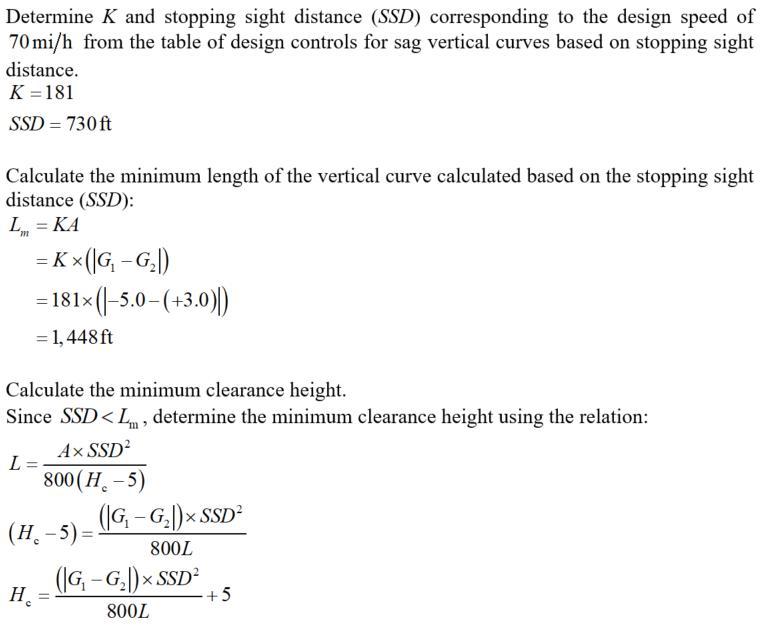
An overpass is being built over the PVI of an existing equal-tangent sag curve. The sag curve has a 70 mi/h design speed and G1=
vivado [14]

Answer: Resultant elevation will be 30.98 ft

8 0
2 years ago
A hand crank generator is used to power a light bulb. The person turning the crank uses 22 Newtons of input force to turn the cr
ikadub [295]

Answer:

1. The input power is 17.6 Watts

2. The output power is 0.7232 Watts

3.The efficiency of the hand crank generator is approximately 4.109%

Explanation:

The given parameters are;

The force with which the crank generator is turned = 22 Newtons

The rate at which the crank is turned = 8 revolutions per 3 seconds

The distance the hand moves during each revolution = 0.3 meters

The current recorded by the multimeter = 0.08 amps

The voltage recorded by the multimeter = 9.04 volts

1. Power = The rate of doing work = Work done/(Time taken to do the work) = Force × Distance/Time

∴ The power input of the hand crank generator = 22 × 0.3 × 8/3 = 17.6 Watts

2. The power output to the bulb, P, is given by the formula for electrical power as follows;

Power = Current, I × Voltage V

∴ P = 0.08 ×  9.04 = 0.7232 Watts

3. Efficiency in percentage = Output/Input × 100

Therefore, the efficiency of the hand crank generator = )Output power/(Input power)) × 100 = (0.7232/17.6) × 100 ≈ 4.109%

8 0
2 years ago
Other questions:
  • Water at 400 kPa with a quality of 75% has its pressure raised 200 kPa (to 600 kPa) in a constant volume process. What is the ne
    15·1 answer
  • ______process in sheet metal is used for producing fluid tight joints. A - Hemming B- Seaming C-Beading D-Roll forming
    9·1 answer
  • A particle has an initial velocity of v0 = 14 ft/s to the right, at s0 = 0, and a = 2 ft/s2 to the left. determine its position
    5·1 answer
  • Air at 40°C flows over a long, 25-mm-diameter cylinder with an embedded electrical heater. In a series of tests, measurements we
    11·1 answer
  • Universal Containers has a junction object called "Job Production Facility". With 2 master-detail relationships to the Job and P
    15·1 answer
  • Two AISI 304 stainless steel plates 10 mm thick are subjected to a contact pressure of 1 bar under vacuum conditions for which t
    9·1 answer
  • A gas pressure difference is applied to the legs of a U-tube manometer filled with a liquid with specific gravity of 1.7. The ma
    15·2 answers
  • A plate of an alloy steel has a plane-strain fracture toughness of 50 MPa√m. If it is known that the largest surface crack is 0.
    12·1 answer
  • Water at 70 kPa and 1008C is compressed isentropically in a closed system to 4 MPa. Determine the final temperature of the water
    6·1 answer
  • Mr. Ray deposited $200,000 in the Old and Third National Bank. If the bank pays 8% interest, how much will he have in the accoun
    10·2 answers
Add answer
Login
Not registered? Fast signup
Signup
Login Signup
Ask question!