answer.
Ask question
Login Signup
Ask question
All categories
  • English
  • Mathematics
  • Social Studies
  • Business
  • History
  • Health
  • Geography
  • Biology
  • Physics
  • Chemistry
  • Computers and Technology
  • Arts
  • World Languages
  • Spanish
  • French
  • German
  • Advanced Placement (AP)
  • SAT
  • Medicine
  • Law
  • Engineering
Masja [62]
2 years ago
11

Triangle QRS is dilated according to the rule DO,2 (x,y). On a coordinate plane, (0, 0) is the center of dilation. Triangle Q R

S has points (negative 3, 3), (2, 4), and (negative 1, 1). What is true about the image ΔQ'R'S'? Select three options. Which statements are true? DO,2 (x,y) = (2x, 2y) Side Q'S' lies on a line with a slope of -1. QR is longer than Q'R'. The vertices of the image are closer to the origin than those of the pre-image. The distance from Q' to the origin is twice the distance from Q to the origin.

Mathematics
2 answers:
Xelga [282]2 years ago
6 0

Answer:

Options A, B and E are correct

Step-by-step explanation:

From the information given above, we would draw a dilation that produces an image that is the same shape as the original image, but has a different size.

The scale factor is 2

QRS → Q'R'S' = (x,y) → 2(x,y)

The coordinates of ∆QRS

Q (-3, 3)

R (2, 4)

S (-1, 1)

To get the coordinates of Q'R'S', we would multiply each coordinate of the original triangle by the scale factor of 2 since the dilation is from the origin. In order words, each vertex of QRS is multiplied by 2 to get each of the vertex of Q'R'S'.

2 (x,y) = (2x, 2y)

The coordinates of ∆Q'R'S' becomes:

Q' (-6, 6)

R' (4, 8)

S' (-2, 2)

To determine the statements that are true about the image ΔQ'R'S,

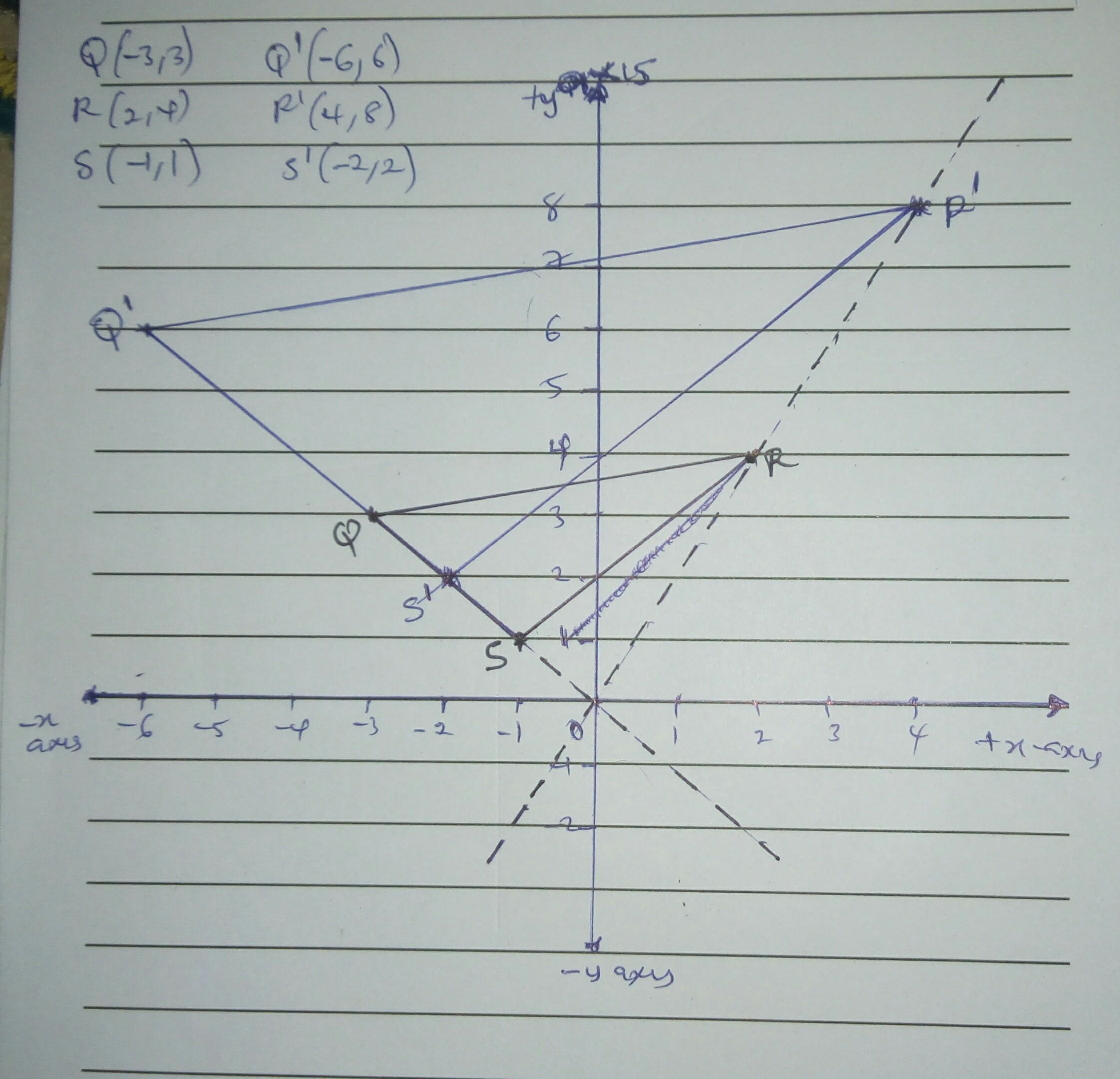
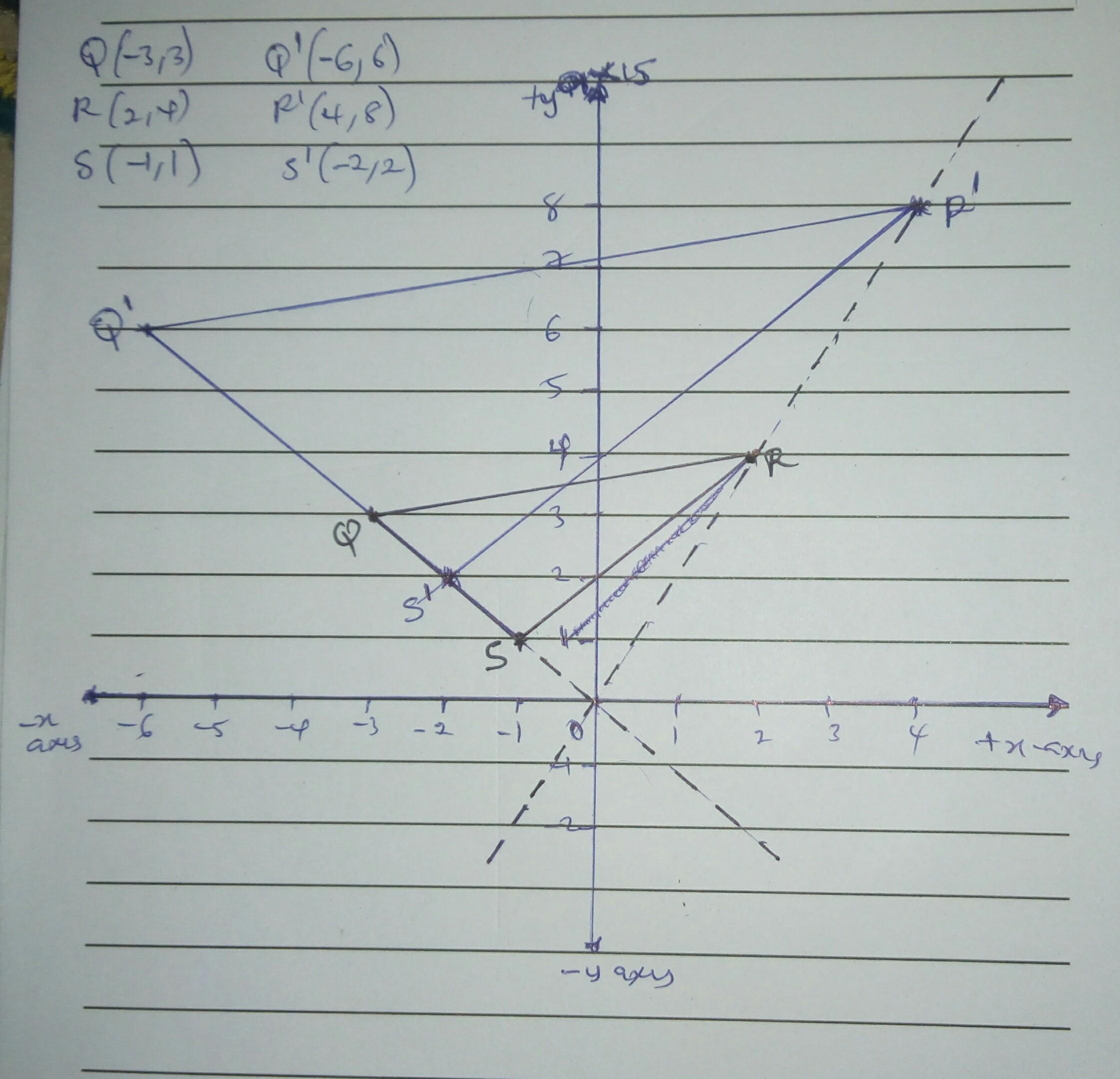
we would graph the coordinates of the two triangles.

Starting with ΔABC, we would draw the dilation image of the triangle with a center at the origin and a scale factor of 2.

See attached the diagram for better explanation.

Let's check out each options and compare it with diagram we obtained:

a) DO, 2 (x,y) = (2x, 2y)

A dilation about the origin with a scale factor 2 is described using the above notation.

Q' = 2(-3,3) = [2(-3), 2(3)] = (-6, 6)

R' (4, 8) = 2(2,4) = [2(2), 2(4)] = (4, 8)

S' (-2, 2) = 2(-1,1) = [2(-1), 2(1)] = (-2, 2)

This option is correct

b) Side Q'S' lies on a line with a slope of -1

Q' (-6, 6)

S' (-2, 2)

coordinate (x, y)

Slope = m = (change in y)/(change in x)

m = (6-2)/[-6-(-2)]

= 4/(-6+2) = 4/-4

m = -1

This option is correct

c) QR is longer than Q'R'

Length of QR (-3 to 2) = 5

Length of Q'R' (-6 to 4) = 10

QR is not longer than Q'R'

This option is false

d) The vertices of the image are closer to the origin than those of the pre-image

The scale factor determines how much bigger or smaller the dilation image will be compared to the preimage. In a transformation, the final figure is referred to as the image. The original figure is referred to as the preimage.

From the diagram, the vertices of the preimage (original image) are closer to the origin than those of the dilation image.

This option is false

e) The distance from Q' to the origin is twice the distance from Q to the origin.

The distance from Q' to the origin (6 to 0) = 6

The distance from Q to the origin (3 to 0) = 3

The distance from Q' to the origin = 2(the distance from Q to the origin)

This option is correct

JulijaS [17]2 years ago
6 0

Answer:

A,B and E is correct

Step-by-step explanation:

You might be interested in
Which is a perfect square? 6 Superscript 1 6 squared 6 cubed 6 Superscript 5 Mark
Mazyrski [523]

Answer:

6^2

Step-by-step explanation:

The square root of a perfect square is a rational number.

So let us take the square root of each number to see which is a rational number.

\sqrt{6^1}=\sqrt{6}......irrational

\sqrt{6^2}=6......rational

\sqrt{6^3}=6\sqrt{6}.........irrational

\sqrt{6^5}=36 \sqrt{6}irrational.

Therefore 6^2 is a perfect square

3 0
2 years ago
Read 2 more answers
Use Gauss's Law to find the charge contained in the solid hemisphere x2 + y2 + z2 ≤ a2, z ≥ 0, if the electric field is E(x, y,
Anit [1.1K]

Answer:<em><u> \frac{16}{3}πa^{3} . </u></em>

Given:

x^{2}+y^{2}+z^{2} \leq a^{2}, z \geq 0

Using Gauss's Law = ∫∫s E ·dS  

= ∫∫∫ div E dV,  

⇒ Divergence (Gauss') Theorem  

= ∫∫∫ (1+1+6) dV  

= 8×(volume of the hemisphere, radius "a")  

= 8× (\frac{1}{2})(4/3)πa^{3}  

<em><u>= \frac{16}{3}πa^{3} . </u></em>

6 0
2 years ago
Hadi earned $120.00 from his job yesterday. Today he expects to earn 15% less than yesterday and tomorrow he expects to earn 15%
alexira [117]
Yesterday Hadi earned: $120

Today he will earn: $120*85% = $102
(You times the amount yesterday by 85% because you want to find the 15% less of 100% of the amount he's earned yesterday. Therefore, to find 15% less than yesterday you multiply it by 85% (100% - 15%) )

Tomorrow he will earn: $102*115% = $117.30
(Same thing here, however you are finding 15% more than 100% today. Therefore, you multiply the amount he earned today it by 115% (100% + 15%) )

To find the amount he earns for the three days you must add the amount earned of yesterday, today and tomorrow earned from the working above.

Therefore, Hadi expects to earn:
Yesterday + Today + Tomorrow = 120 + 102 + 117.30 = $339.3


3 0
2 years ago
Read 2 more answers
If a cone with a diameter of 10 meters has a surface area of 290.6 square meters, find its slant height.
Finger [1]
<h2>Hello!</h2>

The answer is:

The slant height is 13.43 m.

l=13.43m

<h2>Why?</h2>

To solve the problem, we need to use the following equations to calculate the total surface area and the lateral surface area of right cone:

TotalSurfaceArea=LateralSurfaceArea+BaseArea

LateralSurfaceArea=\pi *r*l

Where,

r, is the radius of the cone.

l, is the slant height of the cone.

We are given the following information:

TotalSurfaceArea=290.6m^{2} \\Diameter=10m\\Radius=\frac{1}{2}d=\frac{1}{2}10m=5m

So, calculating the area of the base(circle) in order to find the lateral surface area, we have:

BaseArea=\pi *r^{2} \\\\BaseArea=\pi *5m^{2} =\pi *25m^{2}=79.54m^{2}

Then, substituting the area of the base into the total surface area to calculate the surface area of the cone, we have:

LateralSurfaceArea=TotalSurfaceArea-BaseArea

LateralSurfaceArea=290.6m^{2}-79.54m^{2}

LateralSurfaceArea=211.06m^{2}

Now, calculating the slant height, we have:

LateralSurfaceArea=\pi *r*l

l=\frac{LateralSurfaceArea}{\pi*r }

Substituting, we have:

l=\frac{211.06m^{2}}{\pi*5 }=\frac{211.06}{15.71m }

l=\frac{211.06}{15.71m }=13.43m

Hence, we have that the slant height is 13.43 m.

l=13.43m

Have a nice day!

6 0
2 years ago
Your friend claims that if a line has a slope less than 1, then any line perpendicular to it must have a positive slope. Is your
mezya [45]

Answer:

The friend's claim is not correct

Step-by-step explanation:

we know that

If two lines are perpendicular, then their slopes are opposite reciprocal (the product of their slopes is equal yo -1)

Example

A given line has a slope of m_1=1/2  ---> (is less than 1)

the slope of the line perpendicular to the given line is equal to

m_1*m_2=-1

substitute

(1/2)*m_2=-1

m_2=-2

so

the perpendicular line don't have a positive slope

therefore

The friend's claim is not correct

5 0
2 years ago
Other questions:
  • Select all that apply.
    13·2 answers
  • In 1992, George Brown started the Old Oregon Wood Store to manufacture Old Oregon tables. Each table is carefully constructed by
    14·1 answer
  • FWML is a parallelogram. Find the values of x and y. Solve for the value of z, if z=x−y
    15·1 answer
  • Which type of sampling method is being employed in the following example? A study is being conducted of all schools in Gwinnett
    9·1 answer
  • Do the numbers show a pattern 11.23,10.75,10.3,9.82,9.37,8.89
    5·1 answer
  • A new car is purchased for 24500 dollars. The value of the car depreciates at 14.75% per year. What will the value of the car be
    11·2 answers
  • Hailey has a rectangular bedspread that measures 890 cm by 2891 cm. She wants to sew a fringe around the edge of the bedspread.
    7·2 answers
  • R+5/mn=p solve for m
    13·1 answer
  • Helena builds a shed in her backyard. There is a larger square section for large​ tools, like her lawn​ mower, and a smaller squ
    15·1 answer
  • Given line m is parallel to line n. What theorem or postulate justifies the statement? ∠1 ≅ ∠4 Corresponding angles postulate Al
    12·1 answer
Add answer
Login
Not registered? Fast signup
Signup
Login Signup
Ask question!