answer.
Ask question
Login Signup
Ask question
All categories
  • English
  • Mathematics
  • Social Studies
  • Business
  • History
  • Health
  • Geography
  • Biology
  • Physics
  • Chemistry
  • Computers and Technology
  • Arts
  • World Languages
  • Spanish
  • French
  • German
  • Advanced Placement (AP)
  • SAT
  • Medicine
  • Law
  • Engineering
swat32
2 years ago
3

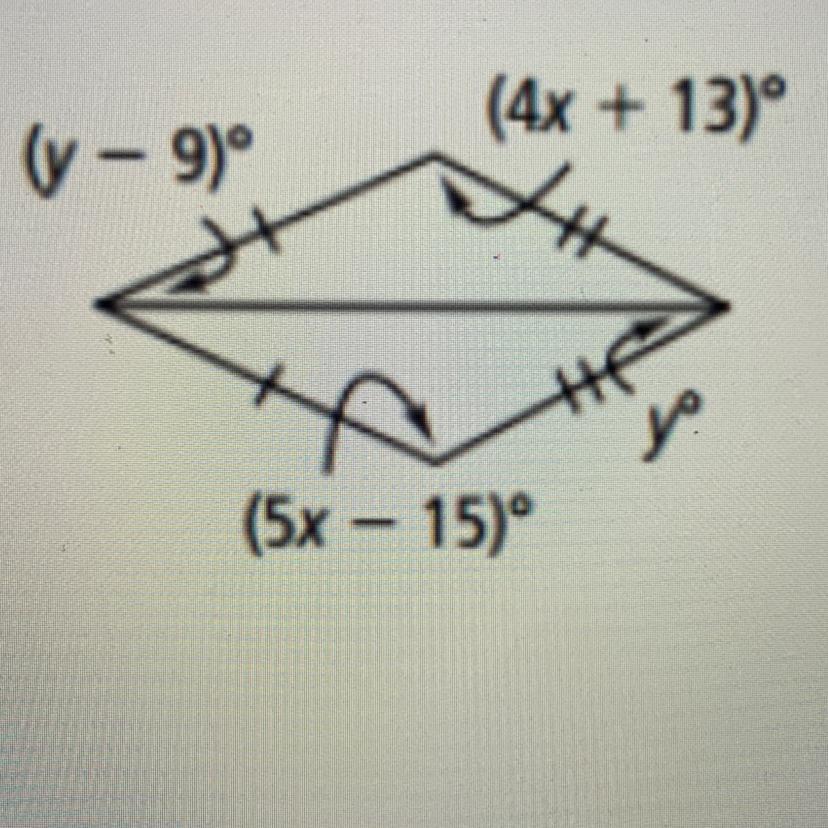
What is the value of y in the kite below? (Picture Included)

Mathematics
1 answer:
lord [1]2 years ago
5 0

Answer:

6

Step-by-step explanation:

trust me bro i aint ever rong

You might be interested in
TV−→− bisects ∠RTS. If the m∠RTV=(16x−6)° and m∠VTS=(13x+9)° , what is the value of x and the m∠RTV ?
natta225 [31]

Answer:

x = 5

RTV = 74

Step-by-step explanation:

Given

RTV=16x - 6

VTS=13x+9

Required

Determine the values of x and RTV

Since, TV is a bisector, then

RTS = RTV + VTS --- (1)

and

RTV = VTS -- (2)

Substitute values of RTV and VTS in (2)

16x - 6 = 13x + 9

Collect Like Terms

16x - 13x = 9 + 6

3x = 15

Solve for x

x = 5

Substitute 5 for x in RTV=16x - 6

RTV = 16 * 5 - 6

RTV = 80 - 6

RTV = 74

8 0
2 years ago
A supermarket has two customers waiting to pay for their purchases at counter I and one customer waiting to pay at counter II. L
Pachacha [2.7K]

Answer:

b. 0.864

Step-by-step explanation:

Let's start defining the random variables.

Y1 : ''Number of customers who spend more than $50 on groceries at counter 1''

Y2 : ''Number of customers who spend more than $50 on groceries at counter 2''

If X is a binomial random variable, the probability function for X is :

P(X=x)=(nCx)p^{x}(1-p)^{n-x}

Where P(X=x) is the probability of the random variable X to assume the value x

nCx is the combinatorial number define as :

nCx=\frac{n!}{x!(n-x)!}

n is the number of independent Bernoulli experiments taking place

And p is the success probability.

In counter I :

Y1 ~ Bi (n,p)

Y1 ~ Bi(2,0.2)

P(Y1=y1)=(2Cy1)(0.2)^{y1}(0.8)^{2-y1}

With y1 ∈ {0,1,2}

And P( Y1 = y1 ) = 0 with y1 ∉ {0,1,2}

In counter II :

Y2 ~ Bi (n,p)

Y2 ~ Bi (1,0.3)

P(Y2=y2)=(1Cy2)(0.3)^{y2}(0.7)^{1-y2}

With y2 ∈ {0,1}

And P( Y2 = y2 ) = 0 with y2 ∉ {0,1}

(1Cy2) with y2 = 0 and y2 = 1 is equal to 1 so the probability function for Y2 is :

P(Y2=y2)=(0.3)^{y2}(0.7)^{1-y2}

Y1 and Y2 are independent so the joint probability distribution is the product of the Y1 probability function and the Y2 probability function.

P(Y1=y1,Y2=y2)=P(Y1=y1).P(Y2=y2)

P(Y1=y1,Y2=y2)=(2Cy1)(0.2)^{y1}(0.8)^{2-y1}(0.3)^{y2}(0.7)^{1-y2}

With y1 ∈ {0,1,2} and y2 ∈ {0,1}

P( Y1 = y1 , Y2 = y2) = 0 when y1 ∉ {0,1,2} or y2 ∉ {0,1}

b. Not more than one of three customers will spend more than $50 can mathematically be expressed as :

Y1 + Y2 \leq 1

Y1 + Y2\leq 1 when Y1 = 0 and Y2 = 0 , when Y1 = 1 and Y2 = 0 and finally when Y1 = 0 and Y2 = 1

To calculate P(Y1+Y2\leq 1) we must sume all the probabilities that satisfy the equation :

P(Y1+Y2\leq 1)=P(Y1=0,Y2=0)+P(Y1=1,Y2=0)+P(Y1=0,Y2=1)

P(Y1=0,Y2=0)=(2C0)(0.2)^{0}(0.8)^{2-0}(0.3)^{0}(0.7)^{1-0}=(0.8)^{2}(0.7)=0.448

P(Y1=1,Y2=0)=(2C1)(0.2)^{1}(0.8)^{2-1}(0.3)^{0}(0.7)^{1-0}=2(0.2)(0.8)(0.7)=0.224

P(Y1=0,Y2=1)=(2C0)(0.2)^{0}(0.8)^{2-0}(0.3)^{1}(0.7)^{1-1}=(0.8)^{2}(0.3)=0.192

P(Y1+Y2\leq 1)=0.448+0.224+0.192=0.864\\P(Y1+Y2\leq 1)=0.864

7 0
2 years ago
You have an ant farm with 31 ants. The population of ants in your farm will double every 3 months. The table shows the populatio
Evgesh-ka [11]

Answer:

I think the table is linear. The total amount after one year is 248 ants.

Step-by-step explanation:

8 0
1 year ago
A tank can contain 40 gallons of gas, but it is not completely full. How much gas is in the tank if 6.5% of the tank is empty?
Katena32 [7]
37.4 Gallons of gas should be your answer! Hope i helped!
6 0
2 years ago
Read 2 more answers
The law of cosines is a2+b2-2abcosC=c2 find the value of 2abcosC
quester [9]
Isolating 2abCos(c) on one side of the equation and using the given values of a, b and c we can find the answer to this question as shown below:

a^{2} + b^{2} -2ab*cos(C)=c^{2}  \\  \\ 
2ab *cos(C)=  a^{2} + b^{2} - c^{2}  \\  \\ 
2ab *cos(C)=2^{2} + 2^{2}- 1^{2} \\  \\ 
2ab*cos(C) = 7
7 0
2 years ago
Read 2 more answers
Other questions:
  • Bob and carol want to hire able refinishing to sand and refinish the dining room floor to match the floor in the living room. ab
    5·1 answer
  • The Pacific Ring of Fire is an area where the Pacific Tectonic Plate encounters other tectonic plates. Which types of encounters
    10·1 answer
  • 12. Toby's faucet dripped a total of 1.92 liters
    14·1 answer
  • Which expressions simplify to a rational answer? Select each correct answer. 29√⋅4√ 3√⋅16−−√ 73⋅−√3√ 5√⋅5√
    7·1 answer
  • Which equation is the inverse of y = 9x2 – 4? y = StartFraction plus-or-minus StartRoot x + 4 EndRoot Over 9 EndFraction y = plu
    7·2 answers
  • W(t)W, left parenthesis, t, right parenthesis models the daily water level (in \text{cm}cmstart text, c, m, end text) at a pond
    12·2 answers
  • Researchers measured the average blood alcohol concentration C(t) of eight men starting one hour after consumption of 30 mL of e
    5·1 answer
  • A line passes through the point (0, -1) and has a positive slope. Which of these points could that line pass through?
    8·3 answers
  • The quotient of 38 times a number and -4
    6·1 answer
  • Liam's monthly bank statement showed the following deposits and withdrawals:
    6·1 answer
Add answer
Login
Not registered? Fast signup
Signup
Login Signup
Ask question!