answer.
Ask question
Login Signup
Ask question
All categories
  • English
  • Mathematics
  • Social Studies
  • Business
  • History
  • Health
  • Geography
  • Biology
  • Physics
  • Chemistry
  • Computers and Technology
  • Arts
  • World Languages
  • Spanish
  • French
  • German
  • Advanced Placement (AP)
  • SAT
  • Medicine
  • Law
  • Engineering
Svet_ta [14]
2 years ago
4

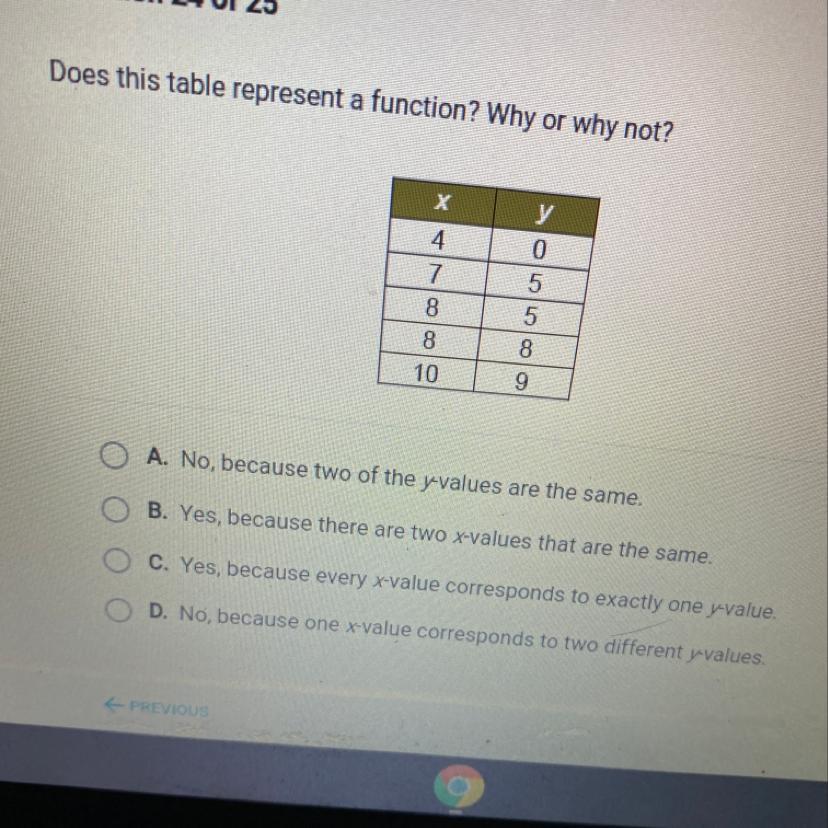
Does this table represent a function? Why or why not?

Mathematics
2 answers:
Kay [80]2 years ago
4 0

Answer: D

Step-by-step explanation:

Just did it on apex

Anuta_ua [19.1K]2 years ago
3 0

Answer:

no because one x value corresponds to two different y values

You might be interested in
Adam reduces a 14 inch long document on the photocopier. The copy is 0.6 times as long. The type on the reduced document is too
Oksanka [162]
14 inch document....it is reduced to 0.6 times as long...
14 * 0.6 = 8.4 inches long
it is too small, so he enlarges it 1.4 times...
8.4 * 1.4 = 11.76 inches <===
7 0
2 years ago
Focus groups of 15 people are randomly selected to discuss products of the Yummy Company. It is determined that the mean number
Morgarella [4.7K]

Answer:

Yes, 15 people would be unusual as it falls outside of 2 standard deviation of mean.

Step-by-step explanation:

Consider the provided information.

The mean number (per group) who recognize the Yummy brand name is 12.5, and the standard deviation is 0.58.

Mean = μ= 12.5  

σ = 0.58

n = 15

\mu\pm2\sigma=12.5\pm 2(0.58)\\\mu\pm2\sigma=12.5\pm1.16\\\mu\pm2\sigma=[11.34, 13.66]

Yes, 15 people would be unusual as it falls outside of 2 standard deviation of mean.

6 0
2 years ago
Point T, the midpoint of segment RS, can be found using the formulas x = (6 – 2) + 2 and y = (4 – 6) + 6. What are the coordinat
Fiesta28 [93]

Question:

Point T, the midpoint of segment RS, can be found using the formulas x = (1/2) (6 – 2) + 2 and y = (1/2) (4 – 6) + 6. What are the coordinates of point T?

Answer:

T(4,5)

Step-by-step explanation:

Given

x = \frac{1}{2}(6 - 2) + 2

y = \frac{1}{2}(4 - 6) + 6

Required

Determine the coordinates of T

The coordinates of T can be represented as T(x,y)

To do this, we simply solve for x and y

x = \frac{1}{2}(6 - 2) + 2

Solve 6 - 2

x = \frac{1}{2}*4 + 2

Solve 1/2 * 4

x = 2 + 2

x = 4

y = \frac{1}{2}(4 - 6) + 6

Solve 4 - 6

y = \frac{1}{2}*-2 + 6

Solve 1/2 * -2

y = -1 + 6

y = 5

Hence, the coordinates of T(x,y) is:

T(x,y) = T(4,5)

5 0
2 years ago
Read 2 more answers
"Immediately after a ban on using hand-held cell phones while driving was implemented, compliance with the law was measured. A r
sergiy2304 [10]

Answer:

(a) Null Hypothesis, H_0 : p_1-p_2=0  or  p_1= p_2  

    Alternate Hypothesis, H_A : p_1-p_2\neq 0  or  p_1\neq p_2

(b) We conclude that there is a statistical difference in these two proportions measured initially and then one year later.

Step-by-step explanation:

We are given that a random sample of 1,250 drivers found that 98.9% were in compliance. A year after the implementation, compliance was again measured to see if compliance was the same (or not) as previously measured.

A different random sample of 1,100 drivers found 96.9% compliance."

<em />

<em>Let </em>p_1<em> = proportion of drivers that were in compliance initially</em>

p_2<em> = proportion of drivers that were in compliance one year later</em>

(a) <u>Null Hypothesis</u>, H_0 : p_1-p_2=0  or  p_1= p_2      {means that there is not any statistical difference in these two proportions measured initially and then one year later}

<u>Alternate Hypothesis</u>, H_A : p_1-p_2\neq 0  or  p_1\neq p_2     {means that there is a statistical difference in these two proportions measured initially and then one year later}

The test statistics that will be used here is <u>Two-sample z proportion statistics</u>;

                     T.S.  = \frac{(\hat p_1-\hat p_2)-(p_1-p_2)}{\sqrt{ \frac{\hat p_1(1-\hat p_1)}{n_1} + \frac{\hat p_2(1-\hat p_2)}{n_2}} }  ~ N(0,1)

where, \hat p_1 = sample proportion of drivers in compliance initially = 98.9%

\hat p_2 = sample proportion of drivers in compliance one year later = 96.9%

n_1 = sample of drivers initially = 1,250

n_2 = sample of drivers one year later = 1,100

(b) So, <u><em>the test statistics</em></u>  =  \frac{(0.989-0.969)-(0)}{\sqrt{ \frac{0.989(1-0.989)}{1,250} + \frac{0.969(1-0.969)}{1,100}} }  

                                           =  3.33

<u>Now, P-value of the test statistics is given by;</u>

         P-value = P(Z > 3.33) = 1 - P(Z \leq 3.33)

                                            = 1 - 0.99957 = <u>0.00043</u>

Since in the question we are not given with the level of significance so we assume it to be 5%. Now at 5% significance level, the z table gives critical values between -1.96 and 1.96 for two-tailed test.

<em>Since our test statistics does not lies within the range of critical values of z, so we have sufficient evidence to reject our null hypothesis as it will fall in the rejection region due to which </em><u><em>we reject our null hypothesis.</em></u>

Therefore, we conclude that there is a statistical difference in these two proportions measured initially and then one year later.
7 0
2 years ago
I need the answers thanks :)
bogdanovich [222]
1.) y=3
2.) y=13
     2y + y = 3y , 22+17= 39
     3y = 39 , divide 3 on each side (which cancels out the 3 with the y which leaves you with y)
3.) y=10
     3y - y = 2y , 35-15= 20
     2y=20 , do the same as # 2.
4.) y=4
     9y - 5y = 4y , 48-32= 16
     4y=16, do the same as #2 & #3
5.) (4,5)
     x + 3y = 19
   2x - 3y = -7
    solve for x first ; x + 2x= 3x , 19-7 = 12; 3x = 12 ; divide 3 ; x= 4. You know have to make the x's cancel out. so I will multiply -2 on the first equation. -2(x+3y=19)
     -2x - 6y = -38
      2x - 3y = -7
    Now solve for y ; -6y + -3y = -9y , -38 + -7 = -45; -9y=-45 ; divide by -9 (since they are both negative your answer will be positive) ; y= 5
6.) (6,8)
   x + 4y = 38
  -x - 3y = -30
solve for y first ; 4y - 3y = y , 38-30 = 8; y=8 (that simple!) Now you need to find a common multiple for 4 & 3 which is 12. So you will have to multiply each equation by either 4 or 3.
  (x + 4y = 38)*3      =     3x + 12y = 114         
 (-x - 3y = -30)*4     =     -4x - 12y = -120
solve for x ; 3x - 4x = -x , 114-120= -6 ; -x=-6. Since the x has a negative that means there's still a 1 there so -1x=-6 ; you will need to divide this which makes the 6 a positive; x=6


8 0
2 years ago
Other questions:
  • A classroom measures 12 meters long and 9 meters wide. When using a scale of 1 cm to 1.5 m to draw the room on your paper, the s
    7·1 answer
  • The grocery store sells kumquats for $5.00 a pound and Asian pears for $3.25 a pound. Write an equation in standard form for the
    13·2 answers
  • A toy company produces two kites whose shapes are geomaetrically similar. Find the length of the missing size of similar kite.
    7·1 answer
  • The diagram shows several planes, lines, and points. Which statement is true about line h? Line h intersects line f at two point
    10·2 answers
  • Julian has to read 4 articles for school. He has 8 nights to read them. He decides to read the same number of articles each nigh
    12·1 answer
  • "A random sample of 50 university admissions officers was asked about expectations in application interviews. Of these sample me
    5·2 answers
  • Morgan is making two cookie recipes. Recipe A calls for one-third less than twice the number of cups of sugar than recipe B call
    9·2 answers
  • Joline is solving the equation 0 = x2 – 5x – 4 using the quadratic formula. Which value is the negative real number solution to
    12·1 answer
  • T-shirts and More Print Shop will print any image on a mouse pad for a cost of $2 per mouse pad and a one-time charge of $12 to
    7·1 answer
  • Ben and Joel are raising money for their class trip by selling wrapping paper. Ben raised $43.50 by selling 12 rolls of solid pa
    9·1 answer
Add answer
Login
Not registered? Fast signup
Signup
Login Signup
Ask question!
