answer.
Ask question
Login Signup
Ask question
All categories
  • English
  • Mathematics
  • Social Studies
  • Business
  • History
  • Health
  • Geography
  • Biology
  • Physics
  • Chemistry
  • Computers and Technology
  • Arts
  • World Languages
  • Spanish
  • French
  • German
  • Advanced Placement (AP)
  • SAT
  • Medicine
  • Law
  • Engineering
kakasveta [241]
2 years ago
12

Draw the Lewis structure of N₂O₄ and then choose the appropriate pair of hybridization states for the two central atoms. Your an

swer choice is independent of the orientation of your drawn structure.

Chemistry
1 answer:
marissa [1.9K]2 years ago
7 0

Answer:

See explanation

Explanation:

In this case, we have to keep in mind the valence electrons for each atom:

<u>N => 5 electrons</u>

<u>O => 6 electrons</u>

If the formula is N_2O_4, we will have in total:

(5*2)+(6*4)=34~electrons

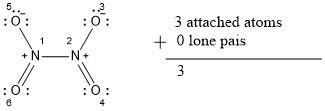
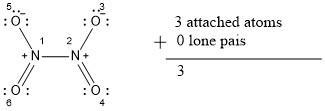
Additionally, we have to remember that each atom must have 8 electrons. So, for <u>oxygens 5 and 3</u> we will have 3 lone pairs and 1 bond (in total 8 electrons. For oxygens, <u>6 and 4</u> we will have 2 lone pairs and 2 bonds (in total 8 electrons) and for <u>nitrogens 1 and 2</u> we will have 4 bonds (in total 8 electrons).

To find the <u>hybridization</u>, we have to count the atoms and the lone pairs around the nitrogen. We have 3 atoms and zero lone pairs. If we take into account the following rules:

Sp^3~=~4

Sp^2~=~3

Sp~=~2

With this in mind, the hybridization of nitrogen is Sp^2.

See figure 1

I hope it helps!

You might be interested in
A sample of chlorine gas is held at a pressure of 1023.6 Pa. When the pressure is decreased to 811.4 Pa the volume is 25.6 L. Wh
My name is Ann [436]

Answer:

V1 = 20.3L

Explanation:

P2 = 811.4Pa

V2 = 25.6L

P1 = 1023.6Pa

V1 = ?

To solve this question, we'll have to use Boyle's law which states that the volume of a fixed mass of gas is inversely proportional to its pressure provided that temperature remains constant.

Mathematically,

V = k / P, k = PV

P1 × V1 = P2 × V2 = P3 ×V3 =......=Pn × Vn

P1 × V1 = P2 × V2

Solve for V1

V1 = (P2 × V2) / P1

V1 = (811.4 × 25.6) / 1023.6Pa

V1 = 20771.84 / 1023.6

V1 = 20.29 = 20.3L

The initial volume was 20.3L

6 0
2 years ago
C5H12, pentane, is a liquid at room temperature.
Art [367]

Answer:

C)We cannot be sure unless we find out its boiling point.

Explanation:

It is necessary to clearly explain here that simply observing two compounds of the same homologous series irrespective of how close they may be in the series will not give us the faintest idea regarding which one will be a liquid, solid or gas at room temperature.

However, to determine whether an unknown substance will be a liquid at room temperature, then its important to measure its boiling point. If the boiling point is above room temperature, and the melting point is below room temperature, the compound is a liquid. If the boiling point of the unknown substance is below room temperature, it is a gas.

It is now safe to conclude that cannot decide on the state of matter in which a compound exists unless we know something about its boiling point, not merely looking closely at the properties of its neighbouring compounds in the same homologous series

8 0
2 years ago
Question 2 The metal molybdenum becomes superconducting at temperatures below 0.90K. Calculate the temperature at which molybden
LenKa [72]

Answer:

Temperature at which molybdenum becomes superconducting is-272.25°C

Explanation:

Conductor are those hard substances which allows path of electric current through them. And super conductors are those hard substances which have resistance against the flow of electric current through them.

As given, molybdenum becomes superconducting at temperatures below 0.90 K.

Temperature in Kelvins can be converted in °C by relation:

T(°C)=273.15-T(K)

Molybdenum becomes superconducting in degrees Celsius.

T(°C)=273.15-0.90= -272.25 °C

Temperature at which molybdenum becomes superconducting is -272.25 °C

5 0
2 years ago
The values used in the scale of pH and pOH are derived from a system designed by ______. Gordonsen Sorenson Curie Dalton
yaroslaw [1]

Sorenson

Explanation:

The values used in the scale of pH and pOH are derived from a system designed by Sorenson. Søren Peter Lauritz Sørensen, a Danish chemist introduced the system of pH and pOH for describing the alkalinity and acidity of substances.

  • The pH and pOH scale is logarithmic scale that ranks the acidity and bascity of compounds.
  • pH is the negative logarithm of the concentration of  hydrogen/hydroxonium ions in solution i.e

              pH = -log₁₀{H⁺]

  • pOH is the negative log of the concentration of the hydroxyl ions in a solution i.e

             pOH = -log₁₀{OH⁻]

Learn more:

calculating pH: brainly.com/question/12985875

pH scale: brainly.com/question/11063271

#learnwithBrainly

3 0
2 years ago
Which of the following statements about monosaccharide structure is true?
Nana76 [90]

Answer:

The only statement about monosaccharide structure which is true is b. (Monosaccharides can be classified according to the spatial arrangement of their atoms)

Explanation:

Monosaccharides are simple sugars that are classified according to the amount of carbon atoms and based on these numbers, we can call them trioses, pentoses and hexoses. They are molecules with aldehyde (aldose) or centone (ketose) groups that have more than one alcohol function, but which do not differ in their position (OH). They do not contain N, since their general formula is Cx (H2O) x. A 6-carbon monosaccharide is called hexose, since the pentose only has 5
8 0
2 years ago
Other questions:
  • A hydrate of CoCl2 with a mass of 6.00 g is heated strongly. after cooling the mass the anhydrate is 3.27g
    14·2 answers
  • A gas can holds 2.9 gal of gasoline.<br><br><br> What is this quantity in cubic centimeters?
    5·1 answer
  • If 14c-labeled uracil is added to the growth medium of cells, what macromolecules will be labeled?
    7·2 answers
  • A piece of metal with a mass of 611 g is placed into a graduated cylinder that contains 25.1 ml of water, raising the water leve
    8·1 answer
  • At 25 °C, an aqueous solution has an equilibrium concentration of 0.00253 M for a generic cation, A2+(aq), and 0.00506 M for a g
    12·2 answers
  • A student carried out this reaction with methane as the limiting reagent. A 12.0 g quantity of methane was used, and the student
    11·1 answer
  • Identify which of the following two reactions you would expect to occur more rapidly: (1) addition of HBr to 2-methyl-2-pentene
    13·1 answer
  • Which of the following species is a molecular element?1. neon 2. carbon dioxide3. chlorine 4. sodium 5. none of the above
    6·1 answer
  • Density of copper is 8.96 g/cm3 and density of zinc is 7.14 g/cm3 . Brass is an alloy made of copper and zinc. You are given a s
    6·1 answer
  • A 1-L soda bottle contains dissolved carbon dioxide gas. Which bottle would have the highest concentration of dissolved gas? a b
    7·2 answers
Add answer
Login
Not registered? Fast signup
Signup
Login Signup
Ask question!
