answer.
Ask question
Login Signup
Ask question
All categories
  • English
  • Mathematics
  • Social Studies
  • Business
  • History
  • Health
  • Geography
  • Biology
  • Physics
  • Chemistry
  • Computers and Technology
  • Arts
  • World Languages
  • Spanish
  • French
  • German
  • Advanced Placement (AP)
  • SAT
  • Medicine
  • Law
  • Engineering
just olya [345]
2 years ago
13

Identify each reaction from the citric acid cycle as an oxidation‑reduction reaction, an esterification reaction, an amidation r

eaction, a hydrolysis reaction, a hydration reaction, or a dehydration reaction.
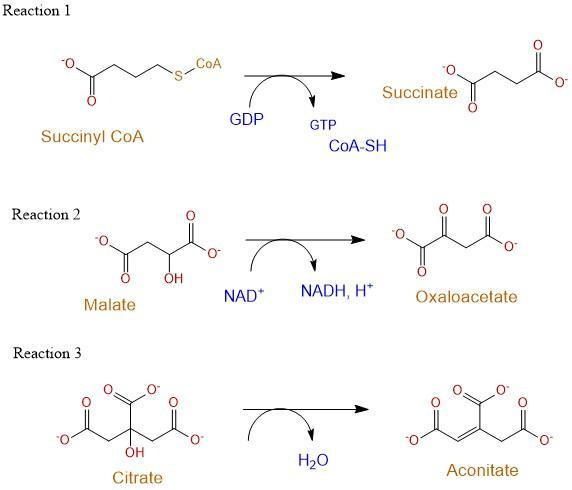
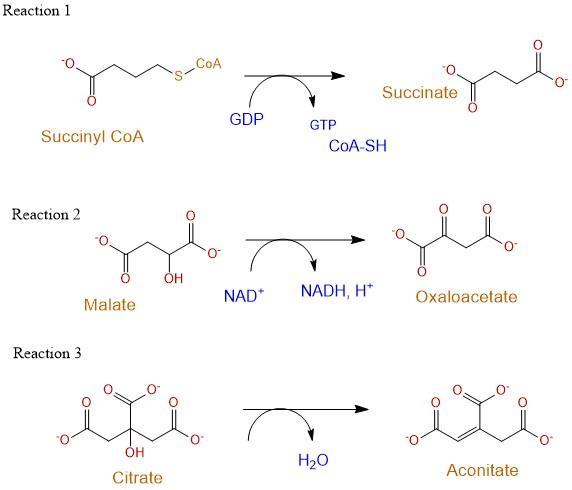
1. Which type of reaction occurs when succinyl-CoA is converted to succinate in the citric acid cycle?
2. Which type of reaction occurs when malate is converted to oxaloacetate in the citric acid cycle?
3. Which type of reaction occurs when aconitate is converted to isocitrate in the citric acid cycle?

Chemistry
1 answer:
ser-zykov [4K]2 years ago
5 0

Answer:

1. Oxidation-reduction and hydrolysis

2. Oxidation-reduction

3. Dehydration

Explanation:

Our options for each reaction are:

a) Oxidation‑reduction reaction

b) Esterification reaction

c) Amidation reaction

d) Hydrolysis reaction

c) Hydration reaction

f) Dehydration reaction

In reaction one the have the <u>rupture of the S-CoA bond</u>. This reaction takes place by the <u>addition of a water molecule</u> and the <u>oxidation to a carboxylic acid group</u>. So, for reaction 1 we will have an oxidation-reduction and a hydrolysis reaction.

For reaction 2, the functional group change from <u>alcohol</u> to a <u>carboxylic acid</u>. So, we have an oxidation-reduction reaction.

In the last reaction, we have the <u>production of a double bond</u> by the removal of water. With this in mind, we have a dehydration reaction.

See figure 1

I hope it helps

You might be interested in
How much heat will be absorbed by a 50.3 g piece of aluminum (specific heat = 0.930 J/g・°C) as it changes temperature from 23.0°
shepuryov [24]

Answer:

quantity of heat= <u>mc</u>*they

=50.3*0.930*(67-23)

=46.779*44

=2058.276

quantity of heat =2058.3kJ

8 0
2 years ago
it takes 26.23 mL of a 1.008 M NaOh solution to neutralize a solution of an unknown monoprotic acid in 150.2 mL of solution. Wha
ASHA 777 [7]

Answer:

.176 M

Explanation:

set the number of moles of the base equal to the number of moles of acid.

(1.008 mol/L)(26.23 x 10^-3 L)=(150.2x10^-3 L)(x)

x = .176030892 mol/L

8 0
2 years ago
Would you expect salts of the gold(I) ion, Au+, to be colored? Explain.
kolezko [41]

Answer:

No. Au⁺ has a complete 5d sublevel.

Explanation:

The color of the transition metal/ion arises due to d-d transition which means that when energy of certain frequency is passed though the solution of the transition metal ions, the electrons of the d orbital gain some energy and goes to higher energy level. The energy absorbed lies in the visible region and thus they are appeared colored.

The electronic configuration of Au is:

1s²2s²2p⁶3s²3p⁶3d¹⁰4s²4p⁶4d¹⁰5s²5p⁶4f¹⁴5d¹⁰6s¹

If the gold atom looses one electron, then the electronic configuration is:

1s²2s²2p⁶3s²3p⁶3d¹⁰4s²4p⁶4d¹⁰5s²5p⁶4f¹⁴5d¹⁰

<u>Hence, in the configuration, the 5d orbital is full filled and there is no scope for d-d transition. </u>

<u>Thus, there will Au⁺ will not be colored.</u>

8 0
2 years ago
Which correctly describes elements in the same group? select one:
Nadya [2.5K]
They have the same amounts of electrons
7 0
2 years ago
How do you draw acetone using a Bohr model?
Inessa [10]

Explanation:

this is the one i found.....
6 0
2 years ago
Other questions:
  • An isotope undergoes radioactive decay by emitting radiation that has a –1 charge. What other characteristic does the radiation
    14·2 answers
  • If the human body were a car, glucose would be:
    11·1 answer
  • Identify the compounds below as a brønsted-lowry acid or lewis acid by clicking and dragging it into the correct column
    7·2 answers
  • A carpet sells for 27.99 a square yard. What is the price of the carpet square per square meter ?
    11·1 answer
  • How many moles of calcium chloride (CaCl2) are needed to react completely with 6.2 moles of silver nitrate (AgNO3)? 2AgNO3 + CaC
    15·1 answer
  • A piece of aluminum foil 1.00cm square and 0.590mm thick is allowed to react with bromine to form aluminum bromide. Part A How m
    12·1 answer
  • Which statement accurately compares ionic and covalent bonding?
    8·2 answers
  • A proton transfer reaction can occur when an aldehyde is placed in strong base, such as an alkoxide ion, producing an alcohol an
    11·1 answer
  • A 20.0-mL sample of lake water was acidified with nitric acid and treated with excess KSCN to form a red complex (KSCN itself is
    14·1 answer
  • Which is an example of how society affects science?
    9·2 answers
Add answer
Login
Not registered? Fast signup
Signup
Login Signup
Ask question!