answer.
Ask question
Login Signup
Ask question
All categories
  • English
  • Mathematics
  • Social Studies
  • Business
  • History
  • Health
  • Geography
  • Biology
  • Physics
  • Chemistry
  • Computers and Technology
  • Arts
  • World Languages
  • Spanish
  • French
  • German
  • Advanced Placement (AP)
  • SAT
  • Medicine
  • Law
  • Engineering
olchik [2.2K]
2 years ago
5

Two small balls A and B with masses 2m and m respectively are released from rest at a height h above the ground. Neglecting air

resistance, which of the following statements are true when the two balls hit the ground?
(a) The kinetic energy of A is the same as the kinetic energy of B
(b) The kinetic energy of A is half the kinetic energy of B.
(c) The kinetic energy of A is twice the kinetic energy of B.
(d) The kinetic energy of A is four times the kinetic energy of B Explain your answer why.
What is the definition of General Plan Motion? What would be the effective methodology or approach to solve a rigid body kinematics problem?
Engineering
1 answer:
statuscvo [17]2 years ago
5 0

Answer:

The kinetic energy of A is twice the kinetic energy of B

Explanation:

You might be interested in
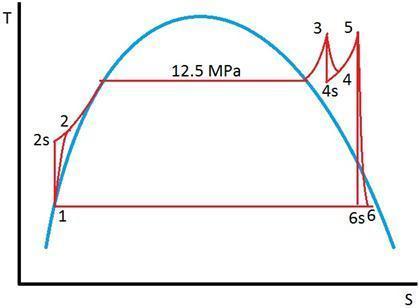
A steam power plant operates on the reheat Rankine cycle. Steam enters the highpressure turbine at 12.5 MPa and 550°C at a rate
gayaneshka [121]

Answer:

A) condenser pressure = 9.73 kPa,

B) 10242 kw

C) 36.9%

Explanation:

given data

entrance pressure of steam = 12.5 MPa

temperature of steam = 550⁰c

flow rate of steam = 7.7 kg/s

outer pressure = 2 MPa

reheated steam temperature = 450⁰c

isentropic efficiency of turbine( nt ) = 85% = 0.85

isentropic efficiency of pump = 90% = 0.90

From steam tables

at 12.5 MPa and 550⁰c ; h3 = 3476.5 kJ/kg,  S3 = 6.6317 kJ/kgK

also for an Isentropic expansion

S4s = S3 .

therefore when S4s = 6.6317 kJ/kg and P4 = 2 MPa

h4s = 2948.1 kJ/kg

nt = 0.85

nt (0.85) = \frac{h3-h4}{h3-h4s} = \frac{3476.5 - h4}{3476.5 - 2948.1}

making h4 subject of the equation

h4 = 3476.5 - 0.85 (3476.5 - 2948.1)

h4 = 3027.3 kj/kg

at P5 = 2 MPa and T5 = 450⁰c

h5 = 3358.2 kj/kg,  s5 = 7.2815 kj/kgk

at P6 , x6 = 0.95  and s5 = s6

using nt = 0.85 we can calculate for h6 and h6s

from the chart attached below we can see that

p6 = 9.73 kPa, h6 = 2463.3 kj/kg

B) the net power output

solution is attached below

c) thermal efficiency

thermal efficiency = 1 - \frac{qout}{qin} = 1 - ( 2273.7/ 3603.8) = 36.9% ≈ 37%

8 0
2 years ago
At an impaired driver checkpoint, the time required to conduct the impairment test varies (according to an exponential distribut
professor190 [17]

Answer:

Option (d) 2 min/veh

Explanation:

Data provided in the question:

Average time required = 60 seconds

Therefore,

The maximum capacity that can be accommodated on the system, μ = 60 veh/hr

Average Arrival rate, λ = 30 vehicles per hour

Now,

The average time spent by the vehicle is given as

⇒ \frac{1}{\mu(1-\frac{\lambda}{\mu})}

thus,

on substituting the respective values, we get

Average time spent by the vehicle = \frac{1}{60(1-\frac{30}{60})}

or

Average time spent by the vehicle = \frac{1}{60(1-0.5)}

or

Average time spent by the vehicle = \frac{1}{60(0.5)}

or

Average time spent by the vehicle = \frac{1}{30} hr/veh

or

Average time spent by the vehicle = \frac{1}{30}\times60 min/veh

[ 1 hour = 60 minutes]

thus,

Average time spent by the vehicle = 2 min/veh

Hence,

Option (d) 2 min/veh

7 0
2 years ago
To unload a bound stack of plywood from a truck, the driver first tilts the bed of the truck and then accelerates from rest. Kno
azamat

Answer:

a) The truck must have an acceleration of at least 3.92 * cos(θ)^2 for the stack to start sliding.

b) a = 2.94 * cos(θ)^2 + 0.32 * L * cos(θ)

Explanation:

The stack of plywood has a certain mass. The weight will depend on that mass.

w = m * g

There will be a normal reaction between the stack and the bed of the truck, this will be:

nr = -m * g * cos(θ)

Being θ the tilt angle of the bed.

The static friction force will be:

ffs = - m * g * cos(θ) * fJK

The dynamic friction force will be:

ffd = - m * g * cos(θ) * fik

These forces would produce accelerations

affs = -g * cos(θ) * fJK

affd = -g * cos(θ) * fik

affs = -9.81 * cos(θ) * 0.4 = -3.92 * cos(θ)

affd = -9.81 * cos(θ) * 0.3 = -2.94 * cos(θ)

These accelerations oppose to movement and must be overcome by another acceleration to move the stack.

The acceleration of the truck is horizontal, the horizontal component of these friction forces is:

affs = -3.92 * cos(θ)^2

affd = -2.94 * cos(θ)^2

The truck must have an acceleration of at least 3.92 * cos(θ)^2 for the stack to start sliding.

Assuming the bed has a lenght L.

The horizontal movement will be over a distance cos(θ) * L because L is tilted.

Movement under constant acceleration:

X(t) = X0 + V0 * t + 1/2 * a * t^2

In this case X0 = 0, V0 = 0, and a will be the sum of the friction force minus the acceleration of the truck.

If we set the frame of reference with the origin on the initial position of the stack and the positive X axis pointing backwards, the acceleration of the truck will now be negative and the dynamic friction acceleration positive.

L * cos(θ) = 1/2 * (2.94 * cos(θ)^2 - a) * 0.4^2

2.94 * cos(θ)^2 - a = 2 * 0.16 * L * cos(θ)

a = 2.94 * cos(θ)^2 + 0.32 * L * cos(θ)

6 0
2 years ago
Dust, dirt, or metal chips can pose a potential ____ injury risk in a shop.
pantera1 [17]

Answer:

Eye.

Explanation:

Dust, dirt, and metal chips are most unpleasant to get in your eyes. Just experience it and you'll know what I mean.

;)

3 0
2 years ago
The force exerted on a bridge pier in a river is to be tested in a 1:10 scale model using water as the working fluid. In the pro
Len [333]

Answer:

Force on the prototype is 5000 N

Solution:

As per the question:

Depth of water, x = 2.0 m

Flow velocity, v' = 1.5 m/s

Width of the river, w = 20 m

Force on the bridge pier model, F' = 5 N

Pressure, Ratio = Ratio of scale length

Scale = 1:10

Now,

\frac{P'}{P} = \frac{x}{w} = \frac{2.0}{20}

where

P' = pressure on model

P = pressure on prototype

\frac{\frac{F'}{A'}}{\frac{F}{A}} = \frac{1}{10}

where

F' = Force on model

F = Force on prototype

A' = Area of model

A = Area of prototype

Now:

\frac{F'}{F}.\frac{A}{A'} = \frac{1}{10}

\frac{5}{F}.\frac{1}{\frac{1}{10}}.\frac{1}{\frac{1}{10}} = \frac{1}{10}

F = 5000 N

3 0
2 years ago
Other questions:
  • Problem 5) Water is pumped through a 60 m long, 0.3 m diameter pipe from a lower reservoir to a higher reservoir whose surface i
    13·1 answer
  • The four-wheel-drive all-terrain vehicle has a mass of 320 kg with center of mass G2. The driver has a mass of 82 kg with center
    15·1 answer
  • The basic barometer can be used to measure the height of a building. If the barometric readings at the top and the bottom of a b
    15·1 answer
  • A steady tensile load of 5.00kN is applied to a square bar, 12mm on a side and having a length of 1.65m. compute the stress in t
    13·1 answer
  • A platinum resistance temperature sensor has a resistance of 120 Ω at 0℃ and forms one arm of a Wheatstone bridge. At this tempe
    12·1 answer
  • The function below takes a single string parameter: input_string. If the input contains the lowercase letter z, return the strin
    15·1 answer
  • - Consider a 2024-T4 aluminum material with ultimate tensile strength of 70 ksi. In a given application, a component of this mat
    7·1 answer
  • 11 Notează, în caiet, trăsăturile personajelor ce se pot
    13·1 answer
  • Draw an ERD for each of the following situations. (If you believe that you need to make additional assumptions, clearly state th
    15·1 answer
  • Why is data driven analytics of interest to companies?
    9·1 answer
Add answer
Login
Not registered? Fast signup
Signup
Login Signup
Ask question!