answer.
Ask question
Login Signup
Ask question
All categories
  • English
  • Mathematics
  • Social Studies
  • Business
  • History
  • Health
  • Geography
  • Biology
  • Physics
  • Chemistry
  • Computers and Technology
  • Arts
  • World Languages
  • Spanish
  • French
  • German
  • Advanced Placement (AP)
  • SAT
  • Medicine
  • Law
  • Engineering
attashe74 [19]
2 years ago
14

Which of the following are units for expressing rotational velocity, commonly denoted by ω?

Physics
2 answers:
Kisachek [45]2 years ago
7 0
Angular or rotational velocity is expressed in radians per second.
KatRina [158]2 years ago
4 0

The rotational velocity is expressed in  {{{\text{rad}}} \mathord{\left/ {\vphantom {{{\text{rad}}} {\text{s}}}} \right. \kern-\nulldelimiterspace} {\text{s}}} or {{\text{1}} \mathord{\left/ {\vphantom {{\text{1}} {\text{s}}}} \right. \kern-\nulldelimiterspace} {\text{s}}} or {{\text{s}}^{{\text{ - 1}}}}.

Further Explanation:

The rotational velocity is the velocity of an object moving around a circular path or rotating or revolving relative to a point or axis of the object in a given interval of time. The rotational velocity is also known as the angular velocity.

Concept:

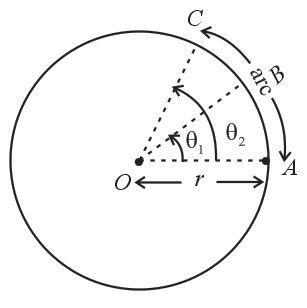
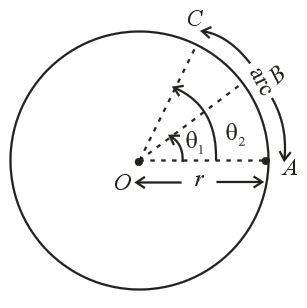
Consider an object, it starts to move on a circular path with a constant velocity v. The distance between the center of the circular path and the object is fixed or constant throughout the motion, it is equal to the radius of the circular path i.e., r.

The object is initially, at rest, is placed at point A. The object starts to move on the circular path and at time {t_1} it reaches the point B and makes an angle {\theta _1} at the center of the circle with respect to its initial position i.e., point A. At time {t_2}, the object makes an angle of {\theta _2} at the center of the circle.

The angular velocity of an object moving on a circular path is defined as the ratio of change in angle made by the object at the center of the circular path with change in time.

The angular velocity is:

\fbox{\begin\omega= \dfrac{{{\theta _2} - {\theta _1}}}{{{t_2} - {t_1}}}= \dfrac{{\Delta \theta }}{{\Delta t}}\end{minispace}}                                                         …… (1)

Here, \Delta \theta is the change in the angle made by the object at the center of the circular path and \Delta t is the change in time.

The angle, made by an object moving on a circular path, at the center of the circular path is measured in radians and time change in time or time interval is measured in seconds. Therefore, from equation (1), the unit of rotational velocity is {{{\text{rad}}} \mathord{\left/ {\vphantom {{{\text{rad}}} {\text{s}}}} \right. \kern-\nulldelimiterspace} {\text{s}}}.

The angular velocity is also defined as the ratio of linear velocity, with which the object is moving on circular path, and the distance between the center of the circular path and the object.

The angular velocity is:

\fbox{\begin\omega=\dfrac{v}{r}\end{minispace}}                                                        …… (2)

The velocity of the object is measured in {{\text{m}} \mathord{\left/ {\vphantom {{\text{m}} {\text{s}}}} \right. \kern-\nulldelimiterspace} {\text{s}}} and the distance between the center of the circular path and the object is measured in {\text{m}}. Therefore, the angular velocity or rotational velocity is measured in {{\text{1}} \mathord{\left/ {\vphantom {{\text{1}} {\text{s}}}} \right. \kern-\nulldelimiterspace} {\text{s}}} or {{\text{s}}^{{\text{-1}}}}.

Thus, the rotational velocity is expressed in  {{{\text{rad}}} \mathord{\left/ {\vphantom {{{\text{rad}}} {\text{s}}}} \right. \kern-\nulldelimiterspace} {\text{s}}} or {{\text{1}} \mathord{\left/ {\vphantom {{\text{1}} {\text{s}}}} \right. \kern-\nulldelimiterspace} {\text{s}}} or {{\text{s}}^{{\text{ - 1}}}}.

Learn more:

1. Acceleration of a moving object  brainly.com/question/7031524

2. Change in momentum brainly.com/question/9484203

3. Conservation of energy brainly.com/question/3943029

Answer Details:

Grade: High School

Subject: Physics

Chapter: Kinematics

Keywords:

Angular velocity, rotational velocity, circular path, rotation, object revolving around a fixed point, change in the angle subtended at the center of circular path, radian/second, rad/sec, rad/s, 1/s, s^-1.
You might be interested in
A 7.0-kilogram cart, A, and a 3.0-kilogram cart, B, are initially held together at rest on a horizontal, frictionless surface. W
7nadin3 [17]
For this problem, we use the conservation of momentum as a solution. Since momentum is mass times velocity, then,

m₁v₁ + m₂v₂ = m₁v₁' + m₂v₂'
where
v₁ and v₂ are initial velocities of cart A and B, respectively
v₁' and v₂' are final velocities of cart A and B, respectively
m₁ and m₂ are masses of cart A and B, respectively

(7 kg)(0 m/s) + (3 kg)(0 m/s) = (7 kg)(v₁') + (3 kg)(6 m/s)
Solving for v₁',
v₁' = -2.57 m/s

<em>Therefore, the speed of cart A is at 2.57 m/s at the direction opposite of cart B.</em>
7 0
2 years ago
Jack pulls a sled across a level field by exerting a force of 110 n at an angle of 30 with the ground. what are the parallel and
Elina [12.6K]
<span>You are given an applied force of 110 n with an angle of 30</span>°<span> with the ground. Since the  force is not perpendicular or parallel to the sled then you will have two components. These components are in sine and cosine form.

for parallel component
x = rcos</span>β
<span>x = 110cos30</span>°
<span>x = 95.26

for the perpendicular component
y = rsin</span>β
<span>y = 110sin30</span>°
<span>y = 55</span>
3 0
2 years ago
Read 2 more answers
A 20 watt lightbulb uses 20 Joules of energy every second.A person expends 50 watts of energy per stair when climbing up stairs.
Pachacha [2.7K]
20W = 20 J/s

Energy expended during climbing stairs = 50 W of energy/stair = 50J/stair

For 20 stairs, Total energy = 50x20 = 1000 J

This can light bulbs for, T= 1000J/20 J/s =50 seconds
6 0
2 years ago
A typical garden hose has an inner diameter of 5/8". Let's say you connect it to a faucet and the water comes out of the hose wi
castortr0y [4]
Since speed (v) is in ft/sec, let's convert our diameters from inches to feet:
1) 5/8in = 0.625in
0.625in × 1ft/12in = 0.0521ft
2) 0.25in × 1ft/12in = 0.021ft
Equation:
v = 4q \div ( {d}^{2} \pi) \: where \: q = flow \\ v = velocity \: (speed) \: and \:  \\ d = diameter \: of \: pipe \: or \: hose \\ and \: \pi = 3.142
we \: can \: only \: assume \:that \\  flow \: (q) \:stays \: same \: since \: it \\  isnt \: impeded \: by \:  anything \\ thus \:it  \: (q)\:  stays \: the \: same \:  \\ so \: 4q \: can \: be \: removed \: from \:  \\ the \: equation
then \: we \: can \: assume \: that \: only \\ v \: and \: d \: change \: leading \:us \: to >  >  \\ (v1 \times {d1}^{2} \pi) = (v2  \times   {d2}^{2}\pi)
both \: \pi \: will \: cancel \: each \: other \: out \:  \\ as \: constants \:since \: one \: is \: on \\ each \: side \: of \: the \:  =

(v1  \times   {d1}^{2}) = (v2 \ \times {d2}^{2}) \\ (7.0 \times   {0.052}^{2}) = (v2  \times   {0.021}^{2}) \\ divide \: both \: sides \: by \:  {0.021}^{2} \\ to \: solve \: for \: v2 >  >
v2 = (7.0)( {0.052}^{2} ) \div ( {0.021}^{2})  \\ v2 = (7.0)(.0027) \div (.00043) \\ v2 = 44 \: feet \: per \: second
new velocity coming out of the hose then is
44 ft/sec
4 0
2 years ago
Two forces F1 and F2 act on a 5.00 kg object. Taking F1=20.0N and F2=15.00N, find the acceleration of the object for the configu
Anit [1.1K]
A) mass m with F1 acting in the positive x direction and F2 acting perpendicular in the positive y direction<span>

m = 5.00 kg
F1=20.0N  ... x direction
F2=15.00N</span><span>  ... y direction

Net force ^2 = F1^2 + F2^2 = (20N)^2 + (15n)^2 =  625N^2 =>

Net force = √625 = 25N

F = m*a => a = F/m = 25.0 N /5.00 kg = 5 m/s^2

Answer: 5.00 m/s^2

b) mass m with F1 acting in the positive x direction and F2 acting on the object at 60 degrees above the horizontal. </span>

<span>m = 5.00 kg
F1=20.0N  ... x direction
F2=15.00N</span><span>  ... 60 degress above x direction

Components of F2

F2,x = F2*cos(60) = 15N / 2 = 7.5N

F2, y = F2*sin(60) = 15N* 0.866 = 12.99 N ≈ 13 N


Total force in x = F1 + F2,x = 20.0 N + 7.5 N = 27.5 N

Total force in y = F2,y = 13.0 N

Net force^2 = (27.5N)^2 + (13.0N)^2 = 925.25 N^2 = Net force = √(925.25N^2) =

= 30.42N

a = F /m = 30.42 N / 5.00 kg = 6.08 m/s^2

Answer: 6.08 m/s^2


</span>
8 0
2 years ago
Read 2 more answers
Other questions:
  • A 3.0 cm object is 12.0 cm from a convex mirror that has a focal length of 20.0 cm.
    13·2 answers
  • an asteroid flies close to the earth. gravity does what? A.repels the asteroid away from the earth. B. attracts the asteroid and
    13·1 answer
  • Two blocks a and b ($m_a&gt;m_b$) are pushed for a certain distance along a frictionless surface. how does the magnitude of the
    7·1 answer
  • A hollow cylinder of mass 2.00 kg, inner radius 0.100 m, and outer radius 0.200 m is free to rotate without friction around a ho
    7·1 answer
  • The eyes of many older people have lost the ability to accommodate, and so an older person’s near point may be more than 25 cm f
    12·1 answer
  • A weatherman carried an aneroid barometer from the ground floor to his office atop the Sears Tower in Chicago. On the level grou
    10·1 answer
  • The frequency of a wave increases. If the speed of the wave remains constant, what happens to the distance between successive cr
    6·1 answer
  • On a guitar, the lowest toned string is usually strung to the E note, which produces sound at 82.4 82.4 Hz. The diameter of E gu
    12·1 answer
  • The superhero Green Lantern steps from the top of a tall building. He falls freely from rest to the ground, falling half the tot
    6·1 answer
  • This is a problem about a child pushing a stack of two blocks along a horizontal floor. The masses of the blocks, and the coeffi
    13·1 answer
Add answer
Login
Not registered? Fast signup
Signup
Login Signup
Ask question!
