answer.
Ask question
Login Signup
Ask question
All categories
  • English
  • Mathematics
  • Social Studies
  • Business
  • History
  • Health
  • Geography
  • Biology
  • Physics
  • Chemistry
  • Computers and Technology
  • Arts
  • World Languages
  • Spanish
  • French
  • German
  • Advanced Placement (AP)
  • SAT
  • Medicine
  • Law
  • Engineering
antoniya [11.8K]
2 years ago
10

When sand is coated with a layer of trimethylhydroxysilane, (CH3)3SiOH, it repels water and can no longer get wet. Hydrophobic s

and (aka, magic sand) is fun to play with, but it can also have useful applications in agriculture to reduce water consumption (Water Resour. Manag. 2010, 24, 2237–2246). Predict the geometry for the silicon atom in trimethylhydroxysilane.
The geometry of the silicon atom in trimethylhydroxysilane is:__________
Chemistry
1 answer:
Juli2301 [7.4K]2 years ago
7 0
Is that how it’s spell trimethyhydrosilane?
You might be interested in
At 10°c one volume of water dissolves 3.10 volumes of chlorine gas at 1.00 atm pressure. what is the henry's law constant of cl2
s344n2d4d5 [400]
Answer is:  0,133 mol/ l· atm.
T(chlorine) = 10°C = 283K.
p(chlorine) = 1 atm.
V(chlorine) = 3,10 l.
R - gas constant, R = 0.0821 atm·l/mol·K. 
Ideal gas law: p·V = n·R·T
n(chlorine) = p·V ÷ R·T.
n(chlorine) = 1atm · 3,10l ÷ 0,0821 atm·l/mol·K · 283K = 0,133mol.
Henry's law: c = p·k.
k - <span>Henry's law constant.
</span>c - solubility of a gas at a fixed temperature in a particular solvent.
c = 0,133 mol/l.
k = 0,133 mol/l ÷ 1 atm = 0,133 mol/ l· atm.

4 0
2 years ago
During an endothermic phase change, what happens to potential energy and the kinetic energy
polet [3.4K]
During this phase Change heat energy is being absorbed by the molecules, and as a result the molecules possess a greater ability to move around and possess higher kinetic energy because of this. The molecules also possess a higher potential energy.
7 0
2 years ago
Read 2 more answers
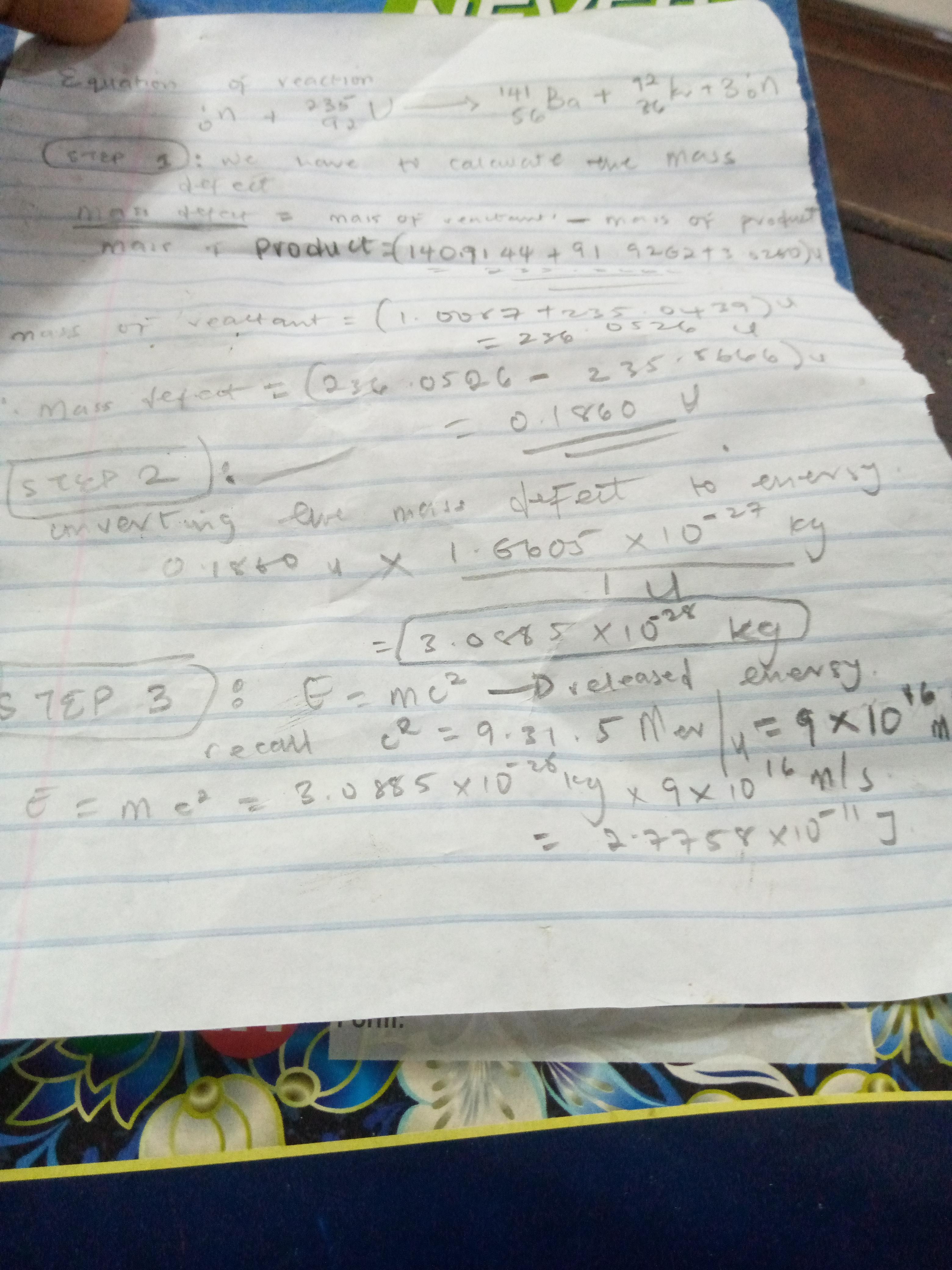
What is the reaction energy Q of this reaction? Use c2=931.5MeV/u. Express your answer in millions of electron volts to three si
emmasim [6.3K]

Answer:

Energy= 2.7758 × 10^-11 J ;

71.112×10^-6 kJ.

Mass defect in Kilogram= 3.0885×10^-28 kg.

That is; 3.1×10^-28 kg(to two significant figure).

Explanation:

(Note: Check equation of reaction in the attached file/picture).

STEP ONE: we have to calculate the Mass defect.

Mass defect= Mass of reactants -- Mass of products.

Mass of the products: (140.9144+91.9262+3.060) u.

= 235.8666 u.

Mass of reactants: (1.0087+235.0439) u= 236.0526 u.

Therefore, the Mass defect= (236.0526 -- 235.8666) u

= 0.1860 u.

STEP TWO: Converting the Mass defect to energy;

0.18860 × 1.6605 × 10^27 kg

= 3.0885× 10^-28 kg

STEP THREE: Calculating energy released . Recall(from the question) c^2= 931.5 Mev/u. This is also equals to 9×10^16 m/s.

E=Mc^2.

Where E= energy released, c= speed of light, M= Mass.

Slotting in the values;

E= 3.0885×10^-28 kg × 9×10^16 m/s.

E=2.7758 × 10^-11 J.

Know that;( 1g of uranium × 1 mol of uranium ÷ 235.0439 g of uranium) × (6.002×10^23 atom of uranium/ 1 mol of uranium) × 2.7758× 10^-11.

=7.1112×10^-10 J

= 71.112×10^6 kJ.

3 0
2 years ago
What is the specific heat of an unknown substance if a 2.50 g sample releases 12 calories as its
pishuonlain [190]

Answer:

c = 4016.64 j/g.°C

Explanation:

Given data:

Mass of substance = 2.50 g

Calories release = 12 cal (12 ×4184 = 50208 j)

Initial temperature = 25°C

Final temperature = 20°C

Specific heat of substance = ?

Formula:

Q = m.c. ΔT

Q = amount of heat absorbed or released

m = mass of given substance

c = specific heat capacity of substance

ΔT = change in temperature

Solution:

Q = m.c. ΔT

ΔT  = T2 - T1

ΔT  = 20°C - 25°C

ΔT  = -5°C

50208 j = 2.50 g . c. -5°C

50208 j = -12.5 g.°C .c

50208 j /-12.5 g.°C =  c

c = 4016.64 j/g.°C

7 0
2 years ago
What is the conjugate acid of each of the following? What is the conjugate base of each?
Lilit [14]

Answer:

a. H₂O (conjugate acid) ; b. OH⁻ (conjugate base), H₃O⁺ (conjugate acid) ; c. H₂CO₃ (conjugate acid), CO₃⁻² (conjugate base) ; d. NH₄⁺ (conjugate strong acid) e. H₂SO₄ (conjugate acid), SO₄⁻² (conjugate base) ; f. No conjugate acid either base;  g. H₂S (conjugate acid), S⁻² (conjugate base);

h. H₄N₂ (conjugate base)

Explanation:

a.  OH⁻  +  H⁺  ⇄ H₂O

The hydroxide acts like a Bronsted Lory base, so it can catch a proton. Water will be the conjugate acid.

b. H₂O, is an amphoterus compound. It can act as an acid or a base. If it is a base, the conjugate acid is the H₃O⁺. If it is an acid, the conjugate base is the OH⁻.

c. HCO₃⁻  +  H⁺  ⇄  H₂CO₃

HCO₃⁻  +  H₂O  ⇄ CO₃⁻²  +  H₃O⁺

The bicarbonate is also amphoteric. When it catches the proton, the carbonic acid is the conjugate acid, cause it works as a base.

When the HCO₃⁻ (acid) release the proton, the conjugate base is the carbonate.

d. Ammonia is a weak base, so the conjugate strong acid is the ammonium.

NH₃ + H₂O  ⇄  NH₄⁺  +  OH⁻

e. Another amphoteric compound. The acid sulfate acts an acid and a base.

(like bicarbonate). When it is a base, the conjugate acid is the sulfuric acid, when it is an acid, the conjugate base is the sulfate.

HSO₄⁻  +  H₂O  ⇄  SO₄⁻²  +  H₃O⁺

HSO₄⁻  +  H⁺  ⇄  H₂SO₄

f. H₂O₂ does not recieve H⁺ or OH⁻, and it does not release H⁺. It is a neutral compound and it doesn't act as a base or acid.

g. HS⁻ is amphoterous.

HS⁻  +  H⁺  ⇄  H₂S

HS⁻  +  H₂O  ⇄  S⁻²  +  H₃O⁺

Same case as bicarbonate or acid sulfate.

h. H₅N₂⁺  +  H₂O  ⇄  H₄N₂  + H₃O⁺

Hidrazinium acts an acid, so, the conjugate base will be the hidrazine.


3 0
2 years ago
Other questions:
  • Which isolated gaseous atom has a total of five electrons occupying spherically shaped orbitals?
    7·1 answer
  • Copper has a face-centered cubic unit cell. the density of copper is 8.96 g/cm3. calculate a value for the atomic radius of copp
    9·1 answer
  • Calculate the heat change in calories for melting 65 g of ice at 0 ∘c.
    8·1 answer
  • A major problem caused by humans is the contamination and depletion of _____ resources. A. solar B. water C. wind
    7·2 answers
  • Water's surface tension and heat storage capacity are accounted for by its ______. A) orbitals B) weight C) hydrogen bonds D) ma
    10·1 answer
  • Why is radioactive dating important when approximating the age of earth?
    11·2 answers
  • Combining aqueous solutions of bai2 and na2so4 affords a precipitate of baso4. Which ions are spectator ions in the reaction?
    9·1 answer
  • What is the minimum mass of ethylene glycol (C2H6O2) that must be dissolved in 14.5 kg of water to prevent the solution from fre
    14·1 answer
  • 1. For HF and HBr, the partial positive charge on H atom is 0.29 and 0.09, respectively. Use electronegativities (EN) to explain
    15·1 answer
  • A scientist discovers a deep bowl-like divot under the ocean off the coast of eastern Mexico that is many kilometers across. The
    10·2 answers
Add answer
Login
Not registered? Fast signup
Signup
Login Signup
Ask question!