answer.
Ask question
Login Signup
Ask question
All categories
  • English
  • Mathematics
  • Social Studies
  • Business
  • History
  • Health
  • Geography
  • Biology
  • Physics
  • Chemistry
  • Computers and Technology
  • Arts
  • World Languages
  • Spanish
  • French
  • German
  • Advanced Placement (AP)
  • SAT
  • Medicine
  • Law
  • Engineering
Vedmedyk [2.9K]
2 years ago
7

A. A 3-kg plastic tank that has a volume of 0.2 m^3 is lled with liquid water. Assuming the density of water is 1000 kg=m^3, det

ermine the weight of the combined system.
b. Is the weight of a system an extensive or intensive property?
c. When analyzing the acceleration of gases as they ow through a nozzle, what would you choose as your system? What type of system is this?
d. Determine the pressure exerted on the surface of a submarine cruising 175 ft below the free surface of the sea. Assume that the atmospheric pressure is 14.7 psia and the speci c gravity of seawater is 1.03. (Consider density of water at 32°F to be 62.4 lbm=ft^3)
Engineering
1 answer:
Tpy6a [65]2 years ago
6 0

Answer:

The answer is below

Explanation:

a) The weight of the combined system is the sum of the weight of the water and the weight of the tank

m_{water}=V_{tank}.\rho_{wtaer}\\\\m_{water}=0.2m^3*1000kg/m^3\\\\m_{water}=200 \ kg\\\\m_{total} = m_{water}+m_{tank}\\\\But\ m_{tank}=3kg,therefore:\\\\m_{total} =200kg+3kg\\\\m_{total} =203\ kg\\\\weight_{total}=m_{total}g\\\\weight_{total}=203kg*9.81m/s^2\\\\weight_{total}=1991.43\ N

b) Since the weight of a system can be divided into smaller portions, hence weight is an extensive property.

c) When analyzing the acceleration of gases as they flow through a nozzle, the geometry of the nozzle which is an open system can be chosen as our system.

d) Given that:

\rho_{water}=1000kg/m^3\\\\1kg/m^3=0.062428lb/ft^3\\\\1000kg/m^3=1000kg/m^3*\frac{0.062428lb/ft^3}{kg/m^3}=62.43lb/ft^3\\ \\\rho=SG*\rho_{water}=1.03*62.43=64.272lb/ft^3\\\\P=P_{atm}+\rho g H\\\\P=14.7\ psia+64.272\ lb/ft^3*32.2\ ft/s^2*175\ ft*\frac{1\ ft^2}{12^2\ in^2}*\frac{1\ lbf}{32.2\ lbm.ft/s^2}  \\\\P=92.8\ psia

You might be interested in
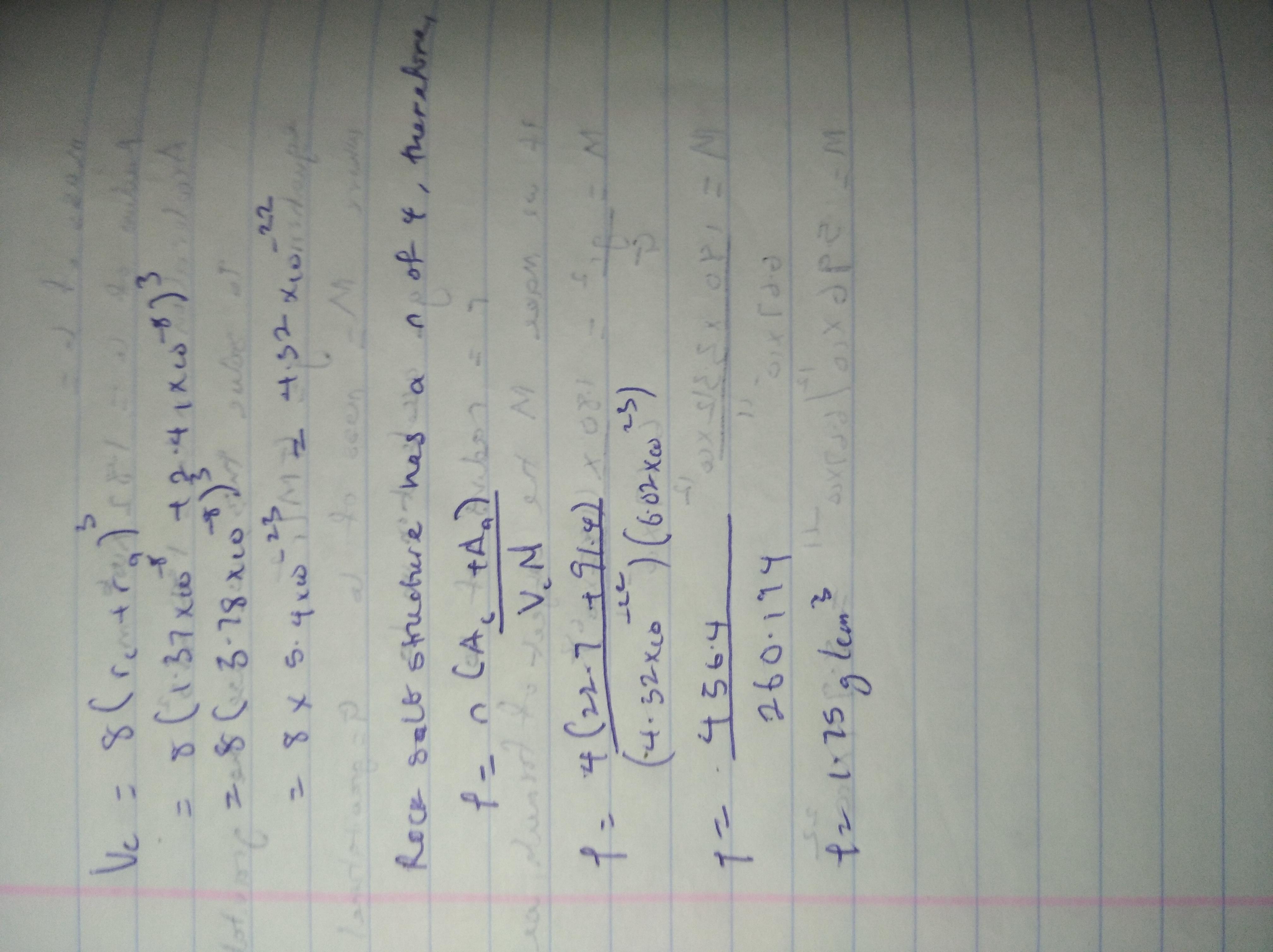
An AX ceramic compound has the rock salt crystal structure. If the radii of the A and X ions are 0.137 and 0.241 nm, respectivel
Tju [1.3M]

Answer:

c) 1.75 g/cm³

Explanation:

Given that

Radii of the A ion, r(c) = 0.137 nm

Radii of the X ion, r(a) = 0.241 nm

Atomic weight of the A ion, A(c) = 22.7 g/mol

Atomic weight of the X ion, A(a) = 91.4 g/mol

Avogadro's number, N = 6.02*10^23 per mol

Solution is attached below

3 0
2 years ago
Serratia marcescens bacteria are used for the production of threonine. The maximum specific oxygen uptake rate of S. marcescens
Sati [7]

Answer:

The rate of cell metabolism is limited by mass transfer since the value of maximum cell concentration obtained (38 g/l) is lower than 50 g l-1, the value planed.

Explanation:

                                                     Data

<u>kLa</u> = 0.17/s

<u>Solubility of oxygen</u> =  8 × 10^-3 kg / m^3

<u>The maximum specific oxygen uptake rate </u>= 4 mmol O2 / g h.

<u>Concentration of oxygen</u> =  0.5 × 10^-3 kg/ m^3

<u>**The maximum cell density</u> = 50 g/l

___________________

The calculated maximum cell concentration:

xmax=  kLa · CAL*/ qo

CAL* is the solubility of oxygen in the broth and qo is the specific oxygen uptake rate

Replacing the data given

xmax= ( 0.17/s ) ·   (8 × 10^-3 kg / m^3)  /  4 mmol O2 / g h

4 mmol O2 / g h  to kg O2/ g s

4 \frac{mmol}{gh} \frac{1 gmol}{1000mmol}\frac{1h}{3600s}\frac{32 g}{gmol} \frac{1Kg}{1000g}

= 3.56 x 10^-3 kg O2/ g s

So then,

xmax= ( 0.17/s ) ·   (8 × 10^-3 kg / m^3)  / 3.56 x 10^-3 o kg O2/ g s

xmax= 3. 8 x 10^4 g/ m^3   = 38 g/l

_____________________

5 0
2 years ago
The purification of hydrogen gas is possible by diffusion through a thin palladium sheet. Calculate the number of kilograms of h
diamong [38]

Answer:

M=0.0411 kg/h or 4.1*10^{-2} kg/h

Explanation:

We have to combine the following formula to find the mass yield:

M=JAt

M=-DAt(ΔC/Δx)

The diffusion coefficient : D=6.0*10^{-8} m/s^{2}

The area : A=0.25 m^{2}

Time : t=3600 s/h

ΔC: (0.64-3.0)kg/m^{3}

Δx: 3.1*10^{-3}m

Now substitute the  values

M=-DAt(ΔC/Δx)

M=-(6.0*10^{-8} m/s^{2})(0.25 m^{2})(3600 s/h)[(0.64-3.0kg/m^{3})(3.1*10^{-3}m)]

M=0.0411 kg/h or 4.1*10^{-2} kg/h

8 0
2 years ago
A spring-loaded toy gun is used to shoot a ball of mass m = 1.50 kg straight up in the air. The spring has spring constant k = 6
adell [148]

Answer:

1) a) Mechanical energy is conserved because no dissipative forces perform work on the ball.

2) The muzzle velocity of the ball is approximately 5.272 meters per second.

3) The maximum height of the ball is 1.417 meters.

Explanation:

1) Which of the following statements are true?

a) Mechanical energy is conserved because no dissipative forces perform work on the ball.

True, statement indicates that there is no air resistence and no friction between ball and the inside of the gun because the first never touches the latter one.

b) The forces of gravity and the spring have potential energies associated with them.

False, force of gravity do work on the ball and spring receives a potential energy at being deformated by the ball.

c) No conservative forces act in this problem after the ball is released from the spring gun.

False, the absence of no conservative forces is guaranteed for the entire system according to the statement of the problem.

2) According to the statement, we understand that spring is deformed and once released and just after reaching its equilibrium position, the muzzle velocity is reached. As spring deformation is too small in comparison with height, we can neglect changes in gravitational potential energy. By Principle of Energy Conservation, we describe the motion of the ball by the following expression:

U_{k, 1}+K_{1}=U_{k,2}+K_{2} (Eq. 1)

Where:

U_{k,1}, U_{k,2} - Initial and final elastic potential energies of spring, measured in joules.

K_{1}, K_{2} - Initial and final translational kinetic energies of the ball, measured in joules.

After using definitions of elastic potential and translational kinetic energies, we expand the equation above as:

\frac{1}{2}\cdot m\cdot (v_{2}^{2}-v_{1}^{2}) = \frac{1}{2}\cdot k\cdot (x_{1}^{2}-x_{2}^{2})

And the final velocity is cleared:

m\cdot (v_{2}^{2}-v_{1}^{2}) = k\cdot (x_{1}^{2}-x_{2}^{2})

v_{2}^{2}-v_{1}^{2} =\frac{k}{m}\cdot (x_{1}^{2}-x_{2}^{2})

v_{2}^{2} =v_{1}^{2}+\frac{k}{m}\cdot (x_{1}^{2}-x_{2}^{2})

v_{2} = \sqrt{v_{1}^{2}+\frac{k}{m}\cdot (x_{1}^{2}-x_{2}^{2}) } (Eq. 2)

Where:

v_{1}, v_{2} - Initial and final velocities of the ball, measured in meters per second.

k - Spring constant, measured in newtons per meter.

m - Mass of the ball, measured in kilograms.

x_{1}, x_{2} - Initial and final position of spring, measured in meters.

If we know that v_{1} = 0\,\frac{m}{s}, k = 667\,\frac{N}{m}, m = 1.50\,kg, x_{1} = -0.25\,m and x_{2} = 0\,cm, the muzzle velocity of the ball is:

v_{2} =\sqrt{\left(0\,\frac{m}{s} \right)^{2}+\left(\frac{667\,\frac{N}{m} }{1.50\,kg} \right)\cdot [(-0.25\,m)^{2}-(0\,m)^{2}]}

v_{2}\approx 5.272\,\frac{m}{s}

The muzzle velocity of the ball is approximately 5.272 meters per second.

3) After leaving the toy gun, the ball is solely decelerated by gravity. We construct this model by Principle of Energy Conservation:

U_{g,2}+K_{2} = U_{g,3}+K_{3} (Eq. 3)

Where:

U_{g,2}, U_{g,3} - Initial and gravitational potential energies of the ball, measured in joules.

K_{2}, K_{3} - Initial and final translational kinetic energies of the ball, measured in joules.

After applying definitions of gravitational potential and translational kinetic energies, we expand the equation above and solve the resulting for the final height:

m\cdot g \cdot (h_{3}-h_{2}) = \frac{1}{2}\cdot m \cdot (v_{2}^{2}-v_{3}^{2})

h_{3}-h_{2}=\frac{v_{2}^{2}-v_{3}^{2}}{2\cdot g}

h_{3} = h_{2} +\frac{v_{2}^{2}-v_{3}^{2}}{2\cdot g} (Eq. 4)

h_{2}, h_{3} - Initial and final heights of the ball, measured in meters.

v_{2}, v_{3} - Initial and final velocities of the ball, measured in meters per second.

g - Gravitational acceleration, measured in meters per square second.

If we get that v_{2} = 5.272\,\frac{m}{s}, v_{3} = 0\,\frac{m}{s}, h_{2} = 0\,m and g = 9.807\,\frac{m}{s^{2}}, the maximum height of the ball is:

h_{3} = 0\,m+\frac{\left(5.272\,\frac{m}{s} \right)^{2}-\left(0\,\frac{m}{s} \right)^{2}}{2\cdot \left(9.807\,\frac{m}{s^{2}} \right)}

h_{3} = 1.417\,m

The maximum height of the ball is 1.417 meters.

5 0
2 years ago
Annealing is a process by which steel is reheated and then cooled to make it less brittle. Consider the reheat stage for a 100-m
kodGreya [7K]

Complete question is;

Annealing is a process by which steel is reheated and then cooled to make it less brittle. Consider the reheat stage for a 100 mm thick plate (ρ = 7830 kg/m3, Cp = 550 J/kg K, k = 48 W/m K). The plate initially is at 200 °C and is to be heated to a minimum temperature of 550 °C. Heating is effected in a gas-fired furnace where the products of combustion at T∞ = 800 °C maintain a convection heat transfer coefficient of h = 250 W/m.K on both surfaces of the plate. How long should the plate be left in the furnace?

Answer:

860 seconds

Explanation:

We are given;

Initial Temperature; Ti = 200 °C

Minimum Temperature; T_i = 550 °C

T∞ = 800 °C

convection coefficient; h = 250 W/m².K

ρ = 7830 kg/m³

Cp = 550 J/kg K

k = 48 W/m K

Plate thickness = 100mm

Thus,L = 100/2 = 50mm = 0.05 m

Let's find the biot number from the formula;

Bi = hL/K

Bi = (250 × 0.05)/48

Bi = 0.2604

Now, lowest temperature in the slab is given as;

θ_o = (T_o - T∞)/(T_i - T∞)

θ_o = (550 - 800)/(200 - 800)

θ_o = 0.4167

Now, from online tables calculation, we can find the root of the biot number.

Thus, root of the biot number Bi = 0.2604 is;

ζ1 = 0.488 rad

Also, C1 is gotten as 1.0396

Now,formula for thermal diffusivity is;

α = k/ρc

α = 48/(7830 × 550)

α = 1.115 × 10^(-5) m²/s

Also, from online tables, f(ζ1) = 0.401

Thus, we can find the time the plate should the plate be left in the furnace from;

-(ζ1)²(αt/L²) = In 0.401

-(ζ1)²(αt/L²) = -0.9138

t = (-0.9138 × 0.05²)/-(0.488² × 1.115 × 10^(-5))

t ≈ 860 s

8 0
2 years ago
Other questions:
  • Degreasers can be broken down into two main categories
    9·2 answers
  • Which of these is true about airbag charts?
    6·1 answer
  • What is the damped natural frequency (in rad/s) of a second order system whose undamped natural frequency is 25 rad/s and has a
    15·1 answer
  • The penalty for littering 15 lb or less is _____.<br> A. $25<br> B. $50<br> C. $100<br> D. $150
    14·1 answer
  • A curve in a speed track has a radius of 1000 ft and a rated speed of 120 mi/h. (From Sample Prob. 12.7 is the definition of rat
    10·1 answer
  • 2. Determine the surface area of a primary settling tank sized to handle a maximum hourly flow of 0.570 m3/s at an overflow rate
    13·2 answers
  • Block D of the mechanism is confined to move within the slot of member CB. Link AD is rotating at a constant rate of ωAD = 6 rad
    11·1 answer
  • A dead-man system should shut off fuel flow within ____ of the system’s maximum flow rate.
    6·2 answers
  • A three-phase motor rated 25 hp, 480 V, operates with a power factor of 0.74 lagging and supplies the rated load. The motor effi
    12·1 answer
  • Technician A says that the carpet padding is designed to help reduce noise and vibrations.
    5·1 answer
Add answer
Login
Not registered? Fast signup
Signup
Login Signup
Ask question!