answer.
Ask question
Login Signup
Ask question
All categories
  • English
  • Mathematics
  • Social Studies
  • Business
  • History
  • Health
  • Geography
  • Biology
  • Physics
  • Chemistry
  • Computers and Technology
  • Arts
  • World Languages
  • Spanish
  • French
  • German
  • Advanced Placement (AP)
  • SAT
  • Medicine
  • Law
  • Engineering
lozanna [386]
2 years ago
7

1. Use the charges to create an electric dipole with a horizontal axis by placing a positive and a negative charge (equal in mag

nitude but opposite in sign) 4 meters away from each other. (Axis of a dipole is a line passing through both charges.) Place positive charge on the left and negative on the right.
2. Describe the field at the following locations, and explain these results using the superposition principle:
on the horizontal axis to the right of the dipole;
on the horizontal axis between charges;
on the horizontal axis to the left of the charges;
on the vertical line bisecting the line segment connecting the charges, above the dipole;
on the vertical line bisecting the line segment connecting the charges, below the dipole;
is there a location where the electric field is exactly zero?
Remove the negative charge and replace it with equal in magnitude positive charge.
3. Observe the change in electric field, and again describe the field at the following locations, explaining these results using the superposition principle:
on the horizontal axis to the right of the charges;
on the horizontal axis between charges;
on the horizontal axis to the left of the charges;
on the vertical line bisecting the line segment connecting the charges, above the charges;
on the vertical line bisecting the line segment connecting the charges, below the charges;
is there a location where the electric field is exactly zero?

Engineering
1 answer:
White raven [17]2 years ago
8 0

Answer:

2)

a)  to the right of the dipole    E_total = kq [1 / (r + a)² - 1 / r²]

b)To the left of the dipole      E_total = - k q [1 / r² - 1 / (r + a)²]

c) at a point between the dipole, that is -a <x <a  

      E_total = kq [1 / x² + 1 / (2a-x)²]

d) on the vertical line at the midpoint of the dipole (x = 0)

E_toal = 2 kq 1 / (a ​​+ y)² cos θ

Explanation:

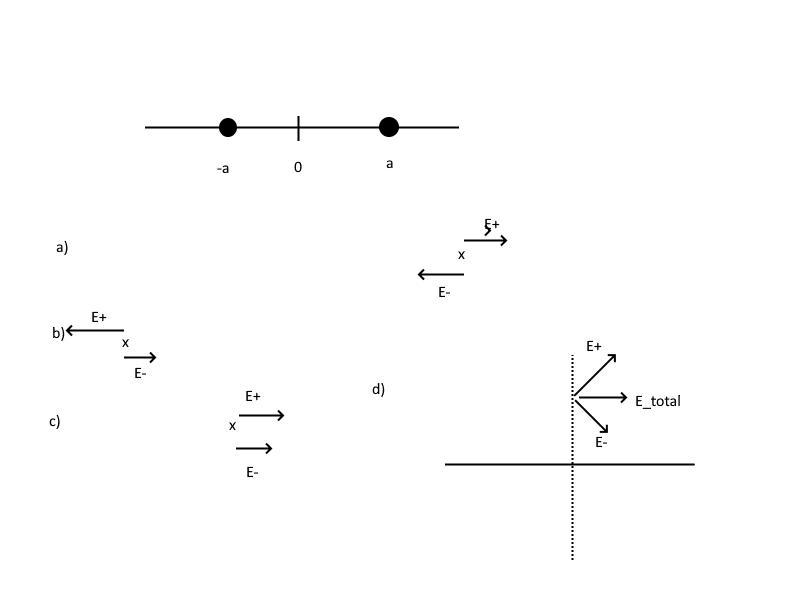
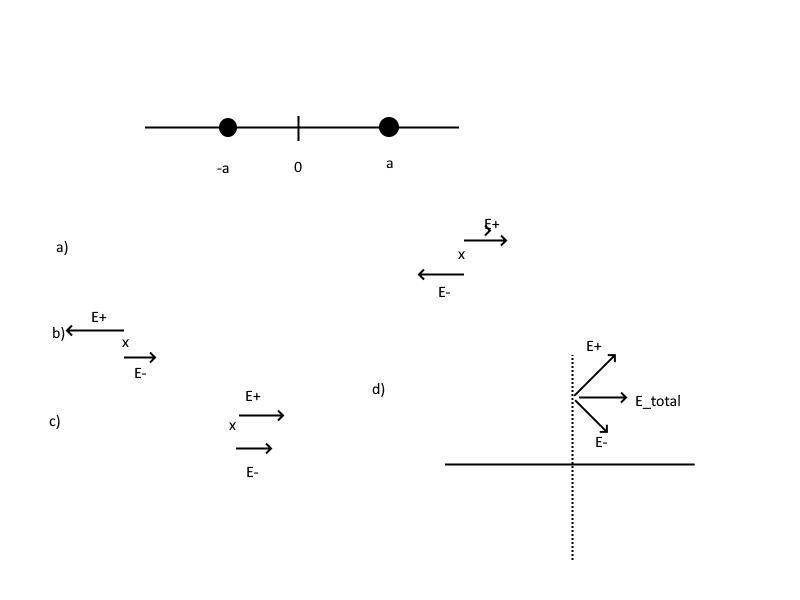
2) they ask us for the electric field in different positions between the dipole and a point of interest. Using the principle of superposition.

This principle states that we can analyze the field created by each charge separately and add its value and this will be the field at that point

Let's analyze each point separately.

The test charge is a positive charge and in the reference frame it is at the midpoint between the two charges.

a) to the right of the dipole

The electric charge creates an outgoing field, to the right, but as it is further away the field is of less intensity

           E₊ = k q / (r + a)²

where 2a is the distance between the charges of the dipole and the field is to the right

the negative charge creates an incoming field of magnitude

           E₋ = -k q / r²

The field is to the left

therefore the total field is the sum of these two fields

           E_total = E₊ + E₋

           E_total = kq [1 / (r + a)² - 1 / r²]

we can see that the field to the right of the dipole is incoming and of magnitude more similar to the field of the negative charge as the distance increases.

b) To the left of the dipole

The result is similar to the previous one by the opposite sign, since the closest charge is the positive one

E₊ is to the left and E₋ is to the right

          E_total = - k q [1 / r² - 1 / (r + a)²]

We see that this field is also directed to the left

c) at a point between the dipole, that is -a <x <a

In this case the E₊ field points to the right and the E₋ field points to the right

                      E₊ = k q 1 / x²

                      E₋ = k q 1 / (2a-x)²

                      E_total = kq [1 / x² + 1 / (2a-x)²]

in this case the field points to the right

d) on the vertical line at the midpoint of the dipole (x = 0)

    In this case the E₊ field points in the direction of the positive charge and the test charge

    in E₋ field the ni is between the test charge and the negative charge,

the resultant of a horizontal field in zirconium on the x axis (where the negative charge is)

                      E₊ = kq 1 / (a ​​+ y) 2

                      E₋ = kp 1 / (a ​​+ y) 2

                      E_total = E₊ₓ + E_{-x}

                      E_toal = 2 kq 1 / (a ​​+ y)² cos θ

e) same as the previous part, but on the negative side

                        E_toal = 2 kq 1 / (a ​​+ y)² cos θ

When analyzing the previous answer there is no point where the field is zero

The different configurations are outlined in the attached

3) We are asked to repeat part 2 changing the negative charge for a positive one, so in this case the two charges are positive

a) to the right

in this case the two field goes to the right

           E_total = kq [1 / (r + a)² + 1 / r²]

b) to the left

            E_total = - kq [1 / (r + a)² + 1 / r²]

c) between the two charges

E₊ goes to the right

E₋ goes to the left

            E_total = kq [1 / x² - 1 / (2a-x)²]

d) between vertical line at x = 0


E₊ salient between test charge and positive charge

           E_total = 2 kq 1 / (a ​​+ y)² sin θ

In this configuration at the point between the two charges the field is zero
You might be interested in
A joining process in which a filler metal is melted and distributed by capillary action between faying surfaces, the base metals
PolarNik [594]

Answer:

A soldering process

Explanation:

Given that ,The filler metal's melting point temperature is less than 450 ° C.

Usually, the brazing material has the liquid temperature of the melting point, the full melting point of the filler material approaching 450 degrees centigrade, while the filler material is less than 450 degrees centigrade in the case of soldering.

Therefore the answer is "A soldering process".

4 0
2 years ago
The uniform 8–ft board is pushed down into the water so it makes an angle of θ = 30o with the water surface. If the cross sectio
lana66690 [7]

Answer:

The vertical force, F = 19.9 lb.

Explanation:

3 0
2 years ago
Determine the design angle ϕ (0∘≤ϕ≤90 ∘) between struts AB and AC so that the 400 lb horizontal force has a component of 600 lb
Svetllana [295]

Answer:

design angle ∅ = 4.9968 ≈ 5⁰

Explanation:

First calculate the force Fac :

Fac = \sqrt{400^2 + 650^2 - 2(400)(650)cos30}

      = \sqrt{160000 + 422500 - 80210}

      = 708.72 Ib

using the sine law to determine the design angle

\frac{sin}{400}  = \frac{sin 30}{Fac}

hence ∅ = sin^{-1} (\frac{sin 30 *400}{708.72} )

              = sin^{-1} 0.0871 =  4.9968 ≈ 5⁰

4 0
2 years ago
Outline an algorithm in **pseudo code** for checking whether an array H[1..n] is a heap and determine its time efficiency.
svlad2 [7]

Answer:

Condition to break: H[j] \geq max {H[2j] , H[2j+1]}

Efficiency: O(n).

Explanation:

Previous concepts

Heap algorithm is used to create all the possible permutations with K possible objects. Was created by B. R Heap in 1963.

Parental dominance condition represent a condition that is satisfied when the parent element is greater than his children.

Solution to the problem

We assume that we have an array H of size n for the algorithm.

It's important on this case analyze the parental dominance condition in order to the algorithm can work and construc a heap.

For this case we can set a counter j =1,2,... [n/2] (We just check until n/2 since in order to create a heap we need to satisfy minimum n/2 possible comparisionsand we need to check this:Break condition: [tex]H[j] \geq max {H[2j] , H[2j+1]}

And we just need to check on the array the last condition and if is not satisfied for any value of the counter j we need to stop the algorithm and the array would not a heap. Otherwise if we satisfy the condition for each j =1,2,.....,[n/2]p then we will have a heap.

On this case this algorithm needs to compare 2*(n/2) times the values and the efficiency is given by O(n).

3 0
2 years ago
The legend that Benjamin Franklin flew a kite as a storm approached is only a legend—he was neither stupid nor suicidal. Suppose
Delicious77 [7]

Answer: 0.93 mA

Explanation:

In order to calculate the current passing through the water layer, as we have the potential difference between the ends of the string as a given, assuming that we can apply Ohm’s law, we need to calculate the resistance of the water layer.

We can express the resistance as follows:

R = ρ.L/A

In order to calculate the area A, we can assume that the string is a cylinder with a circular cross-section, so the Area of the water layer can be written as follows:

A= π(r22 – r12) = π( (0.0025)2-(0.002)2 ) m2 = 7.07 . 10-6 m2

Replacing by the values, we get R as follows:

R = 1.4 1010 Ω

Applying Ohm’s Law, and solving for the current I:

I = V/R = 130 106 V / 1.4 1010 Ω = 0.93 mA

7 0
2 years ago
Other questions:
  • Pam Jones worked for 41 years at the same company and had positive performance ratings and personnel records. She needed a calcu
    9·1 answer
  • Oil in an engine is being cooled by air in a cross-flow heat exchanger, where both fluids are unmixed. Oil (cp = 2000 J/kg. K) f
    12·1 answer
  • Prompt the user to enter five numbers, being five people's weights. Store the numbers in an array of doubles. Output the array's
    11·2 answers
  • Refrigerant-134a at 400 psia has a specific volume of 0.1384 ft3/lbm. Determine the temperature of the refrigerant based on (a)
    6·1 answer
  • The mechanical properties of some metals may be improved by incorporating fine particles of their oxides. If the moduli of elast
    12·1 answer
  • Madison and Oxford are the same distance from the equator and they are both near the ocean. Use the information on the map to an
    11·1 answer
  • A rectangular beam having b=300 mm and d=575 mm, spans 5.5 m face to face of simple supports. It is reinforced for flexure with
    14·1 answer
  • Technician A says that weld-through primer can be removed from the immediate weld area to improve weld quality. Technician B say
    7·1 answer
  • Select the level of education that is best demonstrated in each example.
    10·2 answers
  • Draw an ERD for each of the following situations. (If you believe that you need to make additional assumptions, clearly state th
    15·1 answer
Add answer
Login
Not registered? Fast signup
Signup
Login Signup
Ask question!