answer.
Ask question
Login Signup
Ask question
All categories
  • English
  • Mathematics
  • Social Studies
  • Business
  • History
  • Health
  • Geography
  • Biology
  • Physics
  • Chemistry
  • Computers and Technology
  • Arts
  • World Languages
  • Spanish
  • French
  • German
  • Advanced Placement (AP)
  • SAT
  • Medicine
  • Law
  • Engineering
dusya [7]
2 years ago
11

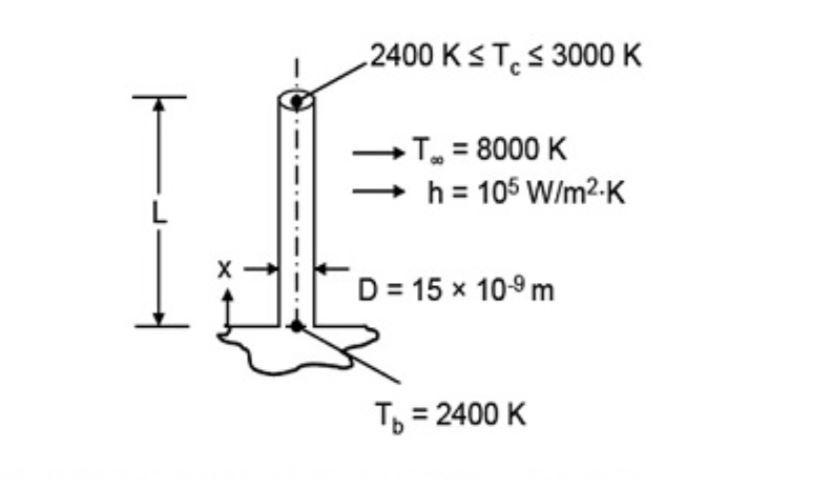
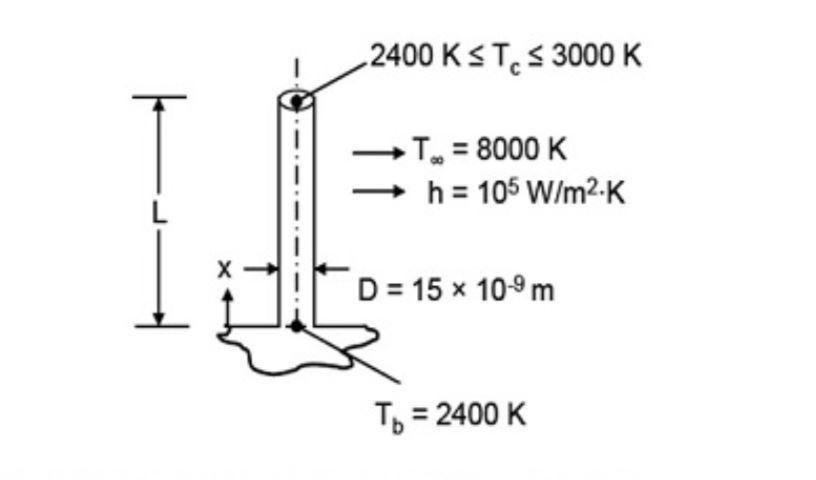
One method that is used to grow nanowires (nanotubes with solid cores) is to initially deposit a small droplet of a liquid catal

yst onto a flat surface. The surface and catalyst are heated and simultaneously exposed to a higher-temperature, low-pressure gas that contains a mixture of chemical species from which the nanowire is to be formed. The catalytic liquid slowly absorbs the species from the gas through its top surface and converts these to a solid material that is deposited onto the underlying liquid-solid interface, resulting in construction of the nanowire. The liquid catalyst remains suspended at the tip of the nanowire. Consider the growth of a 15-nm-diameter silicon carbide nanowire onto a silicon carbide sururface. The surface is maintained at a temperature of Ts = 2400 K and the particular liquid catalyst that is used must be maintained in the range 2400 K ≤ Tc ≤ 3000 K to perform its function. Determine the maximum length of a nanowire that may be grown for conditions characterized by h = 105 W/m2.K and T[infinity] = 8000 KT. Assume properties of the nanowire are the same as for bulk silicon carbide.

Engineering
1 answer:
7nadin3 [17]2 years ago
4 0

Answer: maximum length of the nanowire is 510 nm

Explanation:


From the table of 'Thermo physical properties of selected nonmetallic solids at At T = 1500 K

Thermal conductivity of silicon carbide k = 30 W/m.K

Diameter of silicon carbide nanowire, D = 15 x 10⁻⁹ m  

lets consider the equation for the value of m

m = ( (hP/kAc)^1/2 )  = ( (4h/kD)^1/2 )  

m =  ( ((4 × 10⁵)/(30×15×10⁻⁹ ))^1/2 ) = 942809.04    

now lets find the value of h/mk    

h/mk = 10⁵ / ( 942809.04 × 30) =  0.00353

lets consider the value θ/θb by using the equation

θ/θb = (T - T∞) / (T - T∞)

θ/θb =  (3000 - 8000) / (2400 - 8000)

= 0.893

the temperature distribution at steady-state is expressed as;

θ/θb = [ cosh m(L - x) + ( h/mk) sinh m (L - x)]   / [cosh mL+  (h/mk) sinh mL]

θ/θb = [ cosh m(L - L) + ( h/mk) sinh m (L - L)]   / [cosh mL+  (h/mk) sinh mL]

θ/θb = [ 1 ]  / [cosh mL+  (h/mk) sinh mL]

so we substitute

0.893 =  [ 1 ]  / [cosh (942809.04 × L) +  (0.00353) sinh (942809.04 × L)]

L = 510 × 10⁻⁹m

L = 510 nm

therefore maximum length of the nanowire is 510 nm

You might be interested in
Gina is about to use a fire extinguisher on a small fire. What factor determines the type of extinguisher she should use
amm1812

There’s 5 different types of fire extinguishers that you can differentiate by their color codes.

Red - Water based

Creme - Foam based

Blue - Powder based

Black - CO2 or carbon dioxide based

Yellow - Wet chemical based

What would determine the type of fire extinguisher used would be the class of fire it is.

Class A - Combustible materials ( i.e. paper, wood) Extinguishers to use - Red, Creme, Blue, and Yellow. (Do not use Black)

Class B - Flammable liquids ( i.e. paint, petrol, alcohol) Extinguishers to use - Creme, Blue, and Black. (Do not use Red or Yellow)

Class C - Flammable gases ( i.e. butane, methane) Extinguishers to use - Blue (Do not use Red, Creme, Black or Yellow)

Class D - Flammable metals ( i.e. lithium, potassium) Extinguishers to use - Blue (Do not use Red, Creme, Black or Yellow)

Class F - Deep fat fryers ( i.e. chip pans) Extinguishers to use - Yellow (Do not use Red, Creme, Blue or Black)

Electrical - any sort of electrical equipment

( i.e. computers, generators) Extinguishers to use - Blue and Black (Do not use Red, Creme or Yellow)

8 0
2 years ago
Read 2 more answers
140-character statement that completes this sentence: I pledge to not text and drive because...
s2008m [1.1K]

Answer:

its bad and to drive drunk is even worse

4 0
2 years ago
1. A spur gear made of bronze drives a mid steel pinion with angular velocity ratio of 13 /2 : 1. Thepressure angle is 14 1/2° .
Alik [6]

Answer:

Given data

w1/w2=6.5/1

Power=5 KW

wp=1800 rpm

angle=14 degrees

Based on above values,the minimum diameter=30 mm

5 0
2 years ago
A spring-loaded toy gun is used to shoot a ball of mass m = 1.50 kg straight up in the air. The spring has spring constant k = 6
adell [148]

Answer:

1) a) Mechanical energy is conserved because no dissipative forces perform work on the ball.

2) The muzzle velocity of the ball is approximately 5.272 meters per second.

3) The maximum height of the ball is 1.417 meters.

Explanation:

1) Which of the following statements are true?

a) Mechanical energy is conserved because no dissipative forces perform work on the ball.

True, statement indicates that there is no air resistence and no friction between ball and the inside of the gun because the first never touches the latter one.

b) The forces of gravity and the spring have potential energies associated with them.

False, force of gravity do work on the ball and spring receives a potential energy at being deformated by the ball.

c) No conservative forces act in this problem after the ball is released from the spring gun.

False, the absence of no conservative forces is guaranteed for the entire system according to the statement of the problem.

2) According to the statement, we understand that spring is deformed and once released and just after reaching its equilibrium position, the muzzle velocity is reached. As spring deformation is too small in comparison with height, we can neglect changes in gravitational potential energy. By Principle of Energy Conservation, we describe the motion of the ball by the following expression:

U_{k, 1}+K_{1}=U_{k,2}+K_{2} (Eq. 1)

Where:

U_{k,1}, U_{k,2} - Initial and final elastic potential energies of spring, measured in joules.

K_{1}, K_{2} - Initial and final translational kinetic energies of the ball, measured in joules.

After using definitions of elastic potential and translational kinetic energies, we expand the equation above as:

\frac{1}{2}\cdot m\cdot (v_{2}^{2}-v_{1}^{2}) = \frac{1}{2}\cdot k\cdot (x_{1}^{2}-x_{2}^{2})

And the final velocity is cleared:

m\cdot (v_{2}^{2}-v_{1}^{2}) = k\cdot (x_{1}^{2}-x_{2}^{2})

v_{2}^{2}-v_{1}^{2} =\frac{k}{m}\cdot (x_{1}^{2}-x_{2}^{2})

v_{2}^{2} =v_{1}^{2}+\frac{k}{m}\cdot (x_{1}^{2}-x_{2}^{2})

v_{2} = \sqrt{v_{1}^{2}+\frac{k}{m}\cdot (x_{1}^{2}-x_{2}^{2}) } (Eq. 2)

Where:

v_{1}, v_{2} - Initial and final velocities of the ball, measured in meters per second.

k - Spring constant, measured in newtons per meter.

m - Mass of the ball, measured in kilograms.

x_{1}, x_{2} - Initial and final position of spring, measured in meters.

If we know that v_{1} = 0\,\frac{m}{s}, k = 667\,\frac{N}{m}, m = 1.50\,kg, x_{1} = -0.25\,m and x_{2} = 0\,cm, the muzzle velocity of the ball is:

v_{2} =\sqrt{\left(0\,\frac{m}{s} \right)^{2}+\left(\frac{667\,\frac{N}{m} }{1.50\,kg} \right)\cdot [(-0.25\,m)^{2}-(0\,m)^{2}]}

v_{2}\approx 5.272\,\frac{m}{s}

The muzzle velocity of the ball is approximately 5.272 meters per second.

3) After leaving the toy gun, the ball is solely decelerated by gravity. We construct this model by Principle of Energy Conservation:

U_{g,2}+K_{2} = U_{g,3}+K_{3} (Eq. 3)

Where:

U_{g,2}, U_{g,3} - Initial and gravitational potential energies of the ball, measured in joules.

K_{2}, K_{3} - Initial and final translational kinetic energies of the ball, measured in joules.

After applying definitions of gravitational potential and translational kinetic energies, we expand the equation above and solve the resulting for the final height:

m\cdot g \cdot (h_{3}-h_{2}) = \frac{1}{2}\cdot m \cdot (v_{2}^{2}-v_{3}^{2})

h_{3}-h_{2}=\frac{v_{2}^{2}-v_{3}^{2}}{2\cdot g}

h_{3} = h_{2} +\frac{v_{2}^{2}-v_{3}^{2}}{2\cdot g} (Eq. 4)

h_{2}, h_{3} - Initial and final heights of the ball, measured in meters.

v_{2}, v_{3} - Initial and final velocities of the ball, measured in meters per second.

g - Gravitational acceleration, measured in meters per square second.

If we get that v_{2} = 5.272\,\frac{m}{s}, v_{3} = 0\,\frac{m}{s}, h_{2} = 0\,m and g = 9.807\,\frac{m}{s^{2}}, the maximum height of the ball is:

h_{3} = 0\,m+\frac{\left(5.272\,\frac{m}{s} \right)^{2}-\left(0\,\frac{m}{s} \right)^{2}}{2\cdot \left(9.807\,\frac{m}{s^{2}} \right)}

h_{3} = 1.417\,m

The maximum height of the ball is 1.417 meters.
5 0
2 years ago
A three-phase line has an impedance of 0.4 j2.7 ohms per phase. The line feeds two balanced three-phase loads that are connected
Viktor [21]

Answer:

a. The magnitude of the line source voltage is

Vs = 4160 V

b. Total real and reactive power loss in the line is

Ploss = 12 kW

Qloss = j81 kvar

Sloss = 12 + j81 kVA

c. Real power and reactive power supplied at the sending end of the line

Ss = 540.046 + j476.95 kVA

Ps = 540.046 kW

Qs = j476.95 kvar

Explanation:

a. The magnitude of the line voltage at the source end of the line.

The voltage at the source end of the line is given by

Vs = Vload + (Total current×Zline)

Complex power of first load:

S₁ = 560.1 < cos⁻¹(0.707)

S₁ = 560.1 < 45° kVA

Complex power of second load:

S₂ = P₂×1 (unity power factor)

S₂ = 132×1

S₂ = 132 kVA

S₂ = 132 < cos⁻¹(1)

S₂ = 132 < 0° kVA

Total Complex power of load is

S = S₁ + S₂

S = 560.1 < 45° + 132 < 0°

S = 660 < 36.87° kVA

Total current is

I = S*/(3×Vload)   ( * represents conjugate)

The phase voltage of load is

Vload = 3810.5/√3

Vload = 2200 V

I = 660 < -36.87°/(3×2200)

I = 100 < -36.87° A

The phase source voltage is

Vs = Vload + (Total current×Zline)

Vs = 2200 + (100 < -36.87°)×(0.4 + j2.7)

Vs = 2401.7 < 4.58° V

The magnitude of the line source voltage is

Vs = 2401.7×√3

Vs = 4160 V

b. Total real and reactive power loss in the line.

The 3-phase real power loss is given by

Ploss = 3×R×I²

Where R is the resistance of the line.

Ploss = 3×0.4×100²

Ploss = 12000 W

Ploss = 12 kW

The 3-phase reactive power loss is given by

Qloss = 3×X×I²

Where X is the reactance of the line.

Qloss = 3×j2.7×100²

Qloss = j81000 var

Qloss = j81 kvar

Sloss = Ploss + Qloss

Sloss = 12 + j81 kVA

c. Real power and reactive power supplied at the sending end of the line

The complex power at sending end of the line is

Ss = 3×Vs×I*

Ss = 3×(2401.7 < 4.58)×(100 < 36.87°)

Ss = 540.046 + j476.95 kVA

So the sending end real power is

Ps = 540.046 kW

So the sending end reactive power is

Qs = j476.95 kvar

7 0
2 years ago
Other questions:
  • Mary is interested in developing new machines that would increase the productivity of small scale farmers. After high school, wh
    8·1 answer
  • Compute the mass fractions of α ferrite and cementite in pearlite. Assume T=726⁢ C∘.
    15·1 answer
  • A sign erected on uneven ground is guyed by cables EF and EG. If the force exerted by cable EF at E is 46 lb, determine the mome
    13·1 answer
  • An aircraft component is fabricated from an aluminum alloy that has a plane-strain fracture toughness of 40 MPa1m (36.4 ksi1in.)
    15·1 answer
  • Water is to be withdrawn from an 8-m-high water reservoir by drilling a 2.2-cm-diameter hole at the bottom surface. Disregarding
    12·2 answers
  • Q5. A hypothetical metal alloy has a grain diameter of 2.4 x 10⁻² mm. After a heat treatment at 575°C for 500 min, the grain dia
    7·1 answer
  • An equation used to evaluate vacuum filtration is Q = ΔpA2 α(VRw + ARf) , Where Q ≐ L3/T is the filtrate volume flow rate, Δp ≐
    13·1 answer
  • Which of the following describes boundaries?
    10·1 answer
  • A spherical tank for storing gas under pressure is 25 m in diameter and is made of steel 15 mm thick. The yield point of the mat
    5·2 answers
  • What is the component called that usually has a dual-voltage selector switch and has cables that connect to the motherboard and
    15·1 answer
Add answer
Login
Not registered? Fast signup
Signup
Login Signup
Ask question!