answer.
Ask question
Login Signup
Ask question
All categories
  • English
  • Mathematics
  • Social Studies
  • Business
  • History
  • Health
  • Geography
  • Biology
  • Physics
  • Chemistry
  • Computers and Technology
  • Arts
  • World Languages
  • Spanish
  • French
  • German
  • Advanced Placement (AP)
  • SAT
  • Medicine
  • Law
  • Engineering
tia_tia [17]
2 years ago
6

Wilson Products uses standard costing. It allocates manufacturing overhead (both variable and fixed) to products on the basis of

standard direct manufacturing labor-hours (DLH). Wilson Products develops its manufacturing overhead rate from the current annual budget. The manufacturing overhead budget for 2014 is based on budgeted output of 672,000 units, requiring 3,360,000 DLH. The company is able to schedule production uniformly throughout the year.
A total of 72,000 output units requiring 321,000 DLH was produced during May 2014. Manufacturing overhead (MOH) costs incurred for May amounted to $ 355,800. The actual costs, compared with the annual budget and 1/12 of the annual budget, are as follows:
Calculate the following amounts for Wilson Products for May 2014:

Total Amount Per Output Unit Per DLH Input Unit Monthly MOH Budget May 2017 Actual MOH Costs for May 2017
Variable MOH
Indirect manufacturing labor $1,008,000 $1.50 $0.30 $84,000 $84,000
Supplies 672,000 1.00 0.2 56,000 117,000
Fixed MOH
Supervision 571,200 0.85 0.17 47,600 41,000
Utilities 369,600 0.55 0.11 30,800 55,000
Depreciation 705,600 1.05 0.21 58,800 88,800
Total $33,26,400 $4.95 $0.99 $277,200 $355,800

Required:
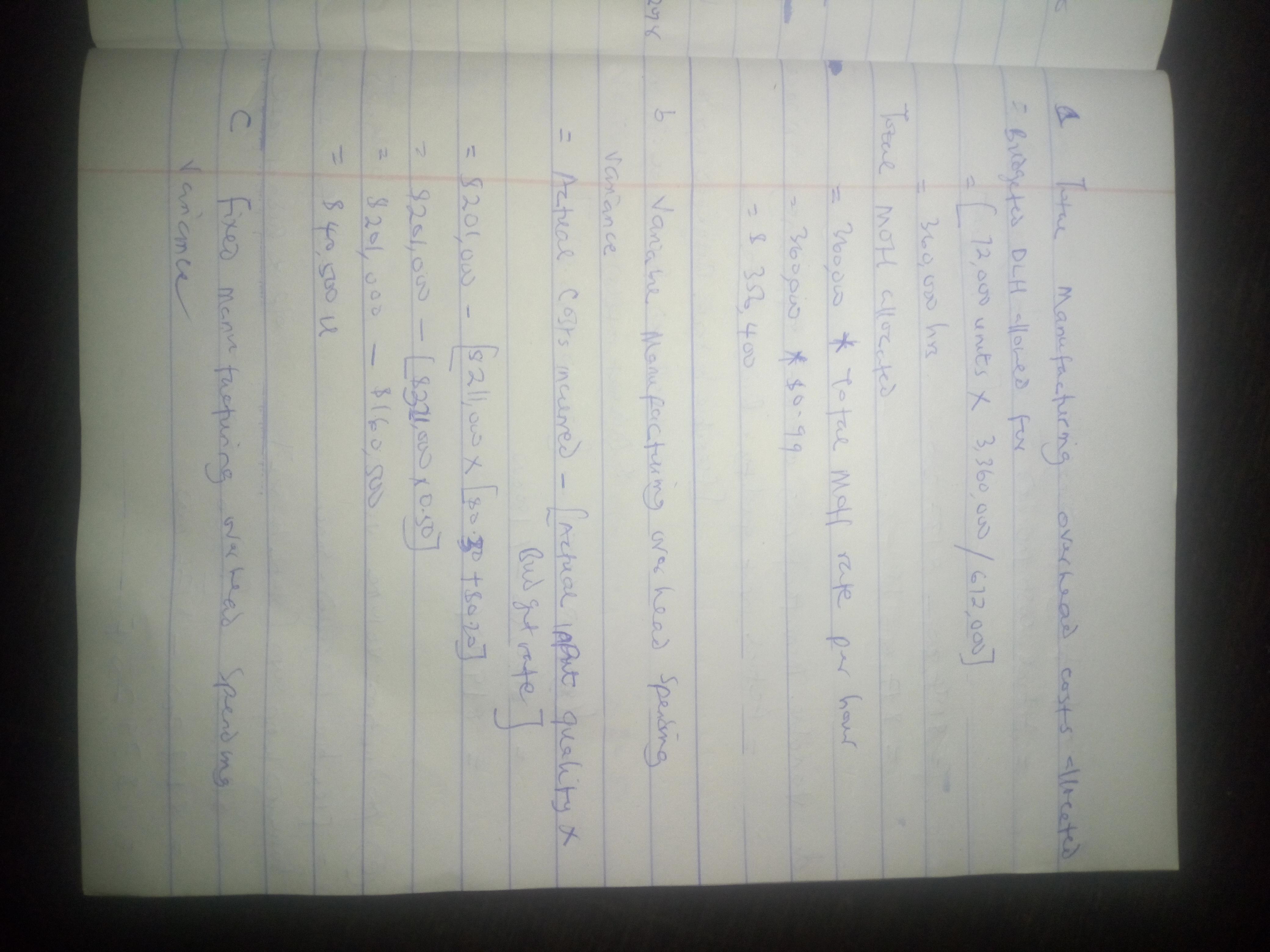
a. Total manufacturing overhead costs allocated.
b. Variable manufacturing overhead spending variance.
c. Fixed manufacturing overhead spending variance.
d. Variable manufacturing overhead efficiency variance.
e. Production-volume variance Be sure to identify each variance as favorable (F) or unfavorable(U).
Business
1 answer:
mrs_skeptik [129]2 years ago
5 0

Answer:

Please see attached solution

Explanation:

a. Total manufacturing overhead costs allocated $356,400

b. Variable manufacturing overhead spending variance $40,500U

c. Fixed manufacturing overhead spending variance $17,600U

d. Variable manufacturing overhead efficiency variance $19,500F

e. Production volume variance $39,200F

Please find attached detailed solution to the above questions

You might be interested in
This pricing tactic works because although we can remember the exact price right when we see the price, after a few weeks we for
PilotLPTM [1.2K]

Answer: A. the 99 principle

Explanation:

This strategy, often called "charm pricing," involves using pricing that ends in "9" and "99."

With charm pricing, the left digit is reduced from a round number by one cent. We come across this technique every time we make purchases but don’t pay attention. For example, your brain processes $3.00 and $2.99 as different values: To your brain $2.99 is $2.00, which is cheaper than $3.00.

How is this technique effective? It all boils down to how a brand converts numerical values. In 2005, Thomas and Morwitz conducted research they called "the left-digit effect in price cognition." They explained that, “Nine-ending prices will be perceived to be smaller than a price one cent higher if the left-most digit changes to a lower level (e.g., $3.00 to $2.99), but not if the left-most digit remains unchanged (e.g., $3.60 to $3.59).”

4 0
2 years ago
Samuelson and Messenger (SAM) began 2021 with 210 units of its one product. These units were purchased near the end of 2020 for
ivann1987 [24]

Answer:

<u>FIFO</u>

Ending inventory: = 6745

Cost of goods sold: = 5120

<u>AVERAGE</u>

Ending inventory: 6215

Cost of goods sold: = 5650

Explanation:

The FIFO (First input, first output) method allows you to make an inventory valuation, taking into account that the first items that enter the stock are the first ones that come out.

In the method of valuation of weighted average cost inventory, a weighted average is used to determine the cost of goods sold and the value of the inventory.  To do this, the cost of the goods available for sale is divided by the number of units available for sale.

<em>(See the attached form to see the calculations)</em>

Download docx
3 0
2 years ago
Mountain Top Markets has total assets of $48,700, net working capital of $1,100, and retained earnings of $21,200. The firm has
spin [16.1K]

Answer: 2.63

Explanation:

The Market to Book ratio is also referred to as the price to book ratio. It is a financial evaluation of the market value of a company relative to its book value. It should be noted that the market value is current stock price of every outstanding shares that the company has while the book value is the amount that the company will have left after its assets have been liquidated and all liabilities have been repaid.

The market-to-book ratio will be the market price per share divided by the book value. It should be noted that the book value per share is the net worth of the business divided by the number of outstanding shares. The book value will be:

= [(12500 ×1) + $21200]/12500

= ($12500 + $21200)/$12500

= $33700/12500

=$2.70

The market-to-book ratio will now be:

= $7.10/$2.70

=2.63

6 0
2 years ago
An organizationally-driven reason for outsourcing is that it can improve effectiveness by focusing on what the firm does best.
VARVARA [1.3K]

Answer:

True

Explanation:

Outsourcing is when a company gives some of its internal activities to an external party that takes the responsibility to get things done and one of the reasons for a company to do this is to get rid of activities that have to get done but that are not part of their core operations to be able to concentrate on their main activity and get those things done by experts which can help increase productivity. According to that, the answer is that the statement is true.

6 0
2 years ago
Ultra Co. uses a periodic inventory system. The following are inventory transactions for the month of January: 1/1 Beginning inv
creativ13 [48]

Answer:

$830,000

Explanation:

Ultra Co.'s inventory for January:

Date               Number of units   Unit balance      Unit cost     Total cost   

January 1             20,000                20,000               $13         $260,000       

January 20          30,000                50,000               $15         $710,000          

January 23          40,000                90,000               $17        $1,390,000      

<u>January 31          (50,000)                                       ($16.60)    ($830,000) </u>

Ending inventory                             40,000                              $560,000

Using the last-in, first-out (LIFO) method, the COGS = (40,000 units x $17 per unit) + (10,000 units x $15 per unit) = $680,000 + $150,000 = $830,000                                          

5 0
2 years ago
Other questions:
  • On july 1, tau, inc., purchased a machine for $12,000 and issued in payment a one-year note payable for $13,200. on august 31, t
    7·1 answer
  • Mark is selling gourmet apples at a price of ​$3 per pound. ​ currently, he sells 150 pounds of apples per week. this​ week, mar
    13·2 answers
  • Karan works at a shoe store where the latest trends in shoes are displayed. Down the road from his store, two more stores opened
    8·2 answers
  • XYZ Corporation, located in the United States, has an accounts payable obligation of ¥750 million payable in one year to a bank
    13·1 answer
  • AlphaBrona Industries manufactures 50,000 components per year. The manufacturing cost of the components was determined as follow
    8·1 answer
  • Which of the statements correctly represents the accounting equation?
    9·1 answer
  • In 2016, sports newscaster Erin Andrews and former wrestler Hulk Hogan were both awarded substantial monetary damages after winn
    10·2 answers
  • Candid, Inc., is a manufacturer of digital cameras. It has two departments: assembly and testing. In January 2014, the company i
    15·1 answer
  • A well-known industrial firm has issued $1,000 bonds that carry a 4% coupon interest rate paid semiannually. The bonds mature 20
    12·1 answer
  • The following cost data for the month of May were taken from the records of the Terrence Manufacturing Company: Depreciation on
    15·1 answer
Add answer
Login
Not registered? Fast signup
Signup
Login Signup
Ask question!
