answer.
Ask question
Login Signup
Ask question
All categories
  • English
  • Mathematics
  • Social Studies
  • Business
  • History
  • Health
  • Geography
  • Biology
  • Physics
  • Chemistry
  • Computers and Technology
  • Arts
  • World Languages
  • Spanish
  • French
  • German
  • Advanced Placement (AP)
  • SAT
  • Medicine
  • Law
  • Engineering
photoshop1234 [79]
2 years ago
13

Water flows along a streamline down a river of constant width. Over a short distance, the water slows from speed v to v/3. Which

of the following can you correctly conclude about the river's depth?
a. It became deeper by a factor of 3.
b. It became shallower by a factor of 3.
c. It became deeper by a factor of 3^2
d. It became shallower by a factor of 3^2
Physics
1 answer:
kvasek [131]2 years ago
8 0

Answer:

a. It became deeper by a factor of 3.

Explanation:

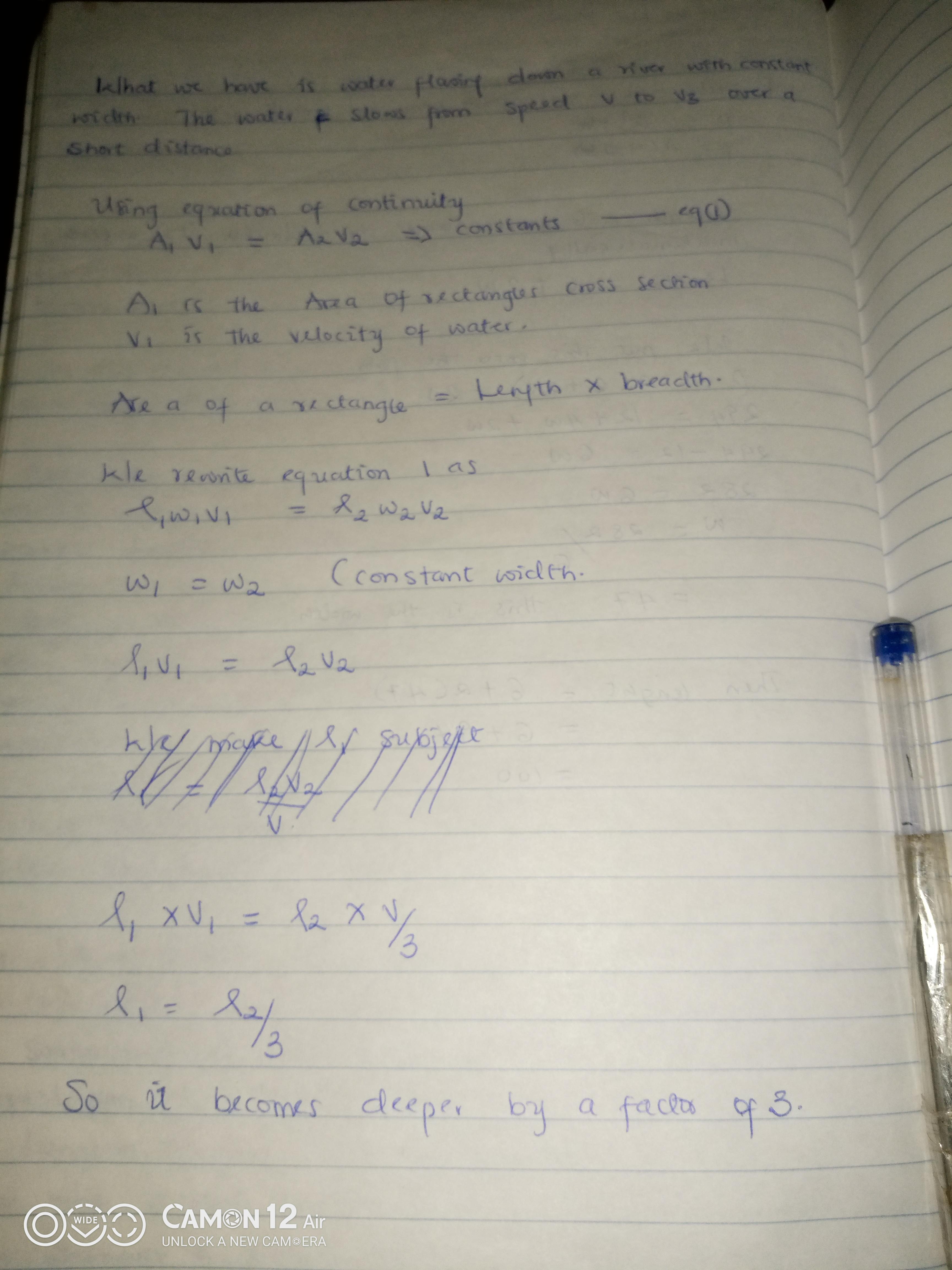
What we have is water flowing down a river with constant width. The water slows from speed v to v3 over a shirt distance

Using the equation of continuity

A1V1 = A2V2 ----1

A1 is the area of rectangle

V1 is the velocity of water

Area of rectangle = length x width

We rewrite equation 1 as

λ1w1v1 = λ2w2v2

We have w1 = w2

λ1v1 = λ2v2

λ1*v1 = λ2*v/3

λ1 = λ2/3

So it becomes deeper by a factor of 3

You might be interested in
A flywheel is a mechanical device used to store rotational kinetic energy for later use. Consider a flywheel in the form of a un
Kamila [148]

Answer:

<em>a) 6738.27 J</em>

<em>b) 61.908 J</em>

<em>c)  </em>\frac{4492.18}{v_{car} ^{2} }

<em></em>

Explanation:

The complete question is

A flywheel is a mechanical device used to store rotational kinetic energy for later use. Consider a flywheel in the form of a uniform solid cylinder rotating around its axis, with moment of inertia I = 1/2 mr2.

Part (a) If such a flywheel of radius r1 = 1.1 m and mass m1 = 11 kg can spin at a maximum speed of v = 35 m/s at its rim, calculate the maximum amount of energy, in joules, that this flywheel can store?

Part (b) Consider a scenario in which the flywheel described in part (a) (r1 = 1.1 m, mass m1 = 11 kg, v = 35 m/s at the rim) is spinning freely at its maximum speed, when a second flywheel of radius r2 = 2.8 m and mass m2 = 16 kg is coaxially dropped from rest onto it and sticks to it, so that they then rotate together as a single body. Calculate the energy, in joules, that is now stored in the wheel?

Part (c) Return now to the flywheel of part (a), with mass m1, radius r1, and speed v at its rim. Imagine the flywheel delivers one third of its stored kinetic energy to car, initially at rest, leaving it with a speed vcar. Enter an expression for the mass of the car, in terms of the quantities defined here.

moment of inertia is given as

I = \frac{1}{2}mr^{2}

where m is the mass of the flywheel,

and r is the radius of the flywheel

for the flywheel with radius 1.1 m

and mass 11 kg

moment of inertia will be

I =  \frac{1}{2}*11*1.1^{2} = 6.655 kg-m^2

The maximum speed of the flywheel = 35 m/s

we know that v = ωr

where v is the linear speed = 35 m/s

ω = angular speed

r = radius

therefore,

ω = v/r = 35/1.1 = 31.82 rad/s

maximum rotational energy of the flywheel will be

E = Iw^{2} = 6.655 x 31.82^{2} = <em>6738.27 J</em>

<em></em>

b) second flywheel  has

radius = 2.8 m

mass = 16 kg

moment of inertia is

I = \frac{1}{2}mr^{2} =  \frac{1}{2}*16*2.8^{2} = 62.72 kg-m^2

According to conservation of angular momentum, the total initial angular momentum of the first flywheel, must be equal to the total final angular momentum of the combination two flywheels

for the first flywheel, rotational momentum = Iw = 6.655 x 31.82 = 211.76 kg-m^2-rad/s

for their combination, the rotational momentum is

(I_{1} +I_{2} )w

where the subscripts 1 and 2 indicates the values first and second  flywheels

(I_{1} +I_{2} )w = (6.655 + 62.72)ω

where ω here is their final angular momentum together

==> 69.375ω

Equating the two rotational momenta, we have

211.76 = 69.375ω

ω = 211.76/69.375 = 3.05 rad/s

Therefore, the energy stored in the first flywheel in this situation is

E = Iw^{2} = 6.655 x 3.05^{2} = <em>61.908 J</em>

<em></em>

<em></em>

c) one third of the initial energy of the flywheel is

6738.27/3 = 2246.09 J

For the car, the kinetic energy = \frac{1}{2}mv_{car} ^{2}

where m is the mass of the car

v_{car} is the velocity of the car

Equating the energy

2246.09 =  \frac{1}{2}mv_{car} ^{2}

making m the subject of the formula

mass of the car m = \frac{4492.18}{v_{car} ^{2} }
3 0
2 years ago
A fellow student of mathematical bent tells you that the wave function of a traveling wave on a thin rope is y(x,t)=2.30mmcos[(6
Shalnov [3]

Answer:

a. y(x,t)= 2.05 mm cos[( 6.98 rad/m)x + (744 rad/s).

b. third harmonic

c. to calculate frequency , we compare with general wave equation

y(x,t)=Acos(kx+ωt)

from ωt=742t

ω=742

ω=2*pi*f

742/2*pi

f=118.09Hz

Explanation:

A fellow student of mathematical bent tells you that the wave function of a traveling wave on a thin rope is y(x,t)=2.30mmcos[(6.98rad/m)x+(742rad/s)t]. Being more practical-minded, you measure the rope to have a length of 1.35 m and a mass of 3.38 grams. Assume that the ends of the rope are held fixed and that there is both this traveling wave and the reflected wave traveling in the opposite direction.

A) What is the wavefunction y(x,t) for the standing wave that is produced?

B) In which harmonic is the standing wave oscillating?

C) What is the frequency of the fundamental oscillation?

a. y(x,t)= 2.05 mm cos[( 6.98 rad/m)x + (744 rad/s).

b. lambda=2L/n

when comparing the wave equation with the general wave equation , we get the wavelength to be

2*pi*x/lambda=6.98x

lambda=0.9m

we use the equation

lambda=2L/n

n=number of harmonics

L=length of string

0.9=2(1.35)/n

n=2.7/0.9

n=3

third harmonic

c. to calculate frequency , we compare with general wave equation

y(x,t)=Acos(kx+ωt)

from ωt=742t

ω=742

ω=2*pi*f

742/2*pi

f=118.09Hz

8 0
2 years ago
The moon’s orbital speed around Earth is 3.680 × 10^3 km/h. Suppose the moon suffers a perfectly elastic collision with a comet
Naily [24]

Answer:

Speed of comet before collision is

v_{2_{i}}=-2.5\times10^{3}\quad km/h

Explanation:

Correction: (As stated after collision comet moves away from moon so velocity of moon and moon and comet must be opposite in direction. as spped of moon after collision is −4.40 × 10^2km/h so that comet's must be 5.740 × 10^3km/h instead of -5.740 × 10^3km/h)

Solution:

mass \quad of\quad moon = m_{1}\\\\mass\quad of \quad comet = m_{2} = 0.5 m_{1}\\\\speed\quad of\quad moon\quad before\quad collision = v_{1_{i}}=3.680\times 10^3 km/h\\\\speed \quad of\quad moon\quad after\quad collision=v_{1_{f}} = -4.40 \times 10^2 km/h\\\\speed\quad of\quad comet\quad after\quad collision =v_{2_{f}} =5.740 \times 10^3 km/h

Case is considered as partially inelastic collision, by conservation of momentum

m_{1}v_{1_{i}}+m_{2}v_{2_{i}}=m_{1}v_{1_{f}}+m_{2}v_{2_{f}}\\\\m_{1}v_{1_{i}}+0.5m_{1}v_{2_{i}}=m_{1}v_{1_{f}}+0.5m_{1}v_{2_{f}}\\\\v_{1_{i}}+0.5v_{2_{i}}=v_{1_{f}}+0.5v_{2_{f}}\\\\v_{2_{i}}=2(v_{1_{f}}+0.5v_{2_{f}}-v_{1_{i}})\\\\v_{2_{i}}=2(-4.40 \times 10^2+0.5(5.740 \times 10^3)-3.680 \times 10^3 )\\\\v_{2_{i}}=-2.5\times10^{3}\quad km/h

8 0
2 years ago
Decide whether the attribute describes Earth, Venus, or both Earth and Venus.
masha68 [24]

1). both

2). Venus

3). Venus catastrophically; Earth too but much less.

4). Earth

5). Earth

6). Venus (It would be pretty hard for US to mistake Earth for a star.)


3 0
2 years ago
Read 2 more answers
Kate is working on a project in her tech education class. She plans to assemble a fan motor. Which form of energy does the motor
grin007 [14]

The job that the fan is designed and built to do is to convert the electrical energy it uses into the kinetic (motion) energy of moving air.

I can't really guarantee that it accomplishes that with MOST of the electrical energy it uses, because I don't know how efficient your fan is. For example, if it's a really old fan, and one blade has the end broken off, and a lot of dust and mosquitoes have gotten into the motor, and it shakes and vibrates and makes a lot of noise when it's running, then it's converting a lot of the electrical energy into thermal energy (it gets hot when it runs) and some into sound energy too.

If you can live without the word "most" in the question, then we can assume that the fan is well designed and running like a top, and the answer is definitely choice-B .

4 0
2 years ago
Other questions:
  • A sound wave traveling eastward through air
    8·2 answers
  • A 3.00-kg model airplane has velocity components of 5.00 m/s due east and 8.00 m/s due north. What is the plane’s kinetic energy
    15·2 answers
  • A compact, dense object with a mass of 2.90 kg is attached to a spring and is able to oscillate horizontally with negligible fri
    13·1 answer
  • A 5 kg block moves with a constant speed of 10 ms to the right on a smooth surface where frictional forces are considered to be
    10·2 answers
  • A ball is thrown upward from the top of a 25.0 m tall building. The ball’s initial speed is 12.0 m/sec. At the same instant, a p
    10·1 answer
  • The momentum of an object is determined to be 7.2 ×× 10-3 kg⋅m/skg⋅m/s. Express this quantity as provided or use any equivalent
    10·1 answer
  • Hydrogen peroxide is sold commercially as an aqueous solution in brown bottles to protect it from light. Calculate the longest w
    6·2 answers
  • A passenger compartment of a rotating amusement park ride contains a bench on which a book of mass
    6·1 answer
  • As light shines from air to another medium, i = 26.0 º. The light bends toward the normal and refracts at 32.0 º. What is the in
    9·1 answer
  • 1. A student is biking to school. She travels 0.7 km north, then realizes something has fallen out of her bag.
    6·1 answer
Add answer
Login
Not registered? Fast signup
Signup
Login Signup
Ask question!
