answer.
Ask question
Login Signup
Ask question
All categories
  • English
  • Mathematics
  • Social Studies
  • Business
  • History
  • Health
  • Geography
  • Biology
  • Physics
  • Chemistry
  • Computers and Technology
  • Arts
  • World Languages
  • Spanish
  • French
  • German
  • Advanced Placement (AP)
  • SAT
  • Medicine
  • Law
  • Engineering
slega [8]
2 years ago
3

A 5% upgrade on a six-lane freeway (three lanes in each direction) is 1.25 mi long. On this segment of freeway, the directional

peak-hour volume is 3800 vehicles with 2% large trucks and 4% buses (no recreational vehicles), the peak-hour factor is 0.90, and all drivers are regular users. The lanes are 12 ft wide, there are no lateral obstructions within 10 ft of the roadway, and the total ramp density is 1.0 ramps per mile. A bus strike will eliminate all bus traffic, but it is estimated that for each bus removed from the roadway, seven additional passenger vehicles will be added as travelers seek other means of travel. What are the density, volume-to-capacity ratio, and level of service of the upgrade segment before and after the bus strike?
Engineering
1 answer:
irakobra [83]2 years ago
3 0

Answer:

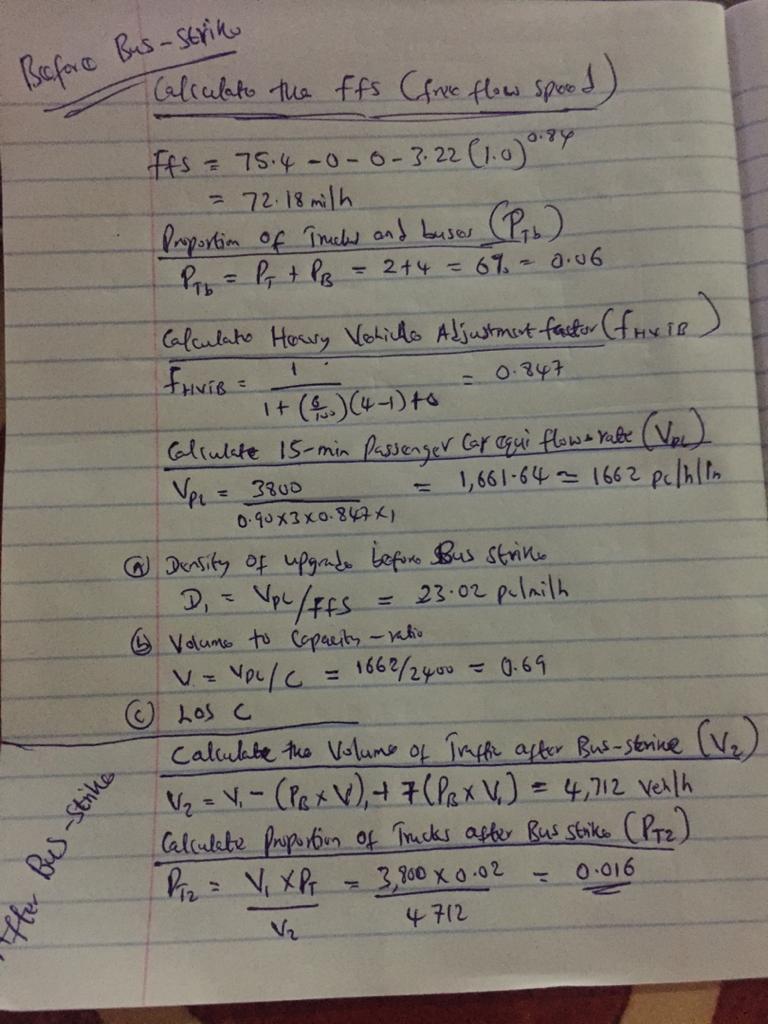
a) <u>Density of the road segment </u>

i) Before bus strike = 23.02 pc/mi/In

ii) after bus strike = 25.76 pc/mi/In

b) <u>Volume to capacity ratio </u>

i) Before bus strike = 0.69

ii) After bus strike = 0.78

<u>C) level of service of the upgrade segment </u>

i) Before bus strike = LOS C

ii) after bus strike = LOS D

Explanation:

<u>a) Density of the road segment </u>

i) before bus strike ( D1 )

 D1 = 1662 / 72.18  = 23.02 pc/mi/In

ii) After bus strike ( D2 )

D1 = 1859 / 72.18 = 25.76 pc/mi/In

<u>b) Volume to capacity ratio </u>

<em>i) Before bus strike ( v 1 )</em>

V1 = 1662 / 2400 = 0.69

<em>ii) After bus strike ( V2 )</em>

V2 = 1859 / 2400 = 0.78

<u>C) level of service of the upgrade segment </u> ( Gotten from " LOS Criteria for basic freeway segments " )

i) Before bus strike =  ( LOS C )

ii) After bus strike  = LOS D

Attached below is the detailed solution to the question above
You might be interested in
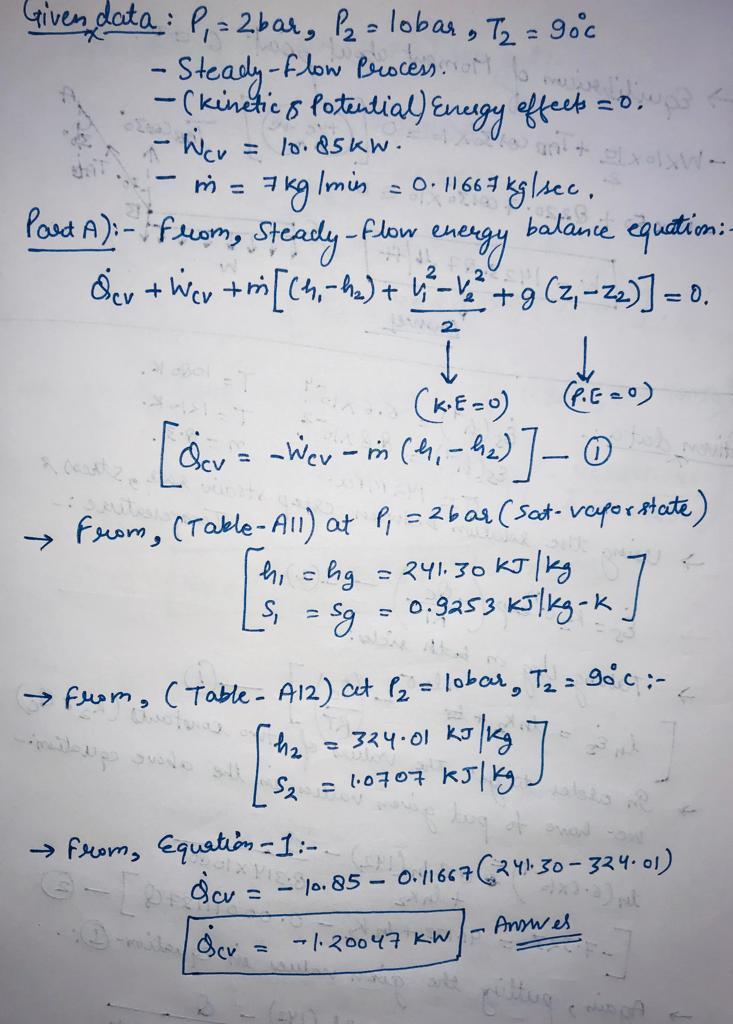
Refrigerant-134a is compressed from 2 bar, saturated vapor, to 10 bar, 90o C in a compressor operating at steady state. The mass
Ronch [10]

Answer:

Find attach the solution

Explanation:

Entropy production is almost the same in (b) and (c) as T_{avg} ~ T_{surroundings}

3 0
2 years ago
What can your employer do to protect you from overhead power lines?
agasfer [191]

Answer:

Have the power company install insulated sleeves (also known as “eels”) over power lines.​

Wearing PPE is the only way to prevent being electrocuted

Explanation:

To prevent electrocution at workplace, employers can ensure that the  power company install insulated sleeves (also known as “eels”) over power lines.​ Additionally, the employees should wear PPEs which are insulators to prevent electrocution.

5 0
2 years ago
Solid spherical particles having a diameter of 0.090 mm and a density of 2002 kg/m3 are settling in a solution of water at 26.7C
IrinaVladis [17]

Answer:

Settling Velocity (Up)= 2.048*10^-5 m/s

Reynolds number Re = 2.159*10^-3

Explanation:

We proceed as follows;

Diameter of Particle = 0.09 mm = 0.09*10^-3 m

Solid Particle Density = 2002 kg/m3

Solid Fraction, θ= 0.45

Temperature = 26.7°C

Viscosity of water = 0.8509*10^-3 kg/ms

Density of water at 26.7 °C = 996.67 kg/m3

The velocity between the interface, i.e between the suspension and clear water is given by,

U = [ ((nf/ρf)/d)D^3] [18+(1/3)D^3)(1/2)]

D = d[(ρp/ρf)-1)g*(ρf/nf)^2]^(1/3)

D = 2.147

U = 0.0003m/s (n = 4.49)

Up = 0.0003 * (1-0.45)^4.49 = 2.048*10^-5 m/s

Re=0.09*10^-3*2.048*10^-5*996.67/0.0008509 = 2.159*10^-3

6 0
2 years ago
A fireboat is to fight fires at coastal areas by drawing seawater with a density of 1030 kg/m through a 20-cm-diameter pipe at a
stealth61 [152]

Answer:

A. 50.93 m/s

B. 201 kW

Explanation:

We have that pump is moving 0.1m³ of water every second. The nozzle is 5cm diameter = 0.05m , or 2.5cm radius. 2.5cm = 0.025m. The cross sectional area of the nozzle is therefore, A = πr²

π×0.025²

= 0.001963m²

Therefore, for 0.1m³ of water to pass through this nozzle in 1 second, it must be travelling at

0.1 / 0.001963

= 50.93 m/s

Pump is meant to impart energy to the water to raise it 4m from sea level to the nozzle and accelerate it from zero to 50.93m/s through the nozzle. Now, assuming no losses, the dynamic energy of the water is equal to the potential energy it would have if it was stationary at some height h.

P.E = k.E

mgh = 0.5mv²

h = v² / 2g

h = 50.93² / (2 ×9.81)

h = 132.21m

So the equivalent head of water required due to accelerating the water is 132.21m. The static head is 4m since the nozzle is 4m above the sea and there is a further loss of 3m of head in the system due to friction etc. So the total head the pump must provide is

132.21 + 4 + 3

= 139.21m

Density = mass / volume so mass = density × volume.

The Pump is moving 0.1m³ per second of water. Therefore in one second the mass of water pumped is

0.1 × 1030 = 103kg

The total energy transferred from the pump to the water is therefore

Potential enegry, which is = mgh

= 103 ×9.81 × 139.21

= 140,662.0 Nm/s

= 140,662.0 Watts

But, we are told that the pump is only 70% efficient. Which implies

140,662 = 0.7P where P is the power supplied to the pump

so P = 140,662 / 0.7

= 200,946 Watts

= 201 kW

3 0
2 years ago
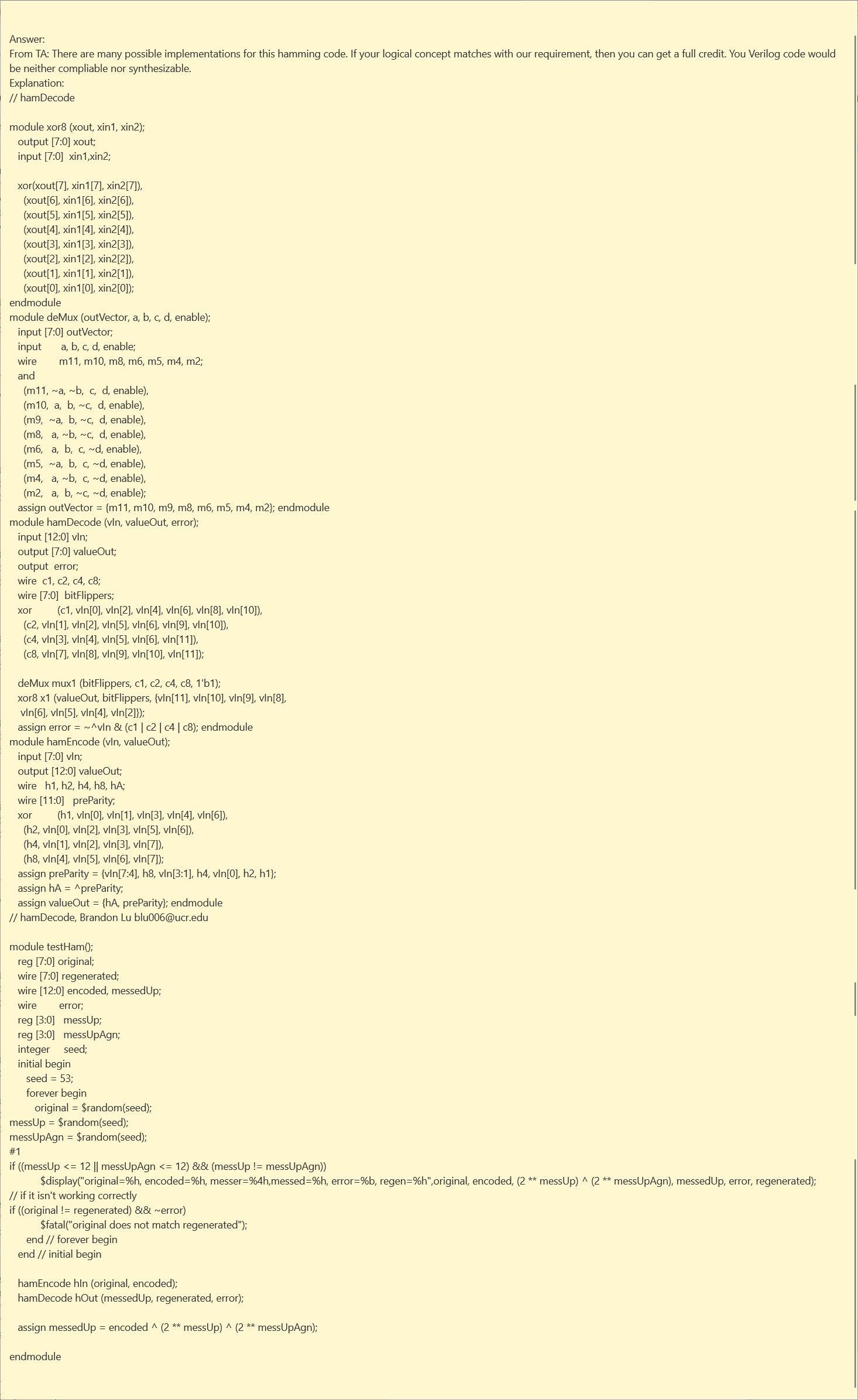
The Hamming encoder/decoder in the lecture detected and corrected one error bit. By adding a thirteen bit which is the exclusive
krek1111 [17]

Cos of error of special characters

The solution has been attached to the portal

7 0
2 years ago
Other questions:
  • The pressure at any point in a static fluid depends only on the Select one a)- depth, surface pressure, and specific weight. b)-
    11·1 answer
  • A hydrogen-filled balloon to be used in high altitude atmosphere studies will eventually be 100 ft in diameter. At 150,000 ft, t
    7·1 answer
  • 5 kg of steam contained within a piston-cylinder assembly undergoes an expansion from state 1, where the specific internal energ
    7·1 answer
  • When a man returns to his well-sealed house on a summer day, he finds that the house is at 35°C. He turns on the air conditioner
    13·1 answer
  • In this module you learned about searching, sorting and algorithms in C++ and how to implement these elements in your C++ progra
    6·1 answer
  • Consider the time domain waveforms below on the left. Match waveforms (a) - (e) to their respective frequency spectrum represent
    11·1 answer
  • What is the component called that usually has a dual-voltage selector switch and has cables that connect to the motherboard and
    15·1 answer
  • Complete the following sentence.
    5·1 answer
  • The signboard truss is designed to support a horizontal wind load of 800 lb. A separate analysis shows that 5 8 of this force is
    12·1 answer
  • What are practical considerations you might encounter when you increase the moment of inertia (I) while keeping the cross-sectio
    13·1 answer
Add answer
Login
Not registered? Fast signup
Signup
Login Signup
Ask question!