answer.
Ask question
Login Signup
Ask question
All categories
  • English
  • Mathematics
  • Social Studies
  • Business
  • History
  • Health
  • Geography
  • Biology
  • Physics
  • Chemistry
  • Computers and Technology
  • Arts
  • World Languages
  • Spanish
  • French
  • German
  • Advanced Placement (AP)
  • SAT
  • Medicine
  • Law
  • Engineering
charle [14.2K]
2 years ago
3

Can somebody please help me!!

Chemistry
1 answer:
weeeeeb [17]2 years ago
6 0

Answer:

Gene, I think

Explanation:

gl

You might be interested in
A 0.529-g sample of gas occupies 125 ml at 60. cm of hg and 25°c. what is the molar mass of the gas?
Llana [10]

<span>Let's </span>assume that the gas has ideal gas behavior. <span>
Then we can use ideal gas formula,
PV = nRT<span>

</span><span>Where, P is the pressure of the gas (Pa), V is the volume of the gas (m³), n is the number of moles of gas (mol), R is the universal gas constant ( 8.314 J mol</span></span>⁻¹ K⁻¹) and T is temperature in Kelvin.<span>
<span>
</span>P = 60 cm Hg = 79993.4 Pa
V = </span>125  mL = 125 x 10⁻⁶ m³

n = ?

<span> R = 8.314 J mol</span>⁻¹ K⁻¹<span>
T = 25 °C = 298 K
<span>
By substitution,
</span></span>79993.4 Pa<span> x </span>125 x 10⁻⁶ m³ = n x 8.314 J mol⁻¹ K⁻¹ x 298 K<span>
                                          n = 4.0359 x 10</span>⁻³ mol

<span>
Hence, moles of the gas</span> = 4.0359 x 10⁻³ mol<span>

Moles = mass / molar mass

</span>Mass of the gas  = 0.529 g 

<span>Molar mass of the gas</span> = mass / number of moles<span>
                                    = </span>0.529 g / 4.0359 x 10⁻³ mol<span>
<span>                                    = </span>131.07 g mol</span>⁻¹<span>

Hence, the molar mass of the given gas is </span>131.07 g mol⁻¹

4 0
2 years ago
Which of the following gives the molarity of a 17.0% by mass solution of sodium acetate, CH 3COONa (molar mass = 82.0 g/mol) in
weeeeeb [17]

Answer:

The molarity of this solution is 2.26 M (option D)

Explanation:

Step 1: Data given

Mass % = 17%

Molar mass of CH3COONa = 82.0 g/mol

Density of the solution = 1.09 g/mL

Step 2:

Assume the mass of the solution is 1.00 gram

⇒ 17.0 % CH3COONa = 0.17 grams

⇒ 83.0 % H2O = 0.83 grams

Step 3:

Density = 1.09 g/mL

Volume of the solution = total mass / density of solution

Volume of solution : 1.00 grams / 1.09 g/mL

Volume of the solution = 0.917 mL = 0.000917 L

Step 4: Calculate  number of moles of CH3COONa

Number of moles = Mass / molar mass

Number of moles CH3COONa = 0.170 grams / 82.0 g/mol

Number of moles = CH3COONa = 0.00207 moles

Step 5: Calculate molarity

Molarity = moles / volume

Molarity solution =   0.00207 / 0.000917 L

Molarity solution =  2.26 mol/L = 2.26 M

The molarity of this solution is 2.26 M (option D)

6 0
2 years ago
Calculate the number of grams of sulfuric acid in 1 gallon of battery acid if the solution has a density of 1.31 g/ml and is 37.
adoni [48]
<span>We know that density is equal to mass divided by volum, D=M/V and in this case we have 1 gallon of a solution of sulfuric acid with 37.4% of concentration in mass. 1 gallon is 3785.41 ml and according the formula M=D*V = 1.31 * 3785.41 = 4958.89 grams of solution. Only 37.4% of the solution is sulfuric acid, that is 4958.89 * 37.4/100= 1854.62 grams Then the number of grams of sulfuric acid is 1854.62 gr.</span>
7 0
2 years ago
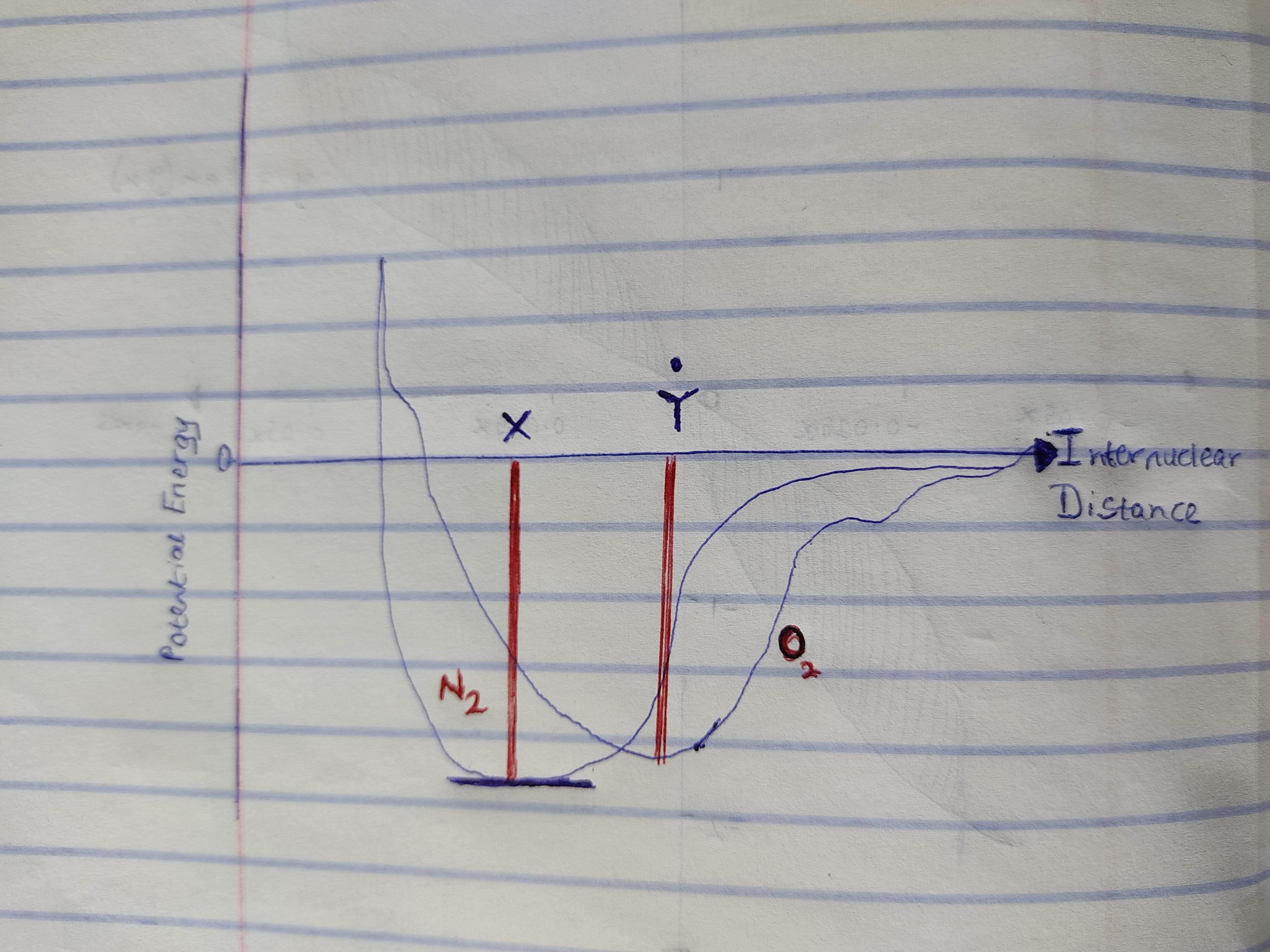
On the graph, indicate the distance that corresponds to the bond length of the N2 molecule by placing an X on the horizontal axi
Brut [27]

Answer:

Check the image in the file attached below.

Explanation:

The objective of this question is to use the diagram provided to indicate the distance that corresponds to the bond length of the N2 molecule by placing X on the horizontal axis.

The bond length shows the distance of the bonds between the nuclei of the bonded atoms between the N2 molecule and O2 molecule. From the diagram, we can see that the bond length of O2 shows a greater tendency over the N2 molecule and it also have higher potential energy than the N2 molecule.

6 0
2 years ago
Assuming that light is composed of particles (photons), how do you think you can adjust the conditions in the simulation to make
andreyandreev [35.5K]
Um I’m not sure what your trying to ask luv
5 0
2 years ago
Other questions:
  • What elements of paint can help forensic scientists compare samples to each other?
    14·1 answer
  • If the actual yield of the reaction was 75% instead of 100%, how many molecules of no would be present after the reaction was ov
    5·2 answers
  • How many moles NaOH are contained in 65.0 mL of a 2.20 M solution of NaOH in H2O?
    6·2 answers
  • Explain why you hear a “whoosh” sound when you open a can containing a carbonated drink. Which gas law applies?
    8·2 answers
  • Question 2 Here are four sketches of pure substances. Each sketch is drawn as if a sample of the substance were under a microsco
    5·1 answer
  • Consider the following hypothetical reaction: 2 P + Q → 2 R + S The following mechanism is proposed for this reaction: P + P Q
    11·1 answer
  • Identify from the following list of molecules and ions which behave as Lewis acids: CO2, NH3, BCl3, Fe3+. (A) CO2 and NH3 (B) NH
    5·1 answer
  • Find the molarity of 186.55 g of sugar (C12H22O11) in 250. mL of water.
    6·1 answer
  • A 5-column table with 2 rows. Column 1 is labeled number of protons, with entries A and D; column 2 is number of neutrons, with
    8·1 answer
  • Describe how the Rube Goldberg device design that you created follows the law of conservation of energy. Be sure to include both
    15·1 answer
Add answer
Login
Not registered? Fast signup
Signup
Login Signup
Ask question!