answer.
Ask question
Login Signup
Ask question
All categories
  • English
  • Mathematics
  • Social Studies
  • Business
  • History
  • Health
  • Geography
  • Biology
  • Physics
  • Chemistry
  • Computers and Technology
  • Arts
  • World Languages
  • Spanish
  • French
  • German
  • Advanced Placement (AP)
  • SAT
  • Medicine
  • Law
  • Engineering
Lady_Fox [76]
2 years ago
5

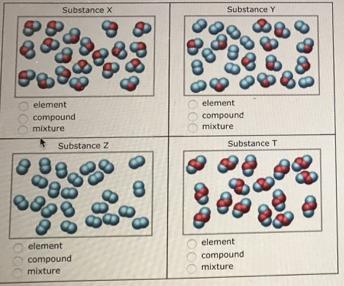
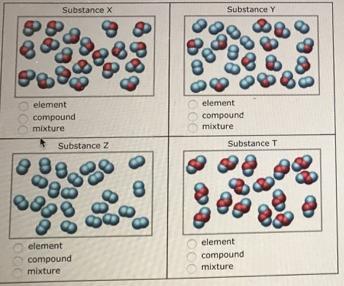
Question 2 Here are four sketches of pure substances. Each sketch is drawn as if a sample of the substance were under a microsco

pe so powerful that individual atoms could be seen. Decide whether each sketch shows a sample of an element, a compound, or a mixture.

Chemistry
1 answer:
Burka [1]2 years ago
6 0

The image with the four sketches that accompany this question was obtained in internet and is attached.

Answer:

  • <u>Substance X: compound</u>
  • <u>Substance Y: mixture</u>
  • <u>Substance W: element</u>
  • <u>Substance Z: compound</u>

Explanation:

The first picture shows substance X as a matter composed by particles of one type. Every particle consists of two white balls bonded to one red ball, sketching a compound formed by two "white atoms" and one "red atom". So, this sketch shows a sample of a compound.

The second picture shows substance Y formed by two different kind of particles. One type of particles are two white balls bonded, sketching a molecule of two equal atoms, i.e. an element in the form of a diatomic molecules of a single element (likely a gas). The other type of particles are two white balls bonded to one red ball (just as in the first picture). This sketch, then, shows the mixture of one element and one compound. Thus, this is a mixture.

The third picture shows substance W formed by one type of particles: groups of two identical white balls. So, every pair of white ball sketchs a diatomic molecule, which means that this is an element (think, for example, in H₂ or O₂).

The fourth picture shows substance Z formed by groups of particles of the same type: two red balls bonded to two white balls. So, every group of these particles represents identical compounds, making this a compound and not a mixture.

You might be interested in
In the top row labeled Before Collision, the left billiard ball labeled 3 meters per second approaches the right billiard ball l
True [87]

Answer:

Sample Response: Yes, the law of conservation of momentum is satisfied. The total momentum before the collision is 1.5 kg • m/s and the total momentum after the collision is 1.5 kg • m/s. The momentum before and after the collision is the same.

Explanation:

Sample Response since i just took it on Edg.

5 0
2 years ago
Read 2 more answers
Students working in lab accidentally spilled 17 l of 3.0 m h2so4 solution. they find a large container of acid neutralizer that
bogdanovich [222]

Answer is: 8568.71 of baking soda.

Balanced chemical reaction: H₂SO₄ + 2NaHCO₃ → Na₂SO₄ + 2CO₂ + 2H₂O.

V(H₂SO₄) = 17 L; volume of the sulfuric acid.

c(H₂SO₄) = 3.0 M, molarity of sulfuric acid.

n(H₂SO₄) = V(H₂SO₄) · c(H₂SO₄).

n(H₂SO₄) = 17 L · 3 mol/L.

n(H₂SO₄) = 51 mol; amount of sulfuric acid.

From balanced chemical reaction: n(H₂SO₄) : n(NaHCO₃) = 1 :2.

n(NaHCO₃) = 2 · 51 mol.

n(NaHCO₃) = 102 mol, amount of baking soda.

m(NaHCO₃) = n(NaHCO₃) · M(NaHCO₃).

m(NaHCO₃) = 102 mol · 84.007 g/mol.

m(NaHCO₃) = 8568.714 g; mass of baking soda.

4 0
2 years ago
The pKs of succinic acid are 4.21 and 5.64. How many grams of monosodium succinate (FW = 140 g/mol) and disodium succinate (FW =
Varvara68 [4.7K]

Answer:

9.744g of monosodium succinate.

4.925g of disodium succinate.

Explanation:

To find pH of the buffer produced by the mixture of monosodium succinate-Disodium succinate is obtained from H-H equation:

pH = pKa + log ([Na₂Suc] / [NaHSuc])

As you want a pH of 5.28 and pKa is 5.64:

5.28 = 5.64 + log ([Na₂Suc] / [NaHSuc])

-0.36 = log ([Na₂Suc] / [NaHSuc])

0.4365 = ([Na₂Suc] / [NaHSuc]) <em>(1)</em>

<em />

As total concentration of the buffer is 100mM = 0.100M:

0.100M = [Na₂Suc] + [NaHSuc] <em>(2)</em>

Replacing (2) in (1):

0.4365 = (0.100M - [NaHSuc] / [NaHSuc])

0.4365 = (0.100M - [NaHSuc] / [NaHSuc])

0.4365 [NaHSuc] = 0.100M - [NaHSuc]

1.4365 [NaHSuc] = 0.100M

[NaHSuc] = 0.0696M

And:

[Na₂Suc] = 0.0304M

As volume of the buffer is 1L:

[NaHSuc] = 0.0696 moles

[Na₂Suc] = 0.0304 moles

Using molar mass of both substances:

Mass of monosodium succinate:

0.0696moles * (140g / 1mol) =<em> 9.744g of monosodium succinate.</em>

Mass of disodium succinate:

0.0304moles * (162g / 1mol) =<em> 4.925g of disodium succinate.</em>

<em></em>
5 0
2 years ago
100 points!!!!!!!!!!!!!!!!!! how does a volcanic eruption benefit the surrounding area? A. Lava and ash bury animal habitats. B.
Shkiper50 [21]
I think it would be C) The surrounding soil can become very fertile

4 0
2 years ago
Read 2 more answers
The standard free energy ( Δ G ∘ ′ ) (ΔG∘′) of the creatine kinase reaction is − 12.6 kJ ⋅ mol − 1 . −12.6 kJ⋅mol−1. The Δ G ΔG
Dmitrij [34]

Answer:

The concentration of [ADP] = 21.896*10^-6 μM

Explanation:

Given Data:

creatine + ATP -----------> ADP + creatine phosphate    

ΔG∘   = -12.6 KJ/mole  = -12600 J/mole

ΔG = -0.1 KJ/mole  =  -100 J/mole

[Creatine phosphate]  = 25 mM = 25*10^-3 M

[Creatine] = 17 mM    = 17*10^-3 M

[ATP]   =5mM = 5*10^-3M

Calculating the concentration of [ADP] using the formula;

ΔG = ΔG∘ + RTlnQc

Substituting, we have

-12600   = -100 + 8.314*298lnQc

-12600+100 = 8.314*298lnQc

-12500   = 2477.57lnQc

lnQc = -12500/2477.57

lnQc = -5.045

Qc = e^ -5.045

Qc   = 6.44*10^-3

But,

Qc    = [Creatine phosphate]*[ADP]/[creatine]*[ATP]

6.44*10^-3   = 25*10^-3*[ADP]/ (17*10^-3* 5*10^-3)

6.44*10^-3 = 25*10^-3[ADP]/8.5*10^-5

6.44*10^-3 * 8.5*10^-5 = 25*10^-3[ADP]

5.474*10^-7 = 25*10^-3[ADP]

[ADP] = 5.474*10^-7 /25*10^-3

          = 2.1896 *10^-5 M

          = 21.896*10^-6 μM

Therefore, the concentration of [ADP] = 21.896*10^-6 μM

3 0
2 years ago
Other questions:
  • Magnesium has an atomic mass of 24.3. there are two isotopes of magnesium - one contains 12 neutrons and the other contains 13 n
    7·1 answer
  • Which state of matter has particles that slide past each other while remaining in contact? Gas Liquid Plasma Solid
    14·1 answer
  • Both black and white road surfaces absorb sunlight. the warmer road surface at the end of a sunny day is the
    12·1 answer
  • What did the Romans build as a step toward environmental management? The Romans built to carry water from abundant water areas t
    13·2 answers
  • Which of the following steps correctly converts 6 grams of fluorine to an equivalent number of moles of fluorine?
    7·2 answers
  • One of the emission lines of the hydrogen atom has a wavelength of 93.07 nm. Determine the initial value of n associated with th
    8·2 answers
  • Report the precise concentration of the undiluted stock solution #1 of TZ in micromoles per liter. This is your most concentrate
    7·1 answer
  • A 150 W electric heater operates for 12.0 min to heat an ideal gas in a cylinder. During this time, the gas expands from 3.00 L
    11·1 answer
  • What is the volume, in liters, occupied by 1.73 moles of N2 gas at 0.992 atm pressure and a temperature of 75º C? (R value- 0.08
    6·1 answer
  • imagine you have four food dyes to test A, B, C and D imagine that you are going to investigate which food dye diffuses more qui
    7·1 answer
Add answer
Login
Not registered? Fast signup
Signup
Login Signup
Ask question!