answer.
Ask question
Login Signup
Ask question
All categories
  • English
  • Mathematics
  • Social Studies
  • Business
  • History
  • Health
  • Geography
  • Biology
  • Physics
  • Chemistry
  • Computers and Technology
  • Arts
  • World Languages
  • Spanish
  • French
  • German
  • Advanced Placement (AP)
  • SAT
  • Medicine
  • Law
  • Engineering
AnnZ [28]
2 years ago
12

A center-point bending test was performed on a 2 in. x d in. wood lumber according to ASTM D198 procedure with a span of 4 ft an

d the 4 in. side is positioned vertically. If the maximum load was 240 kips and the modulus of rupture was 940.3 ksi, what is the value of d
Engineering
1 answer:
Zigmanuir [339]2 years ago
8 0

Answer:

3.03 INCHES

Explanation:

According to ASTM D198 ;

Modulus of rupture = ( M / I ) * y  ----- ( 1 )

M ( bending moment ) = R * length of span / 2

                                     = (120 * 10^3 ) * 48 / 2 = 288 * 10^4 Ib-in

I ( moment of inertia ) = bd^3 / 12

                                    = ( 2 )*( d )^3  / 12 =  2d^3 / 12

b = 2 in ,  d = ?

length of span = 4 * 12 = 48 inches

R = P  / 2 =  240 * 10^3 / 2 =   120 * 10^3 Ib

y ( centroid distance ) = d / 2  inches

back to equation ( 1 )

( M / I ) * y

940.3 ksi = ( 288 * 10^4 / 2d^3 / 12 ) * d / 2

                = ( 288 * 10^4 * 12 ) / 2d^3 )  * d / 2

940300  = 34560000* d / 4d^3

4d^3 ( 940300 ) = 34560000 d  ( divide both sides with d )

4d^2 = 34560000 / 940300

d^2 = 9.188   ∴ Value of d ≈ 3.03 in

You might be interested in
A spring-loaded toy gun is used to shoot a ball of mass m = 1.50 kg straight up in the air. The spring has spring constant k = 6
adell [148]

Answer:

1) a) Mechanical energy is conserved because no dissipative forces perform work on the ball.

2) The muzzle velocity of the ball is approximately 5.272 meters per second.

3) The maximum height of the ball is 1.417 meters.

Explanation:

1) Which of the following statements are true?

a) Mechanical energy is conserved because no dissipative forces perform work on the ball.

True, statement indicates that there is no air resistence and no friction between ball and the inside of the gun because the first never touches the latter one.

b) The forces of gravity and the spring have potential energies associated with them.

False, force of gravity do work on the ball and spring receives a potential energy at being deformated by the ball.

c) No conservative forces act in this problem after the ball is released from the spring gun.

False, the absence of no conservative forces is guaranteed for the entire system according to the statement of the problem.

2) According to the statement, we understand that spring is deformed and once released and just after reaching its equilibrium position, the muzzle velocity is reached. As spring deformation is too small in comparison with height, we can neglect changes in gravitational potential energy. By Principle of Energy Conservation, we describe the motion of the ball by the following expression:

U_{k, 1}+K_{1}=U_{k,2}+K_{2} (Eq. 1)

Where:

U_{k,1}, U_{k,2} - Initial and final elastic potential energies of spring, measured in joules.

K_{1}, K_{2} - Initial and final translational kinetic energies of the ball, measured in joules.

After using definitions of elastic potential and translational kinetic energies, we expand the equation above as:

\frac{1}{2}\cdot m\cdot (v_{2}^{2}-v_{1}^{2}) = \frac{1}{2}\cdot k\cdot (x_{1}^{2}-x_{2}^{2})

And the final velocity is cleared:

m\cdot (v_{2}^{2}-v_{1}^{2}) = k\cdot (x_{1}^{2}-x_{2}^{2})

v_{2}^{2}-v_{1}^{2} =\frac{k}{m}\cdot (x_{1}^{2}-x_{2}^{2})

v_{2}^{2} =v_{1}^{2}+\frac{k}{m}\cdot (x_{1}^{2}-x_{2}^{2})

v_{2} = \sqrt{v_{1}^{2}+\frac{k}{m}\cdot (x_{1}^{2}-x_{2}^{2}) } (Eq. 2)

Where:

v_{1}, v_{2} - Initial and final velocities of the ball, measured in meters per second.

k - Spring constant, measured in newtons per meter.

m - Mass of the ball, measured in kilograms.

x_{1}, x_{2} - Initial and final position of spring, measured in meters.

If we know that v_{1} = 0\,\frac{m}{s}, k = 667\,\frac{N}{m}, m = 1.50\,kg, x_{1} = -0.25\,m and x_{2} = 0\,cm, the muzzle velocity of the ball is:

v_{2} =\sqrt{\left(0\,\frac{m}{s} \right)^{2}+\left(\frac{667\,\frac{N}{m} }{1.50\,kg} \right)\cdot [(-0.25\,m)^{2}-(0\,m)^{2}]}

v_{2}\approx 5.272\,\frac{m}{s}

The muzzle velocity of the ball is approximately 5.272 meters per second.

3) After leaving the toy gun, the ball is solely decelerated by gravity. We construct this model by Principle of Energy Conservation:

U_{g,2}+K_{2} = U_{g,3}+K_{3} (Eq. 3)

Where:

U_{g,2}, U_{g,3} - Initial and gravitational potential energies of the ball, measured in joules.

K_{2}, K_{3} - Initial and final translational kinetic energies of the ball, measured in joules.

After applying definitions of gravitational potential and translational kinetic energies, we expand the equation above and solve the resulting for the final height:

m\cdot g \cdot (h_{3}-h_{2}) = \frac{1}{2}\cdot m \cdot (v_{2}^{2}-v_{3}^{2})

h_{3}-h_{2}=\frac{v_{2}^{2}-v_{3}^{2}}{2\cdot g}

h_{3} = h_{2} +\frac{v_{2}^{2}-v_{3}^{2}}{2\cdot g} (Eq. 4)

h_{2}, h_{3} - Initial and final heights of the ball, measured in meters.

v_{2}, v_{3} - Initial and final velocities of the ball, measured in meters per second.

g - Gravitational acceleration, measured in meters per square second.

If we get that v_{2} = 5.272\,\frac{m}{s}, v_{3} = 0\,\frac{m}{s}, h_{2} = 0\,m and g = 9.807\,\frac{m}{s^{2}}, the maximum height of the ball is:

h_{3} = 0\,m+\frac{\left(5.272\,\frac{m}{s} \right)^{2}-\left(0\,\frac{m}{s} \right)^{2}}{2\cdot \left(9.807\,\frac{m}{s^{2}} \right)}

h_{3} = 1.417\,m

The maximum height of the ball is 1.417 meters.

5 0
2 years ago
What is the linear distance traveled in one revolution of a 36-inch wheel
Afina-wow [57]

Answer:

  36π inches ≈ 113.0973 inches

Explanation:

The circumference of the wheel is pi times its diameter.

  C = πd

  C = π(36 in) = 36π in ≈ 113.0973 in

The distance around the wheel is 36π inches, about 113.0973 inches.

7 0
2 years ago
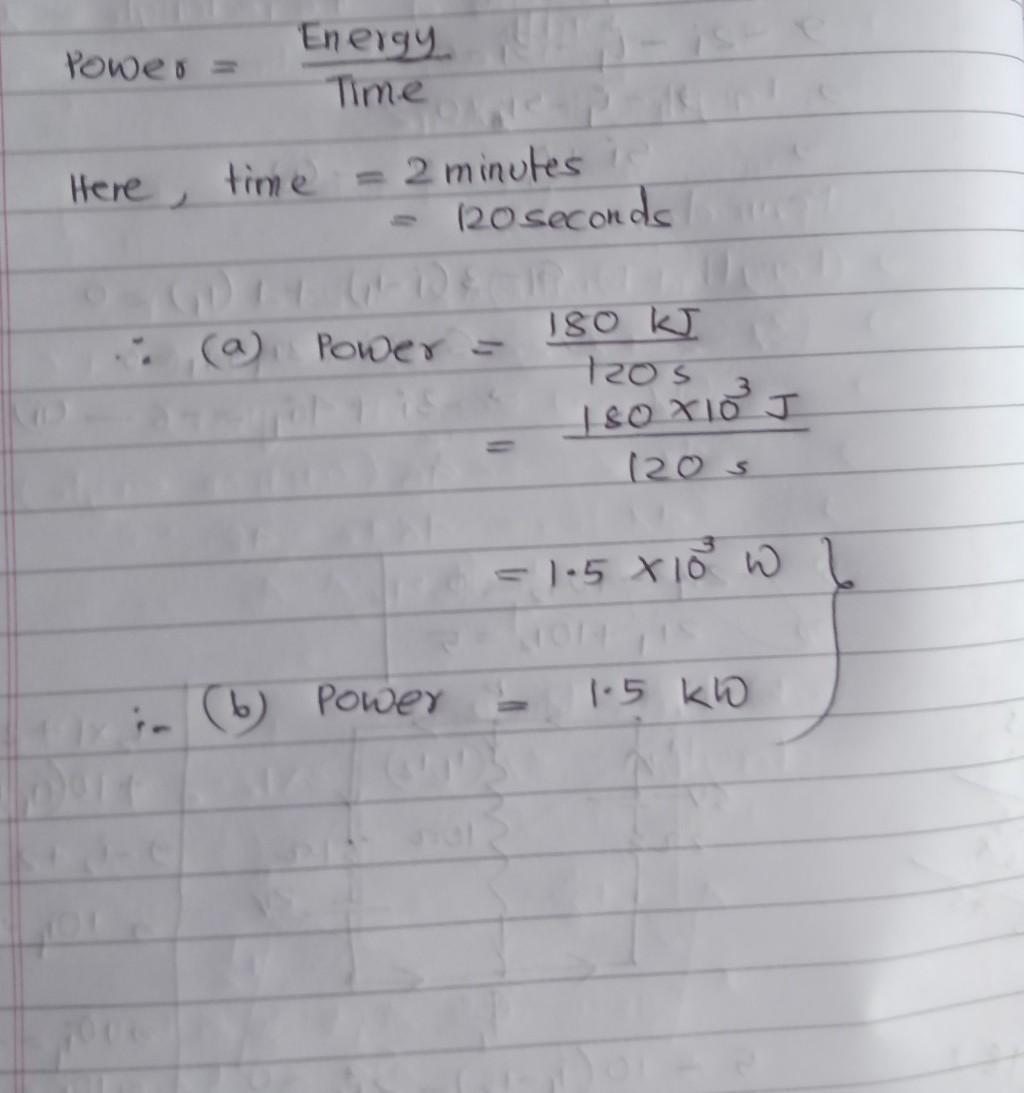
The electrical energy used by an air conditioner for 2 minutes is 180 kJ. Calculate the power of this air conditioner in the fol
ELEN [110]

Answer:

I hope it is correct.....

5 0
2 years ago
A converging-diverging nozzle is designed to operate with an exit Mach number of 1.75 . The nozzle is supplied from an air reser
Flura [38]

Answer:

a. 4.279 MPa

b. 3.198 MPa to 4.279 MPa

c. 0.939 MPa

d. Below 3.198 MPa

Explanation:

From the given parameters

M_{exit} = 1.75 MPa  

M at 1.6 MPa gives A_{exit}/A* = 1.2502

M at 1.8 MPa gives  A_{exit}/A* = 1.4390

Therefore, by interpolation, we have M_{exit} = 1.75 MPa  gives A

However, we shall use M_{exit} = 1.75 MPa and A

Similarly,

P_{exit}/P₀ = 0.1878

a) Where the nozzle is choked at the throat there is subsonic flow in the following diverging part of the nozzle. From tables, we have

A_{exit}/A* = 1.387. by interpolation M

Therefore P_{exit} = P₀ × P

Which shows that the nozzle is choked for back pressures lower than 4.279 MPa

b) Where there is a normal shock at the exit of the nozzle, we have;

M₁ = 1.75 MPa, P₁ = 0.1878 × 5 = 0.939 MPa

Where the normal shock is at M₁ = 1.75 MPa, P₂/P₁ = 3.406

Where the normal shock occurs at the nozzle exit, we have

P_b = 3.406\times 0.939 = 3.198 MPa

Where the shock occurs t the section prior to the nozzle exit from the throat, the back pressure was derived as P_b = 4.279 MPa

Therefore the back pressure value ranges from 3.198 MPa to 4.279 MPa

c) At M_{exit} = 1.75 MPa  and P

d) Where the back pressure is less than 3.198 MPa according to isentropic flow relations supersonic flow will exist at the exit plane    

8 0
2 years ago
A single crystal of a metal that has the FCC crystal structure is oriented such that a tensile stress is applied parallel to the
morpeh [17]

The magnitude of applied stress in the direction of 101 is 12.25 MPA and in the direction of 011, it is not defined.                                          

<u>Explanation</u>:        

<u>Given</u>:

tensile stress is applied parallel to the [100] direction

Shear stress is 0.5 MPA.

<u>To calculate</u>:

The magnitude of applied stress in the direction of [101] and [011].

<u>Formula</u>:

zcr=σ cosФ cosλ

<u>Solution</u>:

For in the direction of 101

cosλ = (1)(1)+(0)(0)+(0)(1)/√(1)(2)

cos λ = 1/√2

The magnitude of stress in the direction of 101 is 12.25 MPA

In the direction of 011

We have an angle between 100 and 011

cosλ = (1)(0)+(0)(-1)+(0)(1)/√(1)(2)

cosλ  = 0

Therefore the magnitude of stress to cause a slip in the direction of 011 is not defined.                                                                                                                                                                      


5 0
2 years ago
Other questions:
  • a. Replacing standard incandescent lightbulbs with energy-efficient compact fluorescent lightbulbs can save a lot of energy. Cal
    9·1 answer
  • Universal Containers (UC) has a requirement to expose a web service to their business partners. The web service will be used to
    10·1 answer
  • 5 kg of steam contained within a piston-cylinder assembly undergoes an expansion from state 1, where the specific internal energ
    7·1 answer
  • 10. Aluminum-lithium (Al-Li) alloys have been developed by the aircraft industry to reduce the weight and improve the performanc
    7·1 answer
  • A digital-to-analog converter uses a reference voltage of 120 V dc and has eight binary digit precision. In one of the sampling
    12·2 answers
  • Steam at 40 bar and 500o C enters the first-stage turbine with a volumetric flow rate of 90 m3 /min. Steam exits the turbine at
    9·1 answer
  • Oil enters a counterflow heat exchanger at 600 K with a mass flow rate of 10 kg/s and exits at 200 K. A separate stream of liqui
    12·1 answer
  • An air standard cycle with constant specific heats is executed in a closed pistoncylinder system and is composed of the followin
    10·1 answer
  • Solid spherical particles having a diameter of 0.090 mm and a density of 2002 kg/m3 are settling in a solution of water at 26.7C
    8·1 answer
  • 140-character statement that completes this sentence: I pledge to not text and drive because...
    12·1 answer
Add answer
Login
Not registered? Fast signup
Signup
Login Signup
Ask question!