answer.
Ask question
Login Signup
Ask question
All categories
  • English
  • Mathematics
  • Social Studies
  • Business
  • History
  • Health
  • Geography
  • Biology
  • Physics
  • Chemistry
  • Computers and Technology
  • Arts
  • World Languages
  • Spanish
  • French
  • German
  • Advanced Placement (AP)
  • SAT
  • Medicine
  • Law
  • Engineering
inysia [295]
2 years ago
6

A student is trying to classify an unidentified, solid gray material as a metal or a nonmetal. Which question will best help the

student classify the material? A. Is the material malleable or ductile?
B. Does the material feel hard to the touch?
C. Will the material float in water?
D. Does the material feel rough or smooth?
Chemistry
1 answer:
vekshin12 years ago
3 0

Answer:

A - Is the material malleable or ductile?

Explanation:

You might be interested in
A car moves at a speed of 50 kilometers/hour. Its kinetic energy is 400 joules. If the same car moves at a speed of 100 kilomete
lys-0071 [83]

ke prop to v^2


ke1/v1^2=ke2/v2^2


400/50x50=joules/100x100


400x2x2


1600j

8 0
2 years ago
Mass in grams of 6.25 mol of copper (II) nitrate?
podryga [215]
Cu = 63.546
N= 14.001 g/mol
O= 15.999 g/mol * 3 = 47.997

Copper (II) Nitrate has a MW of 125.544 g/mol

6.25 x 125.544

= 784.65 <--- is your answer, if there were was a multiple choice or not :)
8 0
2 years ago
Read 2 more answers
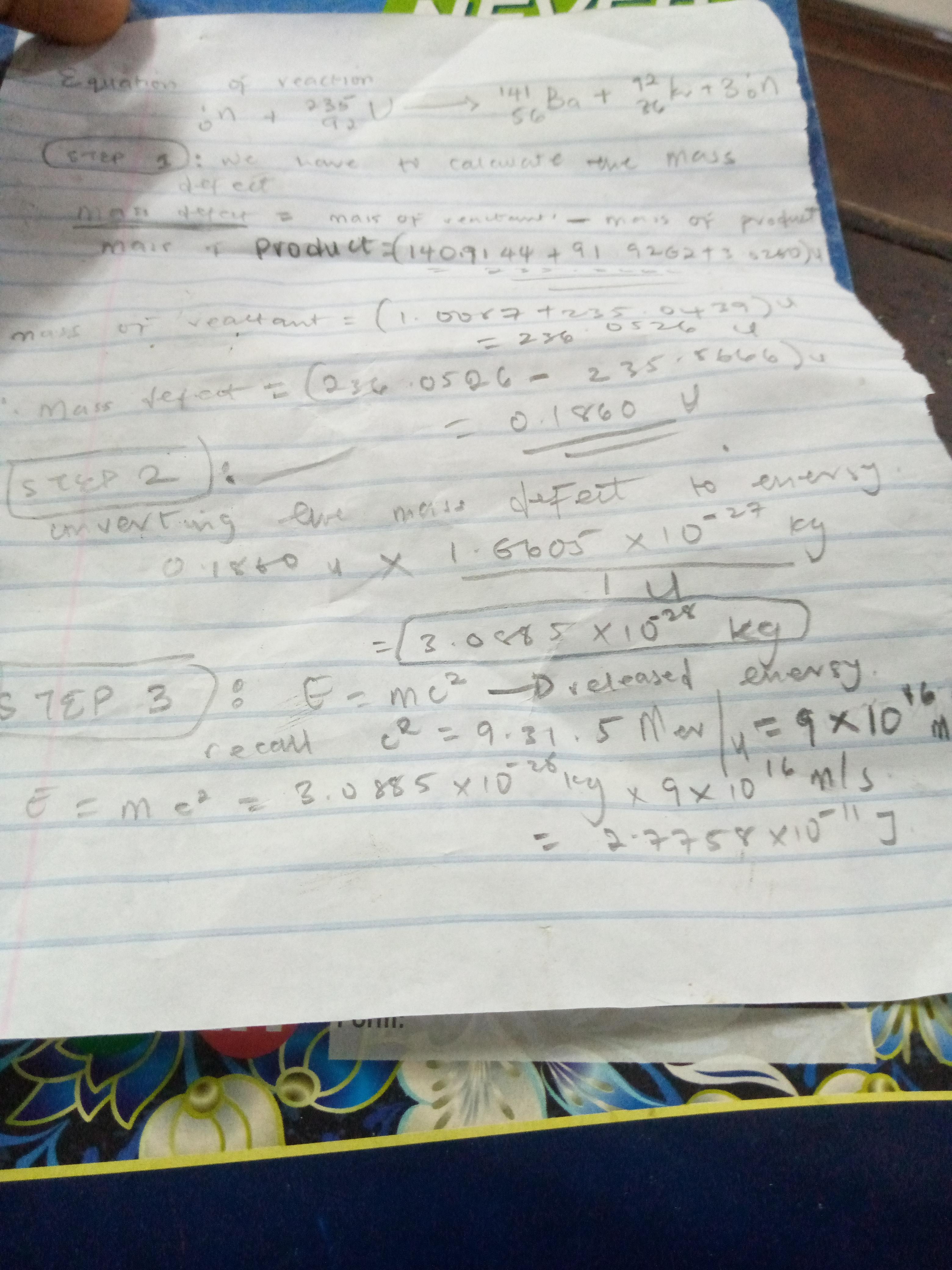
What is the reaction energy Q of this reaction? Use c2=931.5MeV/u. Express your answer in millions of electron volts to three si
emmasim [6.3K]

Answer:

Energy= 2.7758 × 10^-11 J ;

71.112×10^-6 kJ.

Mass defect in Kilogram= 3.0885×10^-28 kg.

That is; 3.1×10^-28 kg(to two significant figure).

Explanation:

(Note: Check equation of reaction in the attached file/picture).

STEP ONE: we have to calculate the Mass defect.

Mass defect= Mass of reactants -- Mass of products.

Mass of the products: (140.9144+91.9262+3.060) u.

= 235.8666 u.

Mass of reactants: (1.0087+235.0439) u= 236.0526 u.

Therefore, the Mass defect= (236.0526 -- 235.8666) u

= 0.1860 u.

STEP TWO: Converting the Mass defect to energy;

0.18860 × 1.6605 × 10^27 kg

= 3.0885× 10^-28 kg

STEP THREE: Calculating energy released . Recall(from the question) c^2= 931.5 Mev/u. This is also equals to 9×10^16 m/s.

E=Mc^2.

Where E= energy released, c= speed of light, M= Mass.

Slotting in the values;

E= 3.0885×10^-28 kg × 9×10^16 m/s.

E=2.7758 × 10^-11 J.

Know that;( 1g of uranium × 1 mol of uranium ÷ 235.0439 g of uranium) × (6.002×10^23 atom of uranium/ 1 mol of uranium) × 2.7758× 10^-11.

=7.1112×10^-10 J

= 71.112×10^6 kJ.

3 0
2 years ago
The student is now told that the four solids, in no particular order, are calcium bromide (CaBr2), sugar (C6H12O6), benzoic acid
lara [203]

MgBr2, 3 ions per mole=best conductor

KBr, 2 ions per mole, 2nd best conductor

Benzoic acid, weak acid, slightly ionized, weak conductor

Sugar, molecular, non ionized, non conductor

8 0
2 years ago
If a car travels 1255 miles how many kilometers is that i mile = 1.609km
ANTONII [103]

Answer:

2,019 km

Explanation:

Step 1: Given data

Distance traveled by the car (D): 1,255 mi

Step 2: Convert the distance traveled by the car to kilometers

To convert one unit into another, we use a conversion factor. In this case, the appropriate conversion factor between miles and kilometers is 1 mile = 1.609 km. The distance traveled by the car, in kilometers, is:

D = 1,255 mi × (1.609 km/1 mi) = 2,019 km

3 0
2 years ago
Other questions:
  • Rhett is solving the quadratic equation 0= x2 – 2x – 3 using the quadratic formula. Which shows the correct substitution of the
    12·1 answer
  • How many Mg atoms are present in 170g of Mg
    15·1 answer
  • Using the idea of electronegativity difference for predicting polarity of bonds and considering the shape of the following molec
    10·1 answer
  • Balance the following reaction. A coefficient of "1" is understood. Choose option "blank" for the correct answer if the coeffici
    8·2 answers
  • How many grams are in 1.183 mol of carbon dioxide (CO2) gas?
    7·2 answers
  • The structure of carbonic acid, an important component of ocean chemistry, is depicted below. What type of model best describes
    10·2 answers
  • Suppose that 0.323 g of an unknown sulfate salt is dissolved in 50 mL of water. The solution is acidified with 6M HCl, heated, a
    6·1 answer
  • Boris is interested in conducting his first "real" scientific research. However, he is a bit overwhelmed with all of the possibl
    11·1 answer
  • A student wants to measure the heat of neutralization reaction. To do this they mixed in a coffer cup calorimeter 58.0 mL of 0.5
    7·1 answer
  • If K3PO4= 0.250M, how many grams of K3PO4 are in 750.0ml of solution? Remember that M is the same as mol/L. Answer: 39.8g
    14·1 answer
Add answer
Login
Not registered? Fast signup
Signup
Login Signup
Ask question!