answer.
Ask question
Login Signup
Ask question
All categories
  • English
  • Mathematics
  • Social Studies
  • Business
  • History
  • Health
  • Geography
  • Biology
  • Physics
  • Chemistry
  • Computers and Technology
  • Arts
  • World Languages
  • Spanish
  • French
  • German
  • Advanced Placement (AP)
  • SAT
  • Medicine
  • Law
  • Engineering
CaHeK987 [17]
2 years ago
10

Using the idea of electronegativity difference for predicting polarity of bonds and considering the shape of the following molec

ules, match the compounds in the order of strongest to weakest expected polarity.
(1 = strongest; 5 = weakest)
HBr
I2
HF
HCl
HI
Chemistry
1 answer:
Zinaida [17]2 years ago
8 0
See electronegativity is the tendency of an atom to gain an electron and flourine with a valecy of one and a vey small size is the most electronegetive because its orbitals are quite closed to the nucleus and hence the attraction is quite strong so it can attract an electron.the question that arises is that some smaller atoms should be more electronegetive as they are closer to the nucleus but it need more energy for them as compared to flourine to complete their octet. now polarity increases when two atoms of quite different sizes form a compound ... the more electronegetive atom will always attract the bond pair forming a negetive charge on it and positive on the less electroneg. one and polarity increases with electronegetivity of the anion.now as your question says 
<span>5=I2.. because both the atoms are same there wont be permanent polarity </span>
<span>4=HI iodine is the least electronegetive of all the halogens due to its large size,electronegetivity decreases down the group </span>
<span>3=HBr bromine is the 2nd largest halogen </span>
<span>2=HCl chlorine is the 3rd largest halogen </span>
<span>1=HF fluorine is the smallest halogen making and hence makes the most polar</span>
You might be interested in
Some versions of the periodic table show hydrogen at the top of Group 1A(1) and at the top of Group 7A(17). What properties of h
lawyer [7]

Answer:Hydrogen is placed such because it exhibits some similar characteristics of both group1 and group VII elements.

Explanation:

The reason why hydrogen is similar to group 1 metals:

#It has same valence electron and inorder achieve octet state it can lose that electron and forms H+ ion

#It acts as a good reducing agent similar to group1 metals

#It can also halides

Similarity to halogens:

#hydrogen can also gain one electron to gain noble gas configuration. It can combine with other non metals to form molecules with covalent bonding.

#It exists as diatomin molecule,H2

#Have the same electronegativity nature

#its reaction with other metal

8 0
2 years ago
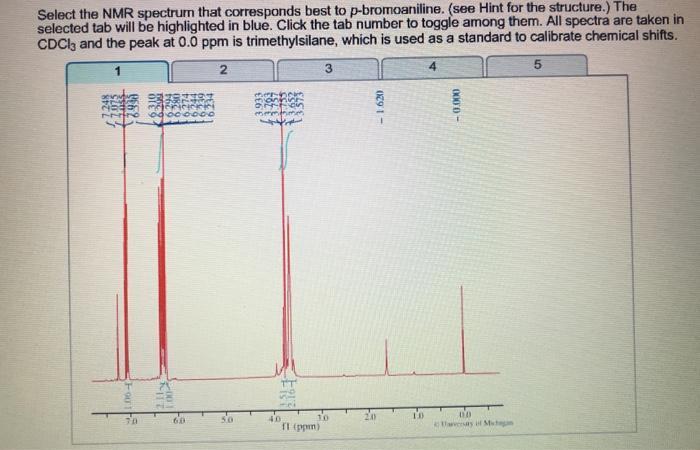
Select the NMR spectrum that corresponds best to p-bromoaniline. (see Hint for the structure.) The selected tab will be highligh
lana [24]

Answer:

The NMR spectrum that corresponds best to p-bromoaniline  is the one that is attached in the image below.

Explanation:

For the p-bromoaniline 3 types of hydrogen are observed. The first signal that appears at 3.7 ppm would be from the hydrogens of the NH2 group, the hydrogens in ortho position with respect to the NH2 group give a double at approximately 6.54 ppm, and finally the characteristic 7.21 ppm signal is observed for the hydrogens in meta position with with respect to the NH2 group.

7 0
2 years ago
Which one is balanced or unbalanced force 1. Change object motion 2. Push or pull 3. Have direction 4. Do not change objects mot
Margaret [11]

Answer:

Explanation:

1. Change object motion - unbalanced force

2. Push or pull - Balanced forces do not cause a change in motion. When balanced forces act on an object at rest, the object will not move. If you push against a wall, the wall pushes back with an equal but opposite force. Neither you nor the wall will move. Forces that cause a change in the motion of an object are unbalanced forces. So if object move it is unbalanced.

3. Have direction - unbalanced force

4. Do not change objects motion - balanced force

5. Net force does not =0 - unbalanced force

6.net force =0 - balanced force

3 0
2 years ago
In a laboratory setting, concentrations for solutions are measured in molarity, which is the number of moles per liter (mol/L).
slamgirl [31]

Answer:

im pretty sure its A or C im leaning more toward A tho

Explanation:

6 0
1 year ago
Read 2 more answers
When of benzamide are dissolved in of a certain mystery liquid , the freezing point of the solution is less than the freezing po
SOVA2 [1]

The given question is incomplete. The complete question is as follows.

When 70.4 g of benzamide (C_{7}H_{7}NO) are dissolved in 850 g of a certain mystery liquid X, the freezing point of the solution is 2.7^{o}C lower than the freezing point of pure X. On the other hand, when 70.4 g of ammonium chloride (NH_{4}Cl) are dissolved in the same mass of X, the freezing point of the solution is 9.9^{o}C lower than the freezing point of pure X.

Calculate the Van't Hoff factor for ammonium chloride in X.

Explanation:

First, we will calculate the moles of benzamide as follows.

    Moles of benzamide = \frac{mass}{\text{Molar mass of benzamide}}

                    = \frac{70.4 g}{121.14 g/mol}

                    = 0.58 mol

Now, we will calculate the molality as follows.

     Molality = \frac{\text{moles of solute (benzamide)}}{\text{solvent mass in kg}}

                   = \frac{0.58 mol}{0.85 kg}

                   = 0.6837

It is known that relation between change in temperature, Van't Hoff factor and molality is as follows.

      dT = i \times K_{f} \times m,

where,      dT = change in freezing point = 2.7^{o}C

                  i = van't Hoff factor = 1 for non dissociable solutes

      K_{f} = freezing point constant of solvent

                m = 0.6837

Therefore, putting the given values into the above formula as follows.

             dT = i \times K_{f} \times m,

            2.7^{o}C = 1 \times K_{f} \times 0.6837 m

            K_{f} = 3.949 C/m

Now, we use this K_{f} value for calculating i for NH_{4}Cl

So, moles of ammonium chloride are calculated as follows.

 Moles of NH_{4}Cl = \frac{70.4 g}{53.491 g/mol}

                            = 1.316 mol

Hence, calculate the molality as follows.

    Molality = \frac{1.316 mol}{0.85 kg}

                  = 1.5484

It is given that value of change in temperature (dT) = 9.9^{o}C. Thus, calculate the value of Van't Hoff factor as follows.

              dT = i \times K_{f} \times m

   9.9^{o}C = i \times 3.949 C/m \times 1.5484 m

                     i = 1.62

Thus, we can conclude that the value of van't Hoff factor for ammonium chloride is 1.62.

5 0
2 years ago
Other questions:
  • If 350.0 grams of Cr2O3 are reacted with 235.0 grams of elemental silicon, 213.2 grams of chromium metal are recovered. What is
    5·1 answer
  • How many molecules of ascorbic acid (vitamin c, c6h8o6) are in a 500 mg tablet?
    14·2 answers
  • What are the missing coefficients for the skeleton equation below? cr(s) + fe(no3)2(aq) → fe(s) + cr(no3)3(aq)?
    9·1 answer
  • An allergy medicine is usually stored in a cabinet at the room temperature where it’s molecules move around each other. By mista
    12·1 answer
  • Automobile batteries are filled with an aqueous solution of sulfuric acid. What is the mass of the acid (in grams) in 800. mL of
    11·1 answer
  • Which statement is true for a solution when its concentration of hydroxide ions becomes equal to the concentration of hydronium
    11·2 answers
  • How many moles are there in 3.612 X 10^24 molecules of phosgene (COCL2)
    14·2 answers
  • Use the words protons neutrons and I suppose in the same sentence ​
    5·1 answer
  • The structures of TeF4 and TeCl4 in the gas phase have been studied by electron diffraction (S. A. Shlykov, N. I. Giricheva, A.
    15·1 answer
  • As the pressure of a system changes, boiling points can change in what direction?
    5·2 answers
Add answer
Login
Not registered? Fast signup
Signup
Login Signup
Ask question!