answer.
Ask question
Login Signup
Ask question
All categories
  • English
  • Mathematics
  • Social Studies
  • Business
  • History
  • Health
  • Geography
  • Biology
  • Physics
  • Chemistry
  • Computers and Technology
  • Arts
  • World Languages
  • Spanish
  • French
  • German
  • Advanced Placement (AP)
  • SAT
  • Medicine
  • Law
  • Engineering
EleoNora [17]
2 years ago
8

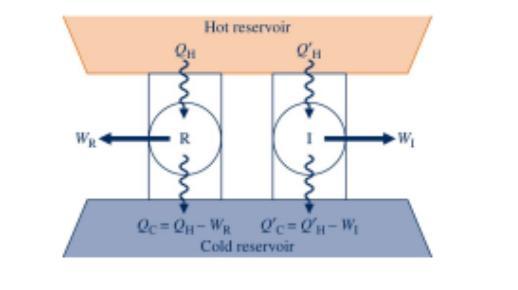
A reversible power cycle R and an irreversible power cycle I operate between the same hot and cold thermal reservoirs. Cycle I h

as a thermal efficiency equal to one third the thermal efficiency of R.
a. If each cycle receives the same amout of energy by heat transfer from the hot reservor, detrmine which cycle:
1. develops greater net work.
2. discharges greater energy by heat transfer to the cold reservoir

b. If each cycle develops the same net work, determine which cycle:
1. receives greater net energy by heat transfer from the hot reservoir
2. discharges greater energy by heat transfer to the cold reservoir.
Engineering
1 answer:
anygoal [31]2 years ago
4 0

Answer: Attached below is the missing diagram

answer :

A)   1) Wr > WI,     2) Qc' > Qc

B)   1) QH' > QH,   2) Qc' > Qc

Explanation:

  л = w / QH = 1 - Qc / QH  and  QH = w + Qc

<u>A) each cycle receives same amount of energy by heat transfer</u>

<u>(</u> Given that ; Л1 = 1/3 ЛR )

<em>1) develops greater bet work </em>

WR develops greater work ( i.e. Wr > WI )

<em>2) discharges greater energy by heat transfer</em>

 Qc' > Qc

solution attached below

<u>B) If Each cycle develops the same net work </u>

<em>1) Receives greater net energy by heat transfer from hot reservoir</em>

QH' > QH   ( solution is attached below )

<em>2) discharges greater energy  by heat transfer to the cold reservoir</em>

Qc' > Qc

solution attached below

You might be interested in
Why is it so dangerous to use a ground lift on a metal cased power tool
MaRussiya [10]
Answer:

Removal of the safety ground connection on equipment can expose users to an increased danger of electric shock and may contradict wiring regulations. ... If a fault develops in any line-operated equipment, cable shields and equipment enclosures may become energized, creating an electric shock hazard.
7 0
1 year ago
An annealed copper strip of 228 mm wide and 25 mm thick being rolled to a thickness of 20 mm, in one pass. The roll radius is 30
sdas [7]

Answer:

The roll force is 1.59 MN

The power required in this operation is 644.96 kW

Explanation:

Given;

width of the annealed copper, w = 228 m

thickness of the copper, h₀ = 25 mm

final thickness, hf = 20 mm

roll radius, R = 300 mm

The roll force is given by;

F = LwY_{avg}

where;

w is the width of the annealed copper

Y_{avg} is average true stress of the strip in the roll gap

L is length of arc in contact, and for frictionless situation it is given as;

L = \sqrt{R(h_o-h_f)} \\\\L = \sqrt{300(25-20)}\\\\L = 38.73 \ mm

Now, determine the average true stress, Y_{avg}, for the annealed copper;

The absolute value of the true strain, ε = ln(25/20)

ε = 0.223

from true stress vs true strain graph; at true strain of 0.223, the true stress is 280 MPa.

Then, the average true stress = ¹/₂(280 MPa.) = 180 MPa

Finally determine the roll force;

F = LwY_{avg}

F = (\frac{38.73 }{1000})(\frac{228}{1000})*180 \ MPa\\\\F =   1.59 \ MN

The power required in this operation is given by;

P = \frac{2\pi FLN}{60}\\\\P =  \frac{2\pi (1.59*10^6)(0.03873)(100)}{60}\\\\P = 644955.2 \ W\\\\P = 644.96 \ kW

5 0
2 years ago
A shaft consisting of a steel tube of 50-mm outer diameter is to transmit 100 kW of power while rotating at a frequency of 34 Hz
nikitadnepr [17]

Answer:

25 - \sqrt[4]{26.66*10^{-8} }  mm

Explanation:

Given data

steel tube : outer diameter = 50-mm

power transmitted = 100 KW

frequency(f) = 34 Hz

shearing stress ≤ 60 MPa

Determine tube thickness

firstly we calculate the ; power, angular velocity and torque of the tube

power = T(torque) * w (angular velocity)

angular velocity ( w ) = 2\pif = 2 * \pi * 34 = 213.71

Torque (T) = power / angular velocity = 100000 / 213.71 = 467.92 N.m/s

next we calculate the inner diameter  using the relation

  \frac{J}{c_{2}  } = \frac{T}{t_{max} }  = 467.92 / (60 * 10^6) =  7.8 * 10^-6 m^3

also

c2 = (50/2) = 25 mm

\frac{J}{c_{2} } = \frac{\pi }{2c_{2} } ( c^{4} _{2} - c^{4} _{1} ) =  \frac{\pi }{0.050} [ ( 0.025^{4} - c^{4} _{1}  ) ]

therefore; 0.025^4 - c^{4} _{1} = 0.050 / \pi (7.8 *10^-6)

c^{4} _{1} = 39.06 * 10 ^-8 - ( 1.59*10^-2 * 7.8*10^-6)

    39.06 * 10^-8 - 12.402 * 10^-8 =26.66 *10^-8

c_{1} = \sqrt[4]{26.66 * 10^{-8} }  =

THE TUBE THICKNESS

c_{2} - c_{1} = 25 - \sqrt[4]{26.66*10^{-8} }  mm

4 0
2 years ago
(3) Calculate the heat flux through a sheet of brass 7.5 mm (0.30 in.) thick if the temperatures at the two faces are 150°Cand 5
bezimeni [28]

Answer:

a.) 1.453MW/m2,  b.)  2,477,933.33 BTU/hr  c.) 22,733.33 BTU/hr  d.) 1,238,966.67 BTU/hr

Explanation:

Heat flux is the rate at which thermal (heat) energy is transferred per unit surface area. It is measured in W/m2

Heat transfer(loss or gain) is unit of energy per unit time. It is measured in W or BTU/hr

1W = 3.41 BTU/hr

Given parameters:

thickness, t = 7.5mm = 7.5/1000 = 0.0075m

Temperatures 150 C = 150 + 273 = 423 K

                        50 C = 50 + 273 = 323 K

Temperature difference, T = 423 - 323 = 100 K

We are assuming steady heat flow;

a.) Heat flux, Q" = kT/t

K= thermal conductivity of the material

The thermal conductivity of brass, k = 109.0 W/m.K

Heat flux, Q" = \frac{109 * 100}{0.0075} = 1,453,333.33 W/m^{2} \\ Heat flux, Q" = 1.453MW/m^{2} \\

b.) Area of sheet, A = 0.5m2

Heat loss, Q = kAT/t

Heat loss, Q = \frac{109*0.5*100}{0.0075} = 726,666.667W

Heat loss, Q = 726,666.667 * 3.41 = 2,477,933.33 BTU/hr

c.) Material is now given as soda lime glass.

Thermal conductivity of soda lime glass, k is approximately 1W/m.K

Heat loss, Q=\frac{1*0.5*100}{0.0075} = 6,666.67W

Heat loss, Q = 6,666.67 * 3.41 = 22,733.33 BTU/hr

d.) Thickness, t is given as 15mm = 15/1000 = 0.015m

Heat loss, Q=\frac{109*0.5*100}{0.015} =363,333.33W

Heat loss, Q = 363,333.33 * 3.41 = 1,238,966.67 BTU/hr

5 0
2 years ago
A fatigue test was conducted in which the mean stress was 46.2 MPa and the stress amplitude was 219 MPa.
sleet_krkn [62]

Answer:

a)σ₁ = 265.2 MPa

b)σ₂ = -172.8 MPa

c)Stress\ ratio =-0.65

d)Range = 438 MPa

Explanation:

Given that

Mean stress ,σm= 46.2 MPa

Stress amplitude ,σa= 219 MPa

Lets take

Maximum stress level = σ₁

Minimum stress level =σ₂

The mean stress given as

\sigma_m=\dfrac{\sigma_1+\sigma_2}{2}

2\sigma_m={\sigma_1+\sigma_2}

2 x 46.2 =  σ₁ +  σ₂

 σ₁ +  σ₂ = 92.4 MPa    --------1

The amplitude stress given as

\sigma_a=\dfrac{\sigma_1-\sigma_2}{2}

2\sigma_a={\sigma_1-\sigma_2}

2 x 219 =  σ₁ -  σ₂

 σ₁ -  σ₂ = 438 MPa    --------2

By adding the above equation

2  σ₁ = 530.4

σ₁ = 265.2 MPa

-σ₂ = 438 -265.2 MPa

σ₂ = -172.8 MPa

Stress ratio

Stress\ ratio =\dfrac{\sigma_{min}}{\sigma_{max}}

Stress\ ratio =\dfrac{-172.8}{265.2}

Stress\ ratio =-0.65

Range = 265.2 MPa - ( -172.8 MPa)

Range = 438 MPa

8 0
2 years ago
Other questions:
  • A petrol engine produces 20 hp using 35 kW of heat transfer from burning fuel. What is its thermal efficiency, and how much powe
    14·1 answer
  • Consider a plane composite wall that is composed of two materials of thermal conductivities kA 0.1 W/mK and kB 0.04 W/mK and thi
    14·1 answer
  • CHALLENGE ACTIVITY 2.8.1: Using constants in expressions. The cost to ship a package is a flat fee of 75 cents plus 25 cents per
    7·1 answer
  • Two physical properties that have a major influence on the cracking of workpieces, tools, or dies during thermal cycling are the
    13·1 answer
  • In this module you learned about searching, sorting and algorithms in C++ and how to implement these elements in your C++ progra
    6·1 answer
  • Madison and Oxford are the same distance from the equator and they are both near the ocean. Use the information on the map to an
    11·1 answer
  • A rectification column is fed 100 kg mol/h of a mixture of 50 mol % benzene and 50 mol % toluene at 101.32 kPa abs pressure. The
    5·1 answer
  • A pair of spur gears with 20 degree pressure angle, full-depth, involute teeth transmits 65 hp. The pinion is mounted on a shaft
    5·1 answer
  • Why is data driven analytics of interest to companies?
    9·1 answer
  • It has been stated that crime rates are impacted by ecological conditions. Which of the following
    13·1 answer
Add answer
Login
Not registered? Fast signup
Signup
Login Signup
Ask question!