answer.
Ask question
Login Signup
Ask question
All categories
  • English
  • Mathematics
  • Social Studies
  • Business
  • History
  • Health
  • Geography
  • Biology
  • Physics
  • Chemistry
  • Computers and Technology
  • Arts
  • World Languages
  • Spanish
  • French
  • German
  • Advanced Placement (AP)
  • SAT
  • Medicine
  • Law
  • Engineering
Luda [366]
2 years ago
15

Can someone please help a struggling physics student?

Physics
1 answer:
zhenek [66]2 years ago
5 0
<h3><u>Part A:</u></h3>

<u><em>What is the maximum height the ball will reach in the air?</em></u>

Kinematics equation used:

  • v_f^2=v_i^2+2ad, where v_f is final velocity, v_i is initial velocity, a is acceleration, and d is distance travelled. From SI units, velocity should be in m/s, acceleration should be in m/s^2, and distance should be in m

We're given that the initial velocity is 12.0 m/s in the y-direction. At the maximum height, the vertical velocity of the ball will be 0 m/s, otherwise it would not be at maximum height. This is our final velocity.

The only acceleration in the system is acceleration due to gravity, which is approximately 9.8\:\mathrm{ m/s^2}. However, the acceleration is acting down, whereas the ball is moving up. To express its direction, acceleration should be plugged in as -9.8\:\mathrm{m/s^2}. We have three variables, and we are solving for the fourth, which is distance travelled. This will be the maximum height of the ball.

Substitute v_i=12, v_f=0, a=-9.8 to solve for d:

0^2=12^2+2(-9.8)(d),\\0=144-19.6d,\\-19.6d=-144,\\d=\frac{-144}{-19.6}=7.34693877551\approx \boxed{7.35\text{ m}}

<u><em>What is the velocity of the ball when it hits the ground?</em></u>

This question tests a physics concept rather than a physics formula. The vertical velocity of the ball when it hits the ground is equal in magnitude but opposite in direction to the ball's initial vertical velocity. This is because the ball spends equal time travelling to its max height as it does travelling from max height to the ground (ball is accelerating from initial velocity to 0 and then from 0 to some velocity over the same distance and time). Since the ball has an initial vertical velocity of +12.0 m/s, its velocity when it hits the ground will be \boxed{-12.0\text{ m/s}}. (The negative sign represents the direction. Because velocity is a vector, it is required.)

<h3><u>Part B:</u></h3>

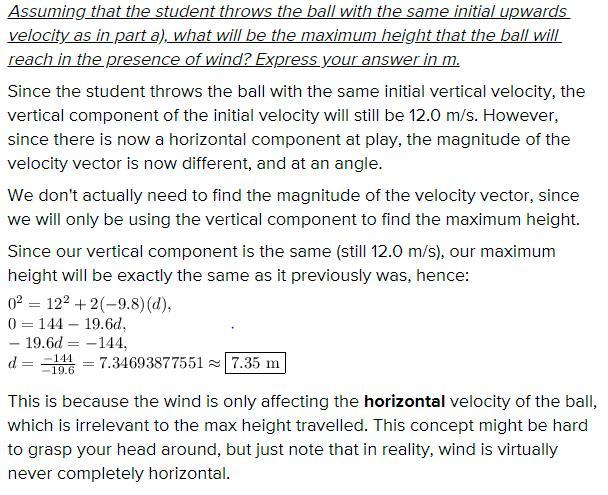
<u>**Since my initial answer exceeds the character limit, I've attached the first question to Part B as an image. Please refer to the attached image for the answer and explanation to the first question of Part B. Apologies for the inconvenience.**</u>

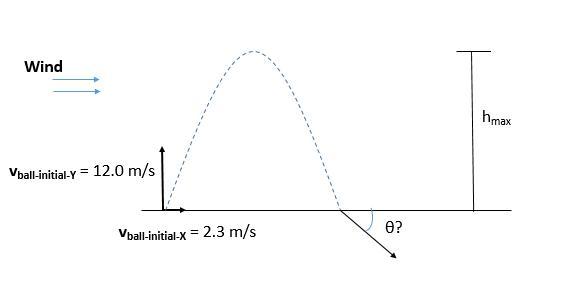
<u><em>What is the direction of the velocity of the ball when it hits the ground? Express your answer in terms of the angle (in degrees ) of the ball's velocity with respect to the horizontal direction (see figure).</em></u>

This question uses a similar concept as the second question of Part A. The vertical velocity of the ball at launch is equal in magnitude but opposite in direction to the ball's final velocity. The horizontal component is equal in both magnitude and direction throughout the entire launch, since there are no horizontal forces acting on the system. Therefore, the angle below the horizontal of the ball's velocity when it hits the ground is equal to the angle of the ball to the horizontal at launch.

To find this, we need to use basic trigonometry for a right triangle. In any right triangle, the tangent/tan of an angle is equal to its opposite side divided by its adjacent side.

Let the angle to the horizontal at launch be \theta. The angle's opposite side is represented by the vertical velocity at launch (12.0 m/s) and the angle's adjacent side is represented by the horizontal velocity at launch (2.3 m/s). Therefore, we have the following equation:

\tan \theta=\frac{12.0\text{m/s}}{2.3\text{ m/s}}

Take the inverse tangent of both sides:

\arctan (\tan \theta)=\arctan (\frac{12.0}{2.3})

Simplify using \arctan(\tan \theta)=\theta \text{ for }\theta \in (-90^{\circ}, 90^{\circ}):

\theta=\arctan(\frac{12.3}{2.3}),\\\theta =79.14989537\approx \boxed{79.15^{\circ}}

We can express our answer by saying that the direction of the velocity of the ball when it hits the ground is \boxed{\text{approximately }79.15^{\circ} \text{ below the horizontal}} or \boxed{\text{approximately }-79.15^{\circ} \text{ to the horizontal}}.

You might be interested in
If a current of 2.4 a is flowing in a cylindrical wire of diameter 2.0 mm, what is the average current density in this wire?
Gnom [1K]

The average current density in the wire is given by:

J=\frac{I}{A}

where I is the current intensity and A is the cross-sectional area of the wire.


The cross-sectional area of the wire is given by:

A=\pi r^2

where r is the radius of the wire. In this problem, r=\frac{d}{2}=\frac{2.0 mm}{2}=1.0 mm=0.001 m, so the cross-sectional area is

A=\pi (0.001 m)^2=3.14 \cdot 10^{-6} m^2


and the average current density is

J=\frac{I}{A}=\frac{2.4 A}{3.14 \cdot 10^{-6} m^2}=7.64 \cdot 10^5 A/m^2

8 0
2 years ago
Read 2 more answers
A certain fuse "blows" if the current in it exceeds 1.0 A, at which instant the fuse melts with a current density of What is the
Alborosie

Answer:

<em>0.45 mm</em>

Explanation:

The complete question is

a certain fuse "blows" if the current in it exceeds 1.0 A, at which instant the fuse melts with a current density of 620 A/ cm^2. What is the diameter of the wire in the fuse?

A) 0.45 mm

B) 0.63 mm

C.) 0.68 mm

D) 0.91 mm

Current in the fuse is 1.0 A

Current density of the fuse when it melts is 620 A/cm^2

Area of the wire in the fuse = I/ρ

Where I is the current through the fuse

ρ is the current density of the fuse

Area = 1/620 = 1.613 x 10^-3 cm^2

We know that 10000 cm^2 = 1 m^2, therefore,

1.613 x 10^-3 cm^2 = 1.613 x 10^-7 m^2

Recall that this area of this wire is gotten as

A = \frac{\pi d^{2} }{4}

where d is the diameter of the wire

1.613 x 10^-7 = \frac{3.142* d^{2} }{4}

6.448 x 10^-7 = 3.142 x d^{2}

d^{2} =\sqrt{ 2.05*10^-7}

d = 4.5 x 10^-4 m = <em>0.45 mm</em>

8 0
2 years ago
Use the formula a=h/n to find the batting average a of a batter who has h hits in n times at bat. Solve the formula for h. if a
Inessa [10]
A = h / n => h = a*n

a = 0.290 hit / time
n = 300 times

=> h = 0.290 hit / time * 300 time = 87 hits

Answer: 87 hits
4 0
2 years ago
If you peel two strips of transparent tape off the same roll and immediately let them hang near each other, they will repel each
g100num [7]

Answer:

1.

Firstly removing off one strip and it leaves electrons behind, so the strip becomes positively charged.

2. The roll however is not negatively charged because it is "earthed " by the hand holding it, thus excess negatives repel each other away through the hand.

3.Tearing off the next strip and once more it leaves electrons behind, the new strip is also positively charged and will repel the first strip.

4. Then, tear two strips apart and one will leave electrons behind on the other. Meaning that one strip is positive and the other is negative and they will attract each other.

5 0
2 years ago
Heat is allowed to flow from the heat source of a heat engine at 425 K to a cold sink at 313 K. What is the efficiency of the he
olga2289 [7]
I assume here that the engine operates following a Carnot cycle, which achieves the maximum possible efficiency. 

Under this assumption, the efficiency of the engine (so, the efficiency of the Carnot cycle) is given by
\eta = 1- \frac{T_{cold}}{T_{hot}}
where
T_{cold} is the cold temperature
T_{hot} is the hot temperature

For the engine in our problem, the cold temperature is 313 K while the hot temperature is 425 K, so the effiency of the engine is
\eta=1- \frac{313 K}{425 K}=0.264 = 26.4 \%
3 0
2 years ago
Read 2 more answers
Other questions:
  • An electric heater of power 1000W has a resistance of 10 ohm. calculate the magnitude of current
    10·1 answer
  • Physics Help!!!!!!!!!!!!!!!!!!!!!!!!!!!!!!!!!!!!!!!!!!!!!!!!!!!!!!!!!!!!
    7·2 answers
  • You are driving to the grocery store at 20 m/s. You are 110m from an intersection when the traffic light turns red. Assume that
    14·1 answer
  • A 25.0-kg child plays on a swing having support ropes that are 2.20 m long. Her brother pulls her back until the ropes are 42.0°
    5·1 answer
  • How can mechanical waves help in the treatment of cancer?
    10·2 answers
  • A Roller Derby Exhibition recently came to town. They packed the gym for twoconsecutive weekend nights at South's field house. O
    7·1 answer
  • Before leaving the house in the morning, you plop some stew in your slow cooker and turn it on Low. The slow cooker has a 160 Oh
    8·1 answer
  • Three cars are tested in a 16 m/s frontal crash. The results of the crash tests are shown below, with data indicating how much t
    10·1 answer
  • Below are four statements about acceleration. Which statement is not correct? A Acceleration always involves changing speed. B C
    13·1 answer
  • A 3400 kg jet is flying at a constant speed of 170 m/s as it makes a vertical loop. At the top of the loop the pilot feels three
    8·1 answer
Add answer
Login
Not registered? Fast signup
Signup
Login Signup
Ask question!