answer.
Ask question
Login Signup
Ask question
All categories
  • English
  • Mathematics
  • Social Studies
  • Business
  • History
  • Health
  • Geography
  • Biology
  • Physics
  • Chemistry
  • Computers and Technology
  • Arts
  • World Languages
  • Spanish
  • French
  • German
  • Advanced Placement (AP)
  • SAT
  • Medicine
  • Law
  • Engineering
Nina [5.8K]
2 years ago
12

Consider the hypothetical atom x. if the molecular formula for lithium carbonate is li2co3 and the formula of x chloride is xcl3

. what is the molecular formula for x carbonate?
Chemistry
1 answer:
eduard2 years ago
7 0
First step is to determine the valency of each of x and CaCO3 from the given compounds:

1- As for Li2CO3: we can deduce that the valency of lithium is one while that of CO3 is two

2- As for XCl3: we can deduce that the valency of chlorine is one while that of X is three

Second step is to write the required compound: 
X : CO3  (elements involved)
3 : 2        (write the valency of each)
Then write the positive ion (X) followed by the valency of the negative ion (2) and then the negative ion (CO3) followed by the valency of the positive ion (3).
The final x carbonate is written as: X2(CO3)3
You might be interested in
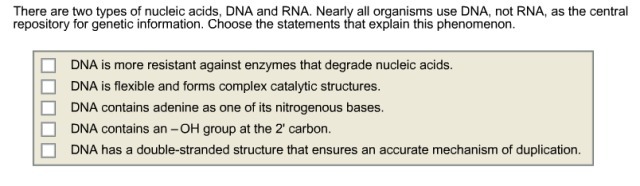
There are two types of nucleic acids, dna and rna. nearly all organisms use dna, not rna, as the central repository for genetic
Leya [2.2K]
Found the choices. Pls see attachment. 

The statements that explains this phenomenon are:
1) DNA contains adenine as one of its nitrogenous bases.
2) DNA has a double-stranded structure that ensures an accurate mechanism of duplication.

6 0
2 years ago
During a titration the following data were collected. A 10. mL portion of an unknown monoprotic acid solution was titrated with
Liula [17]

Answer:

8.0 moles

Explanation:

Since the acid is monoprotic, 1 mole of the acid will be required to stochiometrically react with 1 mole of NaOH.

Using the formula: \frac{concentration of acid X volume of acid}{concentration of base X volume of base} = \frac{mole of acid}{mole of base}

Concentration of acid = ?

Volume of acid = 10 mL

Concentration of base = 1.0 M

Volume of base = 40 mL

mole of acid = 1

mole of base = 1

Substitute into the equation:

\frac{concentration of acid X 10}{1.0 X 40} = \frac{1}{1}

Concentration of acid = 40/10 = 4.0 M

To determine the number of moles of acid present in 2.0 liters of the unknown solution:

Number of moles = Molarity x volume

molarity = 4.0 M

Volume = 2.0 Liters

Hence,

Number of moles = 4.0 x 2.0 = 8 moles

8 0
2 years ago
Website
vredina [299]

Answer:

volume in L = 0.25 L

Explanation:

Given data:

Mass of Cu(NO₃)₂ = 2.43 g

Volume of KI = ?

Solution:

Balanced chemical equation:

2Cu(NO₃)₂  + 4KI    →    2CuI + I₂ + 4KNO₃

Moles of Cu(NO₃)₂:

Number of moles = mass/ molar mass

Number of moles = 2.43 g/ 187.56 g/mol

Number of moles = 0.013 mol

Now we will compare the moles of Cu(NO₃)₂ with KI.

                        Cu(NO₃)₂       :              KI    

                              2              :               4

                            0.013          :            4 × 0.013=0.052 mol

Volume of KI:

<em>Molarity = moles of solute / volume in L</em>

volume in L = moles of solute /Molarity

volume in L =  0.052 mol / 0.209 mol/L

volume in L = 0.25 L

6 0
2 years ago
A student measures a volume as 25 mL, whereas the correct volume is 23 mL. What is the percent error? * O 8.7% O 0.92% O 0.087%
quester [9]

Answer:

no u

Explanation:

5 0
2 years ago
Read 2 more answers
The decomposition of AB given here in this balanced equation 2AB (g)⟶ A2 (g) + B2 (g), has rate constants of 8.58 x 10⁻⁹ L/mol s
denis-greek [22]

Answer:

3.24 × 10^5 J/mol

Explanation:

The activation energy of this reaction can be calculated using the equation:

ln(k2/k1) = Ea/R x (1/T1 - 1/T2)

Where; Ea = the activation energy (J/mol)

R = the ideal gas constant = 8.3145 J/Kmol

T1 and T2 = absolute temperatures (K)

k1 and k2 = the reaction rate constants at respective temperature

First, we need to convert the temperatures in °C to K

T(K) = T(°C) + 273.15

T1 = 325°C + 273.15

T1 = 598.15K

T2 = 407°C + 273.15

T2 = 680.15K

Since, k1= 8.58 x 10⁻⁹ L/mol, k2= 2.16 x 10⁻⁵ L/mol, R= 8.3145 J/Kmol, we can now find Ea

ln(k2/k1) = Ea/R x (1/T1 - 1/T2)

ln(2.16 x 10⁻⁵/8.58 x 10-9) = Ea/8.3145 × (1/598.15 - 1/680.15)

ln(2517.4) = Ea/8.3145 × 2.01 × 10^-4

7.831 = Ea(2.417 × 10^-5)

Ea = 3.24 × 10^5 J/mol

8 0
2 years ago
Other questions:
  • One mole of h2s gas escapes from a container by effusion in 77 seconds how long would it take one mole of nh3 gas to escape from
    10·2 answers
  • Using the following data table and graph, calculate the average k from the data. Amount CO2 (mL) Amount of White Solid (g) y x 1
    5·2 answers
  • If you pump air into cycle tyre a slight warming effect is noticed at valve stem why
    8·1 answer
  • The oxidation numbers of nitrogen in NH3, HNO3, and NO2 are, respectively: -3, -5, +4 +3, +5, +4 -3, +5, -4 -3, +5, +4
    9·1 answer
  • Contractile proteins are found in _____.
    9·2 answers
  • Which one of the following is not a valid expression for the rate of the reaction below? 4NH3 + 7O2 → 4NO2 + 6H2O Which one of t
    12·1 answer
  • You are presented with a mystery as part of your practical experiment. You have a solution of Pb(NO3)2 that has a worn label mak
    14·1 answer
  • The enthalpy change for the explosion of ammonium nitrate with fuel oil is –7198 kJ for every 3 moles of NH4NO3. What is the ent
    13·1 answer
  • Is humidity a extensive or intensive property
    15·2 answers
  • The _________________ are either elements or compounds which are present prior to a chemical reaction.
    12·2 answers
Add answer
Login
Not registered? Fast signup
Signup
Login Signup
Ask question!