answer.
Ask question
Login Signup
Ask question
All categories
  • English
  • Mathematics
  • Social Studies
  • Business
  • History
  • Health
  • Geography
  • Biology
  • Physics
  • Chemistry
  • Computers and Technology
  • Arts
  • World Languages
  • Spanish
  • French
  • German
  • Advanced Placement (AP)
  • SAT
  • Medicine
  • Law
  • Engineering
Alborosie
2 years ago
4

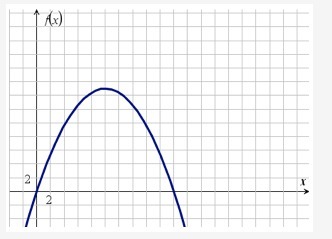
The graph below shows the height of a kicked soccer ball f(x), in feet, depending on the distance from the kicker x, in feet:

Mathematics
2 answers:
Lerok [7]2 years ago
6 0
Because the vertex of the parabola is at (10,15), its equation is of the form
y = a(x-10)² + 15

The graph goes through (0,0), therefore
a(0 - 10)² + 15 = 0
100a = -15
a = -0.15

The equation is 
y = f(x) = -0.15(x - 10)² + 15

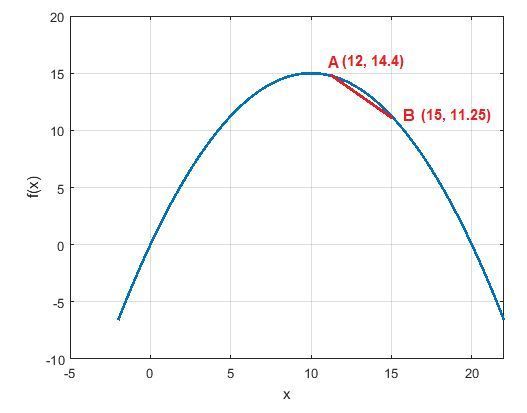
The graph is shown below.

Part A
Note that y = f(x).

The x-intercepts identify values where the function or  y=0. The x-intercepts occur at x=0 and x=20, or at (0,0) and (20,0).

The maximum value of y occurs at the vertex (10, 15) because the curve is down due to the negative leading coefficient of -0.15.

The curve increases in the interval x = (-∞, 10) and it decreases in the interval x = (10, ∞).

Part B
When x=12, y = -0.15(12 - 10)² + 15 = 14.4
When x=15, y = -0.15(15 - 10)² + 15 = 11.25

The average rate of change between x =12 to x = 15 is
(11.25 - 14.4)/(15 - 12) = -1.05

This rate of change represents the slope of the secant line from A to B. It approximates the rate at which f(x) decreases in the interval x =[12, 15].

svlad2 [7]2 years ago
6 0

The x-intercepts are clearly (0, 0) and (20, 0), not (0, 0), (0, 20). Because if we have (0, 0) and (0, 20) then this is no longer a function since we have two similar values of x for different y’s. It should be similar y for different x’s.

Moreover, we can also determine the quadratic function as follows.
The quadratic function with roots a and b, is given by the equation:
f(x) = c (x-a) (x-b).

Since f(a)=0, f(b)=0, f(x) must have one factor (x-a) and one (x-b)

The x coordinates of the x intercepts are the roots of the function so with the roots given:
f(x)=c(x-0)(x-20)=cx(x-20), the vertex is at (10, 15) so

15=f(10)=c*10*(10-20)=c*10*(-10)=-100c
c=-15/100=-3/20


The quadratic function (expressed in factorized form) is
f(x)=(-3/20) x (x-20)

Part A. the x intercept = 0 tells us the point wherein the ball was hit, while the x intercept = 20 tells us the point wherein the ball fell back to the ground, that is 20 feet away from the kicker

The function is increasing in the interval x∈(0, 10) and decreasing in x∈(10, 20) . This only tells us that the height <span> increases</span> in the interval from  (0, 10) and then decreases as x goes through the interval (10,20). While the distance from the kicker is constantly increasing during the whole interval (0, 20)

Part B:

at x1=15,

f(x)=f(15) = y1=(-3/20)*15(15-20)= 45/4


at x2=12

f(x)=f(12)= y2=-3/20*12(12-20)= 72/5

The average rate of change is then calculated as:

average rate of change = (y2-y1)/(x2 –x1) = (72/5 – 45/4) / (12-15) = -1.05


Therefore this means that the height is decreasing at 1.05 ft per feet in horizontal distance from x=12 to x=15.

You might be interested in
Erika is writing a coordinate proof to show that the diagonals of a rectangle are congruent. She begins by assigning coordinates
klemol [59]

Answer:

Option C is the correct choice.

Step-by-step explanation:

We are given the coordinates of rectangle and we are asked to find the correct option that describes that diagonals JL and KM are congruent.

Since we that a rectangle have four right angles.

We will use Pythagorean theorem to prove that diagonals JL and KM are congruent.

In triangle KLM we can see that KL is b units long and LM is a units long. By Pythagorean theorem \sqrt(a^{2}+b^{2})=KM

In triangle JML we can see that JM is b units long and LM is a units long. By Pythagorean theorem \sqrt(a^{2}+b^{2})=JL

Therefore, we can see that \sqrt(a^{2}+b^{2})=KM=LM and option C is the correct choice.  

7 0
2 years ago
Read 2 more answers
A local company makes snack-size bags of potato chips. Each day, the company produces batches of 400 snack-size bags using a pro
ioda

Answer:

Probability that a sample of 40 bags has an average weight of at least 2.02 ounces is 0.103.

Step-by-step explanation:

We are given that the company produces batches of 400 snack-size bags using a process designed to fill each bag with an average of 2 ounces of potato chips. Assume the amount placed in each of the 400 bags is normally distributed and has a standard deviation of 0.1 ounce.

Also, sample of 40 bags are selected.

<em>Let </em>\bar X<em> = sample average weight</em>

The z-score probability distribution for sample mean is given by ;

                Z = \frac{\bar X-\mu}{\frac{\sigma}{\sqrt{n} } } ~ N(0,1)

where, \mu = population mean weight of potato chips = 2 ounces

            \sigma = standard deviation = 0.1 ounces

            n = sample of bags = 40

The Z-score measures how many standard deviations the measure is away from the mean. After finding the Z-score, we look at the z-score table and find the p-value (area) associated with this z-score. This p-value is the probability that the value of the measure is smaller than X, that is, the percentile of X.

Now, the probability that a sample of 40 bags has an average weight of at least 2.02 ounces is given by = P(\bar X \geq 2.02 ounces)

   P(\bar X \geq 2.02) = P( \frac{\bar X-\mu}{\frac{\sigma}{\sqrt{n} } } \geq \frac{2.02-2}{\frac{0.1}{\sqrt{40} } } ) = P(Z \geq 1.265) = 1 - P(Z < 1.265)

                                                      = 1 - 0.89707 = 0.103

<em>The above probability is calculated using z table by looking at value of x = 1.265 which will lie between x = 1.26 and x = 1.27 in the z table which have an area of 0.89707.</em>

<em />

Therefore, probability that a sample of 40 bags has an average weight of at least 2.02 ounces is 0.103.
3 0
2 years ago
Decide, without calculation, if each of the integrals below are positive, negative, or zero. Let D be the region inside the unit
Schach [20]

The integrals over B and T will be positive. Keeping y fixed, xe^x is strictly increasing over D as x increases, so the integrals over x (i.e. the bottom/top left quadrants of D) is negative but the integrals over x>0 are *more* positive.

The integrals over R and L are zero. If we take f(x,y)=xe^x, then f(x,-y)=f(x,y), which is to say f is symmetric across the x-axis. For the same reason, the integral over all of D is also zero.

4 0
2 years ago
Ming used the calculations shown to find out how much he would spend on 6 pounds of ground beef if 10 pounds of ground beef cost
Angelina_Jolie [31]

Answer:

He determined pounds per dollar by dividing 10 by 25 but wrote the unit rate as a dollar value.

Step-by-step explanation:

Given

\frac{10\ pounds}{\$25} = \frac{10\ pounds}{25} / \frac{\$25}{25} = \frac{0.4}{1}

Unit\ Price = 40\ cents

40\ cents * 6 = \$2.40

Required

Determine Ming's error

Ming's error is from here

\frac{10\ pounds}{\$25} = \frac{10\ pounds}{25} / \frac{\$25}{25} = \frac{0.4}{1}

He calculated the unit rate as pound per dollar.

So, after calculating the unit rate, the unit should be:

Unit\ Rate = 0.4\ pound/\$

But instead, he solved as:

Unit\ Rate = \$0.4/ pound

<em>Hence, (a) is correct</em>

5 0
2 years ago
Read 2 more answers
Point C(3.6, -0.4) divides AB in the ratio 3:2. If the coordinates of A are (-6, 5), the coordinates of point B are ___. If poin
kari74 [83]
When a point divides a line segment into ratios of k1:k2, the formula to find the coordiates of the point is:
x=(k2*x1+k1*x2)/(k1+k2), y=(k2*y1+k1*y2)/(k1+k2), 
(x1,y1) being the coordinates of the starting point, and (x2,y2) coordinates of the end point. 
in this case, 3.6=[2*(-6)+3x2]/5
-12+3x2=18
3x2=30
x2=10

use the same method to find y2: -0.4=(2*5+3y2)/5
3y2=-12
y2=-4
so the the coordinates of B is (10,-4)

use the same method to find the coordinates of D.

the answer I've got for D is (58/9, -2) please double check my calculation.
4 0
2 years ago
Read 2 more answers
Other questions:
  • starting on the positive x axis and moving 1/3 of the way around the circle in 3 m radius, ow far will it go?
    11·1 answer
  • Which applies the power of a power rule properly to simplify the expression (710)5? (710)5= 710 ÷ 5 = 72 (710)5= 710 - 5 = 75 (7
    13·1 answer
  • Chuck has a gross pay of $815.70. By how much will Chuck’s gross pay be reduced if he has the following items withheld?
    6·2 answers
  • A quilt is designed using a square pattern. Each square contains two rectangles. Each rectangle contains a shaded rhombus.
    9·2 answers
  • Kx = wv, solve for x? <br> algebra 1 honors^
    5·1 answer
  • Drag each equation show if it could be a correct first step to solving the equation. 4(3+x)=36.
    12·2 answers
  • Carbon-141414 is an element which loses exactly half of its mass every 573057305730 years. The mass of a sample of carbon-141414
    14·1 answer
  • Solve x − 5y = 6 for x.
    13·1 answer
  • A study conducted by Harvard Business School recorded the amount of time CEOs devoted to various activities during the workweek.
    11·1 answer
  • How do I write parametric equations of the line 2x+3y=11​
    7·1 answer
Add answer
Login
Not registered? Fast signup
Signup
Login Signup
Ask question!
