answer.
Ask question
Login Signup
Ask question
All categories
  • English
  • Mathematics
  • Social Studies
  • Business
  • History
  • Health
  • Geography
  • Biology
  • Physics
  • Chemistry
  • Computers and Technology
  • Arts
  • World Languages
  • Spanish
  • French
  • German
  • Advanced Placement (AP)
  • SAT
  • Medicine
  • Law
  • Engineering
grigory [225]
2 years ago
11

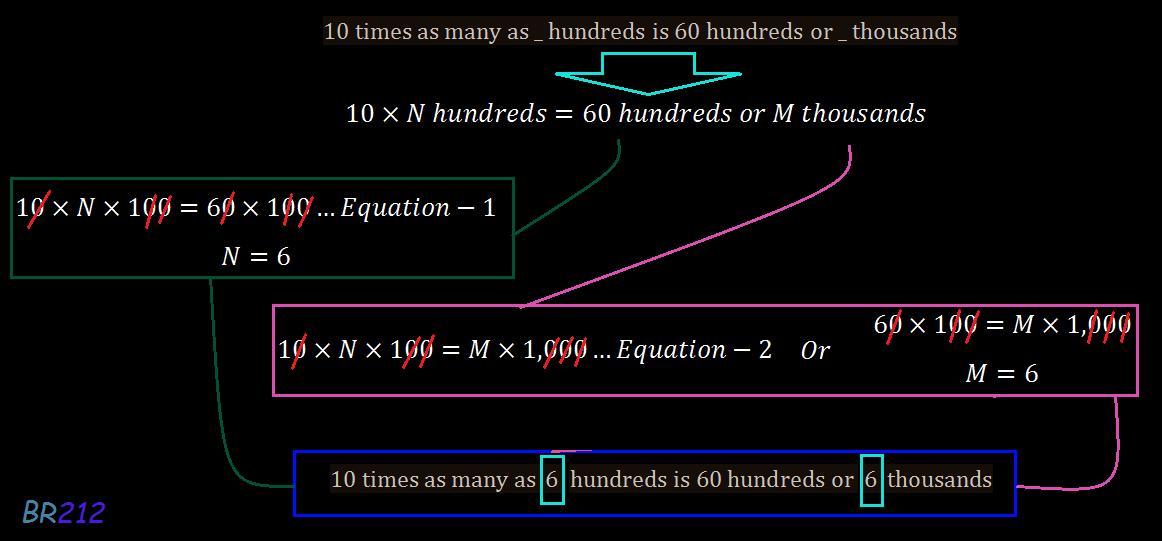
10 times as many as blank hundreds or 60 hundreds is blank thousands

Mathematics
2 answers:
Anettt [7]2 years ago
4 0

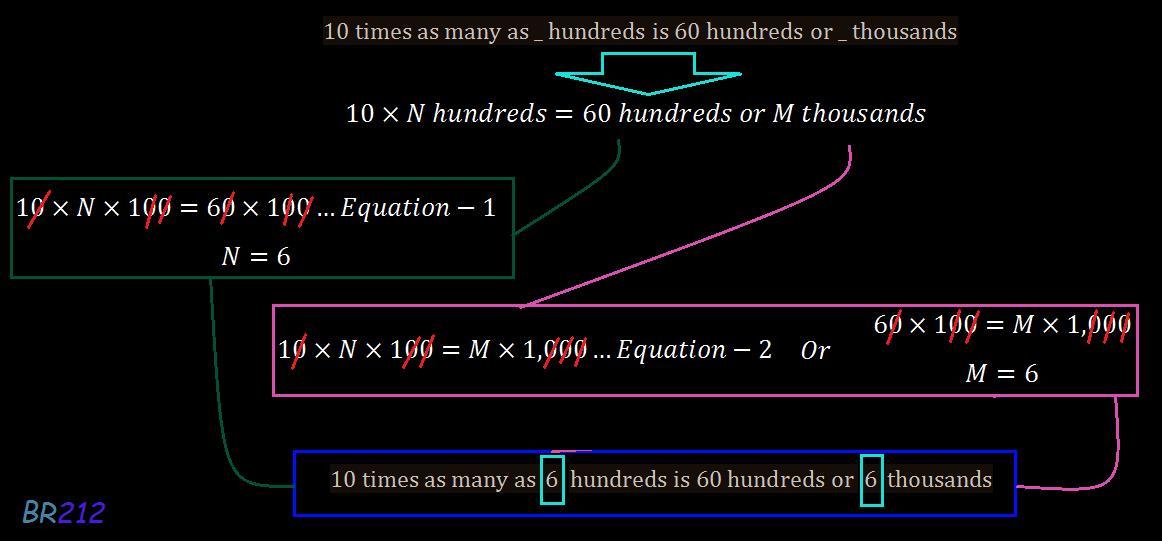
10 times as many as 6 hundreds is 60 hundreds or 6 thousands.

<h3>Further explanation   </h3>

We can simplify the questions as follows:

  • 10 times as many as _____ hundreds is 60 hundreds
  • 60 hundreds is _____ thousands

Let's arrange the above equation into two parts, i.e.,

\boxed{ \ 10 \times (N \times 100) = 60 \times 100 \ }  ... Equation-1

\boxed{ \ 60 \times 100) = M \times 1,000 \ }   ... Equation-2

This question about simple multiplication is related to place value.  We have to solve this calculation to obtain the value of N and M.

The first step, we need to complete Equation-1.

Let's isolate the variable M alone at the end of the process on one side of the equation until the variable will be equal to the value on the opposite side.

\boxed{ \ 10 \times (N \times 100) = 60 \times 100 \ }

\boxed{ \ 1,000 \times N = 6,000 \ }

Both sides are divided by 1,000, in other words, multiplied by \frac{1}{1,000}.

\boxed{ \ \frac{1}{1,000} \times 1,000 \times N = \frac{1}{1,000} \times 6,000 \ }  

We get, \boxed{\boxed{ \ N = 6 \ }}

The second step, we complete Equation-2 to get the value of M.

\boxed{ \ 60 \times 100) = M \times 1,000 \ }

\boxed{ \ 6,000 = M \times 1,000 \ }

Turn this equation over so that the position of variable M is on the left side.  

\boxed{ \ M \times 1,000 = 6,000 \ }

Both sides are divided by 1,000, in other words, multiplied by \frac{1}{1,000}.

\boxed{ \ \frac{1}{1,000} \times M \times 1,000 = \frac{1}{1,000} \times 6,000 \ }

We get, \boxed{\boxed{ \ M = 6 \ }}

- - - - - - -

Alternative to the second step:

60 hundreds = __ thousands

\boxed{ \ 6 \times 10 \ hundreds = \ M \ thousands} \ }

\boxed{ \ 6 \times thousands = \ M \ thousands} \ }

\boxed{\boxed{ \ M = 6 \ }}

<h3>Learn more   </h3>
  1. A rather long version of this discussion  brainly.com/question/4770453
  2. 2 thousands 7 tens divided by 10 equal? brainly.com/question/1648434
  3. 100 is 1/10 of what? brainly.com/question/96535

Keywords:  10 times as many as, blank, hundreds, 60 hundreds, or, thousands, isolate, operations, multiply, divide, fraction, both sides, equal, the opposite, both sides are multiplied by, divided by, turn
tiny-mole [99]2 years ago
3 0

<span>The answer in the question about 10 times as many as blank hundreds or 60 hundreds is blank thousands is that 10 times as many as 6 hundreds or 60 hundreds is 6 thousands therefore its 6 hundreds and 6 thousands.</span>

You might be interested in
The 11th grade class at Red Hook high school was surveyed about the types of music they liked. Of those surveyed, 64% said they
Zarrin [17]

22% liked neither.

Step-by-step explanation:

Given,

64% liked pop music.

52% liked rap music.

38% liked both type of music.

To find out the percentage of those liked neither.

Now,

Let, total number of student = 100

Number of students liked pop = 64

Number of students liked rap = 52

Number of students liked both = 38

So,

Number of students who liked only pop = 64-38 = 26

Number of students who liked only rap = 52-38 = 14

Hence,

Number of students who liked neither = 100 - (26+14+38) = 22

22% liked neither.

6 0
2 years ago
Explain why f(x)= 1/(x-x3)^3 is not continuous at x = 3.
Sloan [31]

Answer: Option b.

Step-by-step explanation:

 1. You have the function f(x)=\frac{1}{(x-3)^{3}} given in the problem above.

2. You must keep on mind that. by definition, the division by zero does not exist.

3. The value x=3 makes the denominator of the function f(x) equal to zero. Therefore you can conclude that the function shown in the problem is not defined at x=3.

The answer is the option b.

5 0
2 years ago
Read 2 more answers
Gus has a fish tank that holds 471047104710 inches^3 3 cubed of water. He is using a cylinder shaped bucket with a radius of 555
ozzi

Answer:

Gus will need to fill up the cylindrical bucket three times to be able to use it to fill up the tank

Step-by-step explanation:

Extracting the key information from the question:-

*** A fish tank has a capacity or volume of 4710 inches^3

*** The owner of the tank uses a cylindrical shaped bucket to fill the tank

*** The radius of the bucket being used to fill the tank is 5 inches and its height is 20 inches

*** We are only required to calculate how many times Gus will need to fill the bucket in order to completely fill the fish tank.

Since the container that the owner of the fish tank is using to fill the fish tank is cylindrical, we will need the formula for calculating the volume of a cylinder in order to determine the volume of this bucket that is being used to fill the fish tank.

Volume of a cylinder = π × r^2 × h. From the question, we were informed that the radius of the cylindrical bucket is 5 inches and the height of this bucket is 20 inches.

The volume of the bucket is = 3.14 × 5^2 × 20 = 1570 inches^3

Again, we were told that the fish tank that Gus was using cylindrical bucket to fill up has a volume of 4710 inches^3. In order to determine the number of filled buckets that will be able to fill the fish tank, we will then divide the volume of the tank by the volume of the cylindrical bucket:

4710/1570 = 3 full buckets.

Therefore, Gus will need to fill the bucket three times in order to be able to fill up the fish tank.

7 0
2 years ago
Area of parallelogram
Aliun [14]
The formula for the area of a parallelogram is base times height or bh.

There's a formula sheet on Khan Academy:
https://www.khanacademy.org/math/basic-geo/basic-geo-area-and-perimeter/parallelogram-area/a/area-of...
5 0
2 years ago
Read 2 more answers
Let d(t) be the total number of miles Joanna has cycled, and let t represent the number of hours after stopping for a break duri
Naddik [55]

Answer:

d(4)=?

where

d= distance

t= hours

In this Linear function given by the law d(t) = 12t +20 and the graph below. To find the d(4), means to find out how many miles she cycled in the instant 4 hours.

By this function, after a break , the instant t=0, she had already cycled 20 miles.

Let's calculate

d(4) = 12(4) +20

d(4) =48+20

d(4)= 68 miles

Step-by-step explanation:

5 0
2 years ago
Read 2 more answers
Other questions:
  • Which equation is y = –6x2 + 3x + 2 rewritten in vertex form?
    7·2 answers
  • In the figure CD is the perpendicular bisector of AB . If the length of AC is 2x and the length of BC is 3x - 5 . The value of x
    15·2 answers
  • Next you need to find the critical points. What are the critical points, and how are they found?
    13·2 answers
  • Which step shows the result of applying the subtraction property of equality?
    13·2 answers
  • three positive numbers are in Arithmetic Progression (A.P). the sum of the squares of the three numbers is 155. while the sum of
    9·1 answer
  • Which measure is the largest? 1.2 km, 120,600 cm, 1,220,000 mm, 120 meters
    12·1 answer
  • ΔABC is a right triangle. Prove: a2 + b2 = c2 Right triangle BCA with sides of length a, b, and c. Perpendicular CD forms right
    13·2 answers
  • at an amusement park, Robin bought a t-shirt for $8 and 5 ticket for ride. she spent a total of $23. How much did each ticket co
    5·2 answers
  • In triangle DEF, FE= 12 and angle D =62. find DE to the nearest tenth
    12·1 answer
  • In the month of June, the temperature in Johannesburg, South Africa, varies over the day in a periodic way that can be modeled a
    14·1 answer
Add answer
Login
Not registered? Fast signup
Signup
Login Signup
Ask question!
