answer.
Ask question
Login Signup
Ask question
All categories
  • English
  • Mathematics
  • Social Studies
  • Business
  • History
  • Health
  • Geography
  • Biology
  • Physics
  • Chemistry
  • Computers and Technology
  • Arts
  • World Languages
  • Spanish
  • French
  • German
  • Advanced Placement (AP)
  • SAT
  • Medicine
  • Law
  • Engineering
julia-pushkina [17]
2 years ago
3

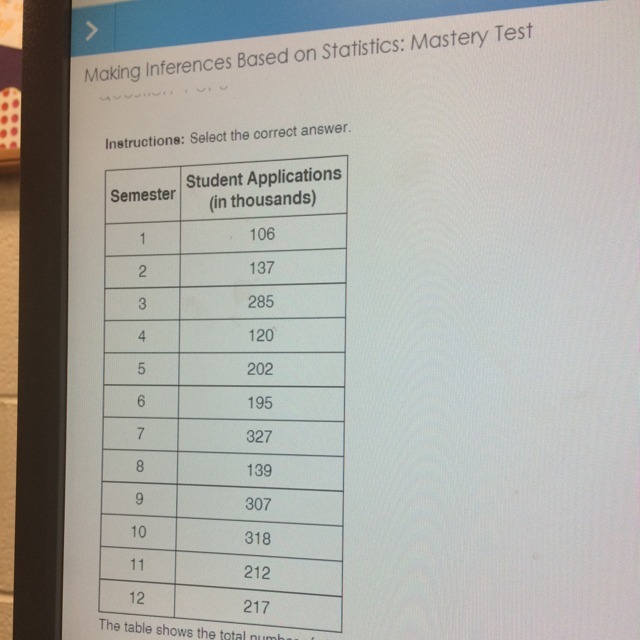
The table shows the total number of student applications to universities in a particular state over a period of 12 semesters. St

ates base their decisions on data like this. Suppose the decide that if fewer than 200,000 students apply during 6 or more semesters, the state will make a special effort to promote university education. Using this data, what is the population proportion of semesters for which the number of student applications is less than 200,000?

Mathematics
1 answer:
Alla [95]2 years ago
5 0
There are 12 semesters. Since it's in thousands, 106 becomes 106,000, 137 is 137,000, etc., making everything over 200 in the data table over 200,000. Therefore, 7 out of the 12 are over 200,000, making the population proportion 7/12 for over 200,000. Since there are none exactly at 200,000, everything else is under 200,000. To get the population proportion for that, we do 1-7/12=12/12-7/12=5/12
You might be interested in
If a boy and a half can eat a hot dog and a half, in a minute and a half, how many hot dogs can six boys eat in six minutes?
Yanka [14]
SIx boys can eat seven (7) hotdogs in six (6) minutes.
3 0
2 years ago
Aubree went shopping at her favorite store, Target. She bought 3 shirts and a pair of jeans that cost $28. She spent a total of
serg [7]

Answer:

88.00 and subtract 28 and the 3 shirts were

Step-by-step explanation:

answer 60

5 0
2 years ago
Read 2 more answers
An anthropologist finds that a prehistoric bone contains less than 8.1% of the amount of Carbon-14 the bones would have containe
stealth61 [152]

Answer:

20,944 years

Step-by-step explanation:

The formula you use for this type of decay problem is the one that uses the decay constant as opposed to the half life in years.  We are given the k value of .00012.  If we don't know how much carbon was in the bones when the person was alive, it would be safer to say that when he was alive he had 100% of his carbon.  What's left then is 8.1%.  Because the 8.1% is left over from 100% after t years, we don't need to worry about converting that percent into a decimal.  We can use the 8.1.  Here's the formula:

N(t)=N_{0} e^{-kt}

where N(t) is the amount left over after the decay occurs, N_{0} is the initial amount, -k is the constant of decay (it's negative cuz decay is a taking away from as opposed to a giving to) and t is the time in years.  Filling in accordingly,

8.1=100e^{-.00012t}

Begin by dividing the 100 on both sides to get

.081=e^{-.00012t}

Now take the natural log of both sides.  Since the base of a natual log is e, natural logs and e "undo" each other, much like taking the square root of a squared number.

ln(.081)= -.00012t

Take the natual log of .081 on your calculator to get

-2.513306124 = -.00012t

Now divide both sides by -.00012 to get t = 20,944 years

4 0
2 years ago
The amount of rhubarb in the original recipe is 3 1/2 cups. Using what you know of whole numbers and what you know of fractions,
Alexxx [7]
The easiest way, I think, is to convert the mixed number into an improper fraction, then multiply by 3.
3 1/2 = 7/2
7/2 · 3 = 21/2
now just change the improper fraction back to a mixed number by dividing and putting the remainder into fraction form
21/2 = 10 1/2

You could also multiply the whole number by 3 and the fraction by 3, ending up with 9 3/2, but then have to convert the improper fraction into a mixed number
3/2 = 1 1/2
then add the numbers together
9 + 1 1/2 = 10 1/2
either way works, whatever is easiest for you.  
8 0
2 years ago
Andre ran 2 kilometers in 15 minutes, and Jada ran 3 kilometers in 20 minutes. Both ran at a constant speed. Did they run at the
Goshia [24]

Answer:

speed of Jada = 6km per hour which is not equal to

speed of Andre = 8km per hour

They did not run at same speed

Step-by-step explanation:

formula of speed = distance covered/ time taken

For Andre

Distance = 2 KM

time = 15 mins

60 mins = 1 hour

15 mins = 1/60 * 15 hour = 0.25 hours

thus,

speed = 2km/0.25 hour = 8 km per hour

Similarly for Jada

Distance = 3 KM

time = 20 mins

60 mins = 1 hour

20 mins = 1/60 * 20 hour = 1/3 hours

thus,

speed = 2km/(1/3)hour = 6  km per hour

Now we have

speed of Jada = 6km per hour which is not equal to

speed of Andre = 8km per hour
6 0
2 years ago
Other questions:
  • Describe a situation that could be modeled with the ratio 4:1
    6·2 answers
  • If Bianca is trying to find the area of this rectangle. She already measured one side 10cm. Witch other length(s) could she meas
    8·1 answer
  • Triangle KLM represents a section of a park set aside for picnic tables. The picnic area will take up approximately 400 square y
    13·2 answers
  • The rule T1, -4 RO, 180°(x, y) is applied to rectangle KLMN. Which rectangle shows the final image??
    14·2 answers
  • What is the value of the digit 6 in 968,743,220
    9·1 answer
  • Use the drop-down menus to complete the paragraph proof. we are given that xy is parallel to zw. if xz is a transversal that int
    7·2 answers
  • A lamp shade has a radius of 9 inches. What is the circumference of the top of the shade? Use 3.14 to approximate pi. Round your
    11·1 answer
  • A silicon chip is 14 nanometers thick. A nanometer is equal to 0.000000001 meter. Express the thickness of the chip using scient
    12·2 answers
  • Use the De Morgan law that states: ~(p ∧ q) is equivalent to ~ p ∨ ~ q to write an equivalent English statement for the statemen
    14·1 answer
  • Last week, Thomas jogged a total of 35.209 miles on his treadmill. Two weeks ago, he jogged 38.074 miles.
    15·1 answer
Add answer
Login
Not registered? Fast signup
Signup
Login Signup
Ask question!
