answer.
Ask question
Login Signup
Ask question
All categories
  • English
  • Mathematics
  • Social Studies
  • Business
  • History
  • Health
  • Geography
  • Biology
  • Physics
  • Chemistry
  • Computers and Technology
  • Arts
  • World Languages
  • Spanish
  • French
  • German
  • Advanced Placement (AP)
  • SAT
  • Medicine
  • Law
  • Engineering
Svetlanka [38]
2 years ago
10

Consider the chemical reaction: 2 cu(no3)2→ 2 cuo (s) + 4 no2 (g) + o2 (g)when 9.378 g of cu(no3)2 completely decomposed, how

many liters of gas will be produced at 273 k and 1 atm? the molar mass of cu(no3)2 is 187.56 g/mol.a) 0.56
b.1.12c) 2.24
d.2.80e) 3.92
Chemistry
1 answer:
Allushta [10]2 years ago
6 0

2Cu(NO3)2 ---------->    2CuO (s) +4NO2 (g) + O2(g)

9.378g=0.05moles   

no of moles = weight / MW = 9.378/187.56 = 0.05moles

as per the above reaaction 2moles of Cu(NO3)2 can produce 4moles of N2

                                                    0.05moles Cu(NO3)2 can produce (0.05*4)/2 = 0.1moles of N2

and 2moles of Cu(NO3)2 can produce 1moles of O2

       0.05moles Cu(NO3)2 can produce (0.05*1)/2 = 0.025moles of O2

Total moles of gas i.e., N2 and O2 =0.1+0.025 = 0.125moles

From PV = nRT

       V = nRT/ P = 0.125*0.0821*273 = 2.80166Lit option is correct

You might be interested in
If a 0.4856 gram sample of khp is dissolved in sufficient water to prepare 250 ml of solution, and 25 ml of the solution require
dangina [55]

Mass of potassium hydrogen pthalate KHP is 0.4856 g, its molar mass is 204.22 g/mol, number of moles of KHP can be calculated as follows:

n=\frac{m}{M}

Here, m is mass and M is molar mass, putting the values,

n=\frac{0.4856 g}{204.22 g/mol}=0.00237 mol

This will be number of moles of NaOH at equivalent point.

Detailed calculations:

Molarity is defined as number of moles in 1 L of solution, for 250 mL of solution, molarity will be:

M=\frac{0.00237 mol}{250 \times 10^{-3}L}=0.009511 M

For 25 mL, apply dilution law as follows:

M_{1}V_{1}=M_{2}V_{2}

Putting the values,

0.009511\times 250=M_{2}\times 25 mL

On rearranging,

M_{2}=\frac{0.009511\times 250}{25}=0.09511 M

Convert molarity into number of moles,

n=M\times V=0.09511 mol/L\times 25\times 10^{-3}L=0.00237 mol

At equivalent point, number of moles of KHP will be equal to NaOH, thus, number of moles of NaOH will be 0.00237 mol.

Calculation for molarity:

Volume of NaOH is 18.75 mL, thus, molarity can be calculated as follows:

M=\frac{n}{V}

Putting the values,

M=\frac{0.00237 mol}{18.75\times 10^{-3}L}=0.1264 M

Therefore, molarity of NaOH is 0.1264 M

7 0
2 years ago
Calculate the percent activity of the radioactive isotope strontium-89 remaining after 5 half-lives.
maria [59]
The answer to this question would be: 3.125%

Half-life is the time needed for a radioactive molecule to decay half of its mass. In this case, the strontium-89 is already gone past 5 half lives. Then, the percentage of the mass left after 5 half-lives should be:
100%*(1/2^5)= 100%/32=3..125%
5 0
2 years ago
If the symbol X represents a central atom, Y represents outer atoms, and Z represents lone pairs on the central atom, the struct
MA_775_DIABLO [31]

Answer:

1. sp  = XY₂

2. sp²  = XY₂Z, XY₃

3. sp3³ = XY₄, XY₂Z₂, XY₃Z

4. sp³d  = XY₅, XY₂Z₃, XY₃Z₂, XY₄Z

5. sp³d² = XY₆, XY₄Z₂, XY₅Z

Explanation:

this is quite dicey, so it should be looked into carefully.

we would classify each of the abbreviation according to their  hybridization and it electron domain.

⇒ sp hybridization = XY₂

in this, we can see that the central atom X is bonded to two outer atoms Y.

this makes the no of hybrid orbitals and the no of sigma bonds both 2.

electron domain = 2.

⇒ sp² hybridization = XY₂Z, XY₃

Here we can see the central atom X bonded with three outer atoms Y in XY₂Z and in XY₃. For XY₂Z molecule, the no of sigma bonds is 2 and the no of hybrid orbitals is 3. While for XY₃ molecule, the no of sigma bonds is 3 while the no of hybrid orbital is 3.

electron domain = 3.

⇒ sp³ hybridization = XY₄, XY₂Z₂, XY₃Z

for XY₄ molecule, the central atom X is bonded with four outer atoms Y. It has 4 numbers of both the sigma and orbital atoms.

In XY₂Z₂, the central atom X is bonded to 2 outer atoms Y, and has 2 lone pairs Z. From this, the no of hybrid orbitals is 4 and the no of sigma bonds is 2, with 2 lone pairs causing the sp³ hybridization.

⇒ sp³d hybridization = XY₅, XY₂Z₃, XY₃Z₂, XY₄Z

for all the molecules listed above, the sum of both the lone pairs and the outer atoms both give a total of 5, hence have the sp³d structure, viz;

XY₂Z₃:

total electron domain = 2+3 = 5  

XY₃Z₂:

total electron domain = 2+3 = 5

XY₄Z:

total electron domain = 1+4 = 5

⇒ sp³d² hybridization = XY₆, XY₄Z₂, XY₅Z

Same thing goes for the above molecule, where the sum of both the outer atoms and the lone pairs gives a total of 6 as can be seen in the example below.

XY4Z2:

total electron domain = 2+4 = 6

cheers, i hope this helps.

5 0
2 years ago
An important reaction sequence in the industrial production of nitric acid is the following: N2(g) + 3H2(g) → 2NH3(g) 4NH3(g) +
frutty [35]

Answer:

The answer to your question is 50 moles of O₂

Explanation:

Balanced Chemical reactions

1.-                 N₂(g)  +  3H₂ (g)   ⇒   2NH₃ (g)

2.-                4NH₃ (g) + 5O₂(g)  ⇒  4NO (g)  +  6H₂O (l)

moles of N₂(g) = 20 moles

moles of O₂(g) = ?

Process

1.- Calculate the moles of NH₃

                     1 mol of N₂ ------------- 2 moles of NH₃

                   20 moles of N₂ ---------  x

                     x = (20 x 2) / 1

                     x = 40 moles of NH₃

2.- Calculate the moles of O₂

                4 moles of NH₃ -------------- 5 O₂

               40 moles of NH₃ ------------  x

                    x = (40 x 5) / 4

                    x = 200 / 4

                    x = 50 moles of O₂

3 0
2 years ago
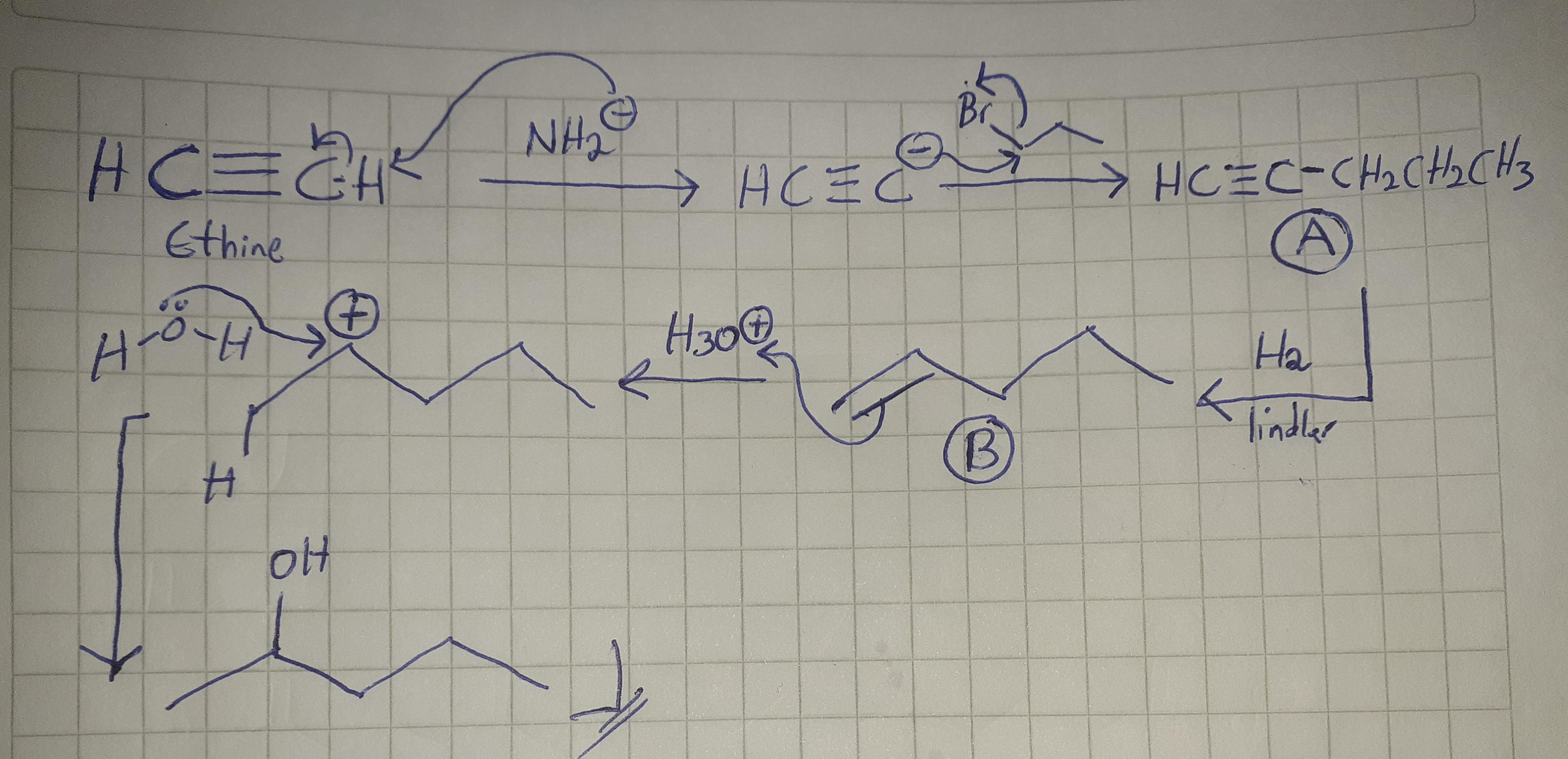
Draw the structures of organic compounds A and B. Indicate stereochemistry where applicable The starting material is ethyne, a c
k0ka [10]

Answer:

See explanation below

Explanation:

In this case we have the starting reactant which is the ethine, In the first step reacts with NaNH₂, a strong base. This base will substract the hydrogen from one of the carbon of the ethine, and form a carbanion. This will react with the propane bromide, displacing the bromine and forming a 5 carbon chain with the triple bond on the carbon 1 and 2.

In the second step, reacts with the lindlar catalyst to do a reduction, and form a double bond between carbon 1 and 2. In essence, compound A is similar to compound B.

Finally B reacts with water in acid and makes a addition reaction, and form an alcohol.

The whole process can be seen in the picture below.

Hope this helps

3 0
2 years ago
Other questions:
  • Under identical conditions of temperature and pressure, which of the following gasses is the densest: Ne, CO2, or Cl2?
    7·1 answer
  • Draw the electron dot structures for each molecule. Identify polar covalent bonds by assigning slightly positive and slightly ne
    13·1 answer
  • Draw the condensed structural formula in the equation for the saponification of trimyristin with koh
    13·2 answers
  • Calculate the freezing point of a 0.08500 m aqueous solution of nano3. the molal freezing-point-depression constant of water is
    11·2 answers
  • Silver (ag) has a molar mass of 107.8682 g, nitrogen has a molar mass of 14.0067 g, and oxygen has a molar mass of 15.9994 g. wh
    13·2 answers
  • The volume of a single strontium atom is 4.15×10⁻²³ cm3. What is the volume of a strontium atom in microliters
    15·1 answer
  • Washing soda is a hydrate of sodium carbonate. Elemental analysis of a sample of washing soda gave 4.20% C and 7.05% H. What is
    8·1 answer
  • A student had 1.00 L of a 1.00 M acid solution. Much to the surprise of the student, it took 2.00 L of 1.00 M NaOH solution to r
    10·1 answer
  • Fe3+(aq)+6H2O(l)⇌Fe(H2O)63+(aq) : F e 3 + ( a q ) + 6 H 2 O ( l ) ⇌ F e ( H 2 O ) 6 3 + ( a q ) : blank is the Lewis acid and bl
    15·1 answer
  • Is humidity a extensive or intensive property
    15·2 answers
Add answer
Login
Not registered? Fast signup
Signup
Login Signup
Ask question!