answer.
Ask question
Login Signup
Ask question
All categories
  • English
  • Mathematics
  • Social Studies
  • Business
  • History
  • Health
  • Geography
  • Biology
  • Physics
  • Chemistry
  • Computers and Technology
  • Arts
  • World Languages
  • Spanish
  • French
  • German
  • Advanced Placement (AP)
  • SAT
  • Medicine
  • Law
  • Engineering
sweet-ann [11.9K]
2 years ago
10

A student had 1.00 L of a 1.00 M acid solution. Much to the surprise of the student, it took 2.00 L of 1.00 M NaOH solution to r

eact completely with the acid. Explain why it took twice as much NaOH to react with all of the acid. In a different experiment, a student had 10.0 mL of 0.020 M HCl. Again, much to the surprise of the student, it took only 5.00 mL of 0.020 M strong base to react completely with the HCl. Explain why it took only half as much strong base to react with all of the HCl.
Chemistry
1 answer:
miss Akunina [59]2 years ago
7 0

Answer:

1. A diprotic acid was neutralized.

2. HCl has the ability to accept two protons.

Explanation:

Hello,

Neutralization chemical reactions are better quantified by using equivalent grams instead of moles since they define the mass of a given substance which will neutralize the other substance, thus, in the first, experiment, 1 mole of NaOH has 1 equivalent grams since there's just one hydroxile in its structure, on the other hand, as 2.00 L of a 1.00 M solution of NaOH were needed to neutralize 1.00 L of a 1.00 M solution of an acid, one concludes that the acid was diprotic, it means that it has two hydrogens in its structe.

In such a way, in the second experiment, it was the other way around but by using the hydrochloric acid as it has the ability to accept two protons, it means that the base had two hydroxile ions in its structure.

Best regards.

You might be interested in
A student assistant is cleaning up after a chemistry laboratory exercise and finds three one-liter bottles containing alcohol so
Svetllana [295]

The approximate alcohol content is 210 ml.

Explanation:

It can be deduced from the question that each bottle is of 1000ml or 1 litre.

The first bottle is one half full means it has 500 ml of solution and it has 20% alcohol in it. So volume of alcohol in the solution is

20/100*500

=100 ml

The first bottle is one fifth full, so the volume of mixture is 1/5th of 1000ml

so it is 200ml having 30% alcohol

30/100*200

= 60 ml

The third bottle is one tenth full so its volume is 1/10*1000

100 ml.  having 50% of alcohol

50/100*100

50 ml.

The alcohol content obtained from all these 3 litres is:

100+60+50

= 210 ml of alchohol is obtained from 800 ml of mixture.

3 0
2 years ago
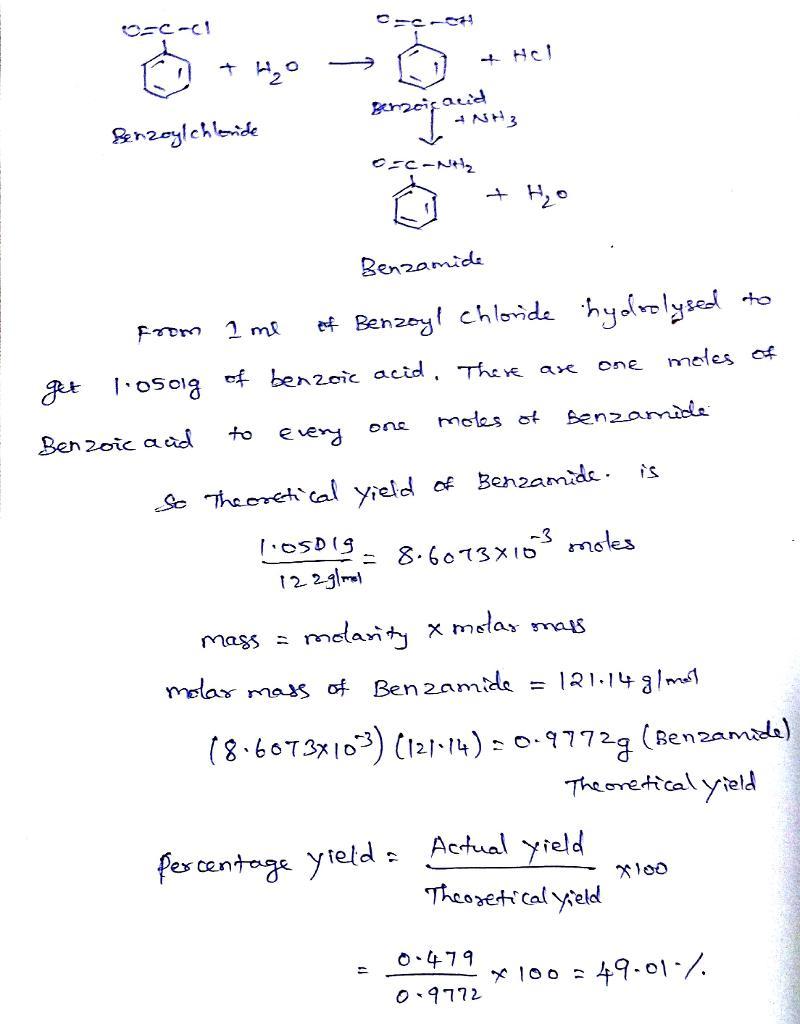
Consider the ammonolysis of benzoyl chloride by adding concentrated ammonium hydroxide to form the final product, benzamide. Rea
gizmo_the_mogwai [7]

Answer:

Explanation: see attachment below

4 0
2 years ago
Movement of the ___<br> creates the London dispersion forces.
Tanzania [10]

Answer: electrons

Explanation: moving electrons cause momentarily charge

Distribution on molecule. This distribution induces similar distribution to

Adjacent molecule.

7 0
2 years ago
Which conjugate pair is suited best to make this buffer? Which conjugate pair is suited best to make this buffer? Phosphoric aci
Juliette [100K]

Answer:

bkfhjjfrsxtr

Explanation:

4 0
2 years ago
How much heat must be removed from 25.0g of steam at 118.0C in order to form ice at 15C
NemiM [27]

Answer:

-10778.95 J heat must be removed in order to form the ice at 15 °C.

Explanation:

Given data:

mass of steam = 25 g

Initial temperature = 118 °C

Final temperature = 15 °C

Heat released = ?

Solution:

Formula:

q = m . c . ΔT

we know that specific heat of water is 4.186 J/g.°C

ΔT = final temperature - initial temperature

ΔT = 15 °C - 118 °C

ΔT = -103 °C

now we will put the values in formula

q = m . c . ΔT

q = 25 g × 4.186 J/g.°C × -103 °C

q = -10778.95 J

so, -10778.95 J heat must be removed in order to form the ice at 15 °C.

3 0
2 years ago
Other questions:
  • What is the oxidation state of each element in FeBr2
    14·2 answers
  • A knife manufacturer visits your business to show his product line. He claims that the most popular material for knives is indus
    14·1 answer
  • Sodium thiosulfate (Na2S2O3), photographer’s
    6·2 answers
  • What mass of sodium chloride (NaCl) forms when 7.5 g of sodium carbonate (Na2CO3) reacts with a dilute solution of hydrochloric
    11·2 answers
  • Compound A, C6H12 reacts with HBr/ROOR to give compound B, C6H13Br. Compound C, C6H14, reacts with bromine and light to produce
    5·1 answer
  • Calculate the grams of so2 gas present at stp in a 5.9 l container. (r = 0.0821 l·atm/k·mol)
    15·1 answer
  • The water-gas shift reaction plays a central role in the chemical methods for obtaining cleaner fuels from coal: CO(g) + H2O (g)
    15·1 answer
  • Old aspirin exposed to moisture often smells like acetic acid (vinegar). When aspirin is heated in boiling water, it decomposes
    8·1 answer
  • Salt in crude oil must be removed before the oil undergoes processing in a refinery. The
    15·1 answer
  • Trimix is a general name for a type of gas blend used by technical divers and contains nitrogen, oxygen and helium. In one Trimi
    6·1 answer
Add answer
Login
Not registered? Fast signup
Signup
Login Signup
Ask question!